
Bettina von Zwehl
There is something about Von Zwehl’s (2019) work that draws me in. Is it the simplicity, the use of silhouettes or having her models where black clothing. There is a flow to her work which makes you want to dive in and see more.
Meditations in an Emergency I found that, despite the fact that all the images are is of the head and shoulders of people lying on their back with their eyes closed as if meditating, there were elements that caught my attention. For instance a number of the images have what could be described as a heat signature effect. The sort of appearance you get when looking at a person or object with an infra red camera or sensor.

My initial thought on noting it was that it was my monitor but as the effect changed with different images I can only conclude it is part of the image itself. Almost like you are seeing the person’s ethereal body.
The fact that this effect is black means it doesn’t stand out from the rest of the image and you have to look closely to see it.
Bloodlines is another interesting series because it features young girls posing with snakes. There is a biblical feel to the images with the young girls being reminiscent of the innocent Eve in the Garden of Eden and the manipulative Serpent who would eventually pursuade her to break one of the rules that God gave to her and Adam.

Von Zwehl’s use of similar background colours to those worn by her models is like a signature theme or her way of expressing her artistic voice.
The simplicity of the images and the consistent colour scheme across the images is what appeals to me about her work.
Ishiuchi Miyako
When watching the YouTube video Presenting Hiroshima by Ishiuchi Miyako (2011) which shows Miyako’s photobook of items gathered after the atomic bomb dropped on Hiroshima at the end of World War 2, several things leapt out at me.
The first thing was that if you are going to photograph something with such historical importance then doing it simply without distractions means that you get the full impact of the item itself.
The second thing was that you don’t always need words, the images can be enough as they stand. Words can detract from images, unless they are tied to the object in some way, like being from the person that owned an object or being the thoughts of a person who the image concerns.
Finally, the unexpected can have a huge impact. In Miyako’s book there are a number of images of items of clothing, and then there is one of what appears to be a false tooth. The juxtaposition of every day items of clothing to something intimate like a person’s tooth causes you to stop, to pause, and to think, rather than simply turn the page.
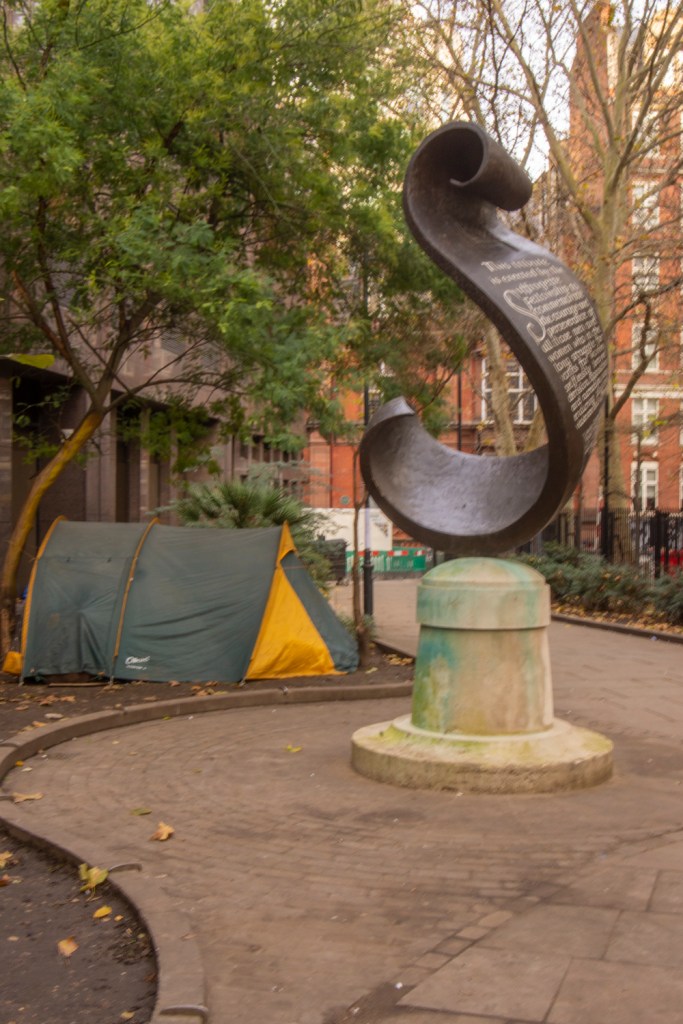
One of the photographs I took for this assignment is of a Suffragettre memorial in London. I took several of the memorial but then took some of the memorial with its surroundings. In these images you can see several tents used by homeless people to sleep in. With those images I was trying to highlight that although we achieved something amazing just over a hundred years ago by giving a disenfranchised part of the population a chance to have their say, we still have a part of the population who are disenfranchised even today. A part of the population who don’t have a voice through circumstances that may be beyond their control, just like being a female and not being able to vote was beyond women’s control up until the start of the 20th century.
Mårten Lange
In Citizen, Lange (2015) has produced a series of images of birds that gel together. The monotone colour scheme brings the whole together, as does the way that the birds have been photographed so they are standing in similar, but not identical, ways.
The eyes are what draw you in to each image, even when they are missing. It is as if the birds are looking back at you, the viewer. Especially in #4 and #16 where the birds gaze is quite intent.


Photographing a series of similar items and using the same colour scheme and positioning helps bring the series together as a whole.
Andrew Langford
When describing his work Series Langford (2020) states “The aim was to create a collection of new symmetrical specimens of uncertain origin and scale that could allude to both the familiar and everyday and the unfamiliar and the out of the ordinary. “
Langford has achieved this by his use of a background that removes any means for a viewer to gauge the scale of the items. In the image below these items could be any size from microscopic to macroscopic. In addition without an indication of what the items are, the viewer has the opportunity to visualise them in ways that are personal to them. For me, at first glance, these items are reminiscent of Christmas tree decorations, something that has to do with it being the festive season as I write this. At another time of the year I might see them differently, as pieces of jewellery or shells or something else. Something familiar to me but which is different to what they actually are.

Similarly with the images on the walls below, my experiences and background make me think of samples from microscope slides, stained so parts of them stand out but blown up 100s and 1000s of times.

The nature of the objects that I’ve decided to photograph doesn’t easily lend itself to what Andrew Langford has done in this series. Background will be different and enlarging something that is already life size doesn’t seem like an easy task.
Edward Ruscha
Tate (2013) shows a copy of Ruscha’s book ‘Twentysix Gasoline Stations’ held by the Tate Museum. Ruscha’s idea has been copied several times over the year, using different themes, such as Fire Stations, Publishers and coach seats.
Ruscha’s series of images shows that anything can be the subject for a photographic project, even things that we take for granted.
In someway Twentysix Gasoline Stations is also a historical document as it records buildings that may still exist but also could have been taken over by other companies, been demolished to make way for something else that the local community needs, been repurposed, or may still exist but in a delapidated form.
Albert Renger-Patzsch
Tate (s.d) and Fulston Photography (2015) have examples of Albert Renger-Patzsch’s The World is Beautiful. The Tate reference contains a single example while the Fulston reference contains a number of examples.
Looking at these images the use of monochrome provides a coherency to the series as a whole. Beyond that the lines and repetition of things in the man-made structures highlights that, as advanced as we are, we copy from nature when it suits us.
We may not, as a species, respect nature as much as we should, but we learn from it, after all nature has been creating things for millions of years without our input and done a good job of it.
Renger-Patzsch’s book shows that we can find things in both the natural and man-made worlds that have similarities.
References
- von Zwehl, B. (2019) Bettina von Zwehl. At: http://www.bettinavonzwehl.com/ (Accessed 02/01/2020).
- Lange, M. (2015) Mårten Lange – Citizen. At: https://martenlange.com/works/citizen/#1 (Accessed 02/01/2020).
- Presenting Hiroshima by Ishiuchi Miyako (2011) Directed by Colberg, J. At: https://www.youtube.com/watch?v=csVx_QRPvps&feature=youtu.be (Accessed 02/01/2020).
- Langford, A. (2020) Species (1999-2002). At: http://www.andrewlangford.co.uk/projects/species/ (Accessed 02/01/2020).
- Tate (s.d) Albert Renger-Patzsch. At: https://www.tate.org.uk/whats-on/tate-modern/display/albert-renger-patzsch (Accessed 02/01/2020).
- Tate (2013) Edward Ruscha ‘Twentysix Gasoline Stations’ 1963. At: https://www.tate.org.uk/about-us/projects/transforming-artist-books/summaries/edward-ruscha-twentysix-gasoline-stations-1963 (Accessed 02/01/2020).
- Fulston Photography (2015) The World is beautiful. At: http://fulstonphotography.weebly.com/the-world-is-beautiful.html (Accessed 02/01/2020).
 Jenna Powell - Expressing Your Vision
Leave a comment