
Robert Capa

Capa’s ‘D-Day and the Omaha Beach landings’, Magnum (2017) must be one of the most well-known images of the 20th century. Taken during the D-Day landings, Capa had joined American forces during the landings at Omaha Beach.
Having made his way to the beach from a landing craft, with soldiers trying to make it ashore while under gunfire, Capa turned back to face the way he had come and saw an American soldier lying in the water. Capa was quick to capture the image, a risky endeavour because it meant he was facing away from where gunfire was raining down on the invading troops.
The low quality of the photograph has its advantages. Although it allows those that were lucky enough to be far away from the beaches and the risk of death that lay there, it also symbolises those men who were willing to lay down their life in order to free a continent from oppression. Like the unknown soldier before him, the figure in the water symbolises a generation of men who were willing to give up the safety of their homes to travel thousands of miles and risk their lives for their fellow man.
Robert Frank

A young woman stands at the controls of an elevator. Her eyes are looking upwards so we can tell that she is thinking, maybe daydreaming, to pass the time. Her world a box that moves upwards and downwards only. People coming and going as she ferries them between floors.
Jack Kerouac described the figures around her as blurred demons. The blurriness of the figures gives some of them a sinister feel, particularly the figure of a man at the back of the elevator who is just a shadow.
That Frank’s was able to take four photographs of the young woman without her knowledge and without using a flash demonstrates why he is seen as one of the great photographers of the 20th century.
Hiroshi Sugimoto
In the short film Contacts (s.d) Hiroshi Sugimoto explains that his intentional use of out of focus photographs is a way to remove detail and information from the buildings that he is photographing. This runs counter to how we would normally look to capture images of architecture.
What Hiroshi Sugimoto is demonstrating by doing this is that it is possible to break the rules, but when you do, then it has to be for a reason but also, that when you do you have to know that you are breaking the rules. Taking photographs of buildings, or any other subject, in a way that runs counter to how it would normally be done, is not something that you can just do, and then say that it’s what you intended. You need to set out with that as your aim.
In the second half of the film Contacts: Hiroshi Sugimoto 2 (s.d.) Hiroshi Sugimoto discusses his series on movie theatres. As I looked at this I found myself thinking about the work of Bernd and Hilla Becher, particularly in the way that the images are displayed in a grid format but also in the way that a series of locations have been captured in similar ways. In the Becher’s case through trying to capture the winding and water towers in a similar orientation and lighting conditions. In Sugimoto’s case the orientation is always going to be the same, i.e. facing the screen, while the lighting conditions are going to be those required for the film goer to be able to watch the movie without being distracted by the people and things around them.
Michael Wesely
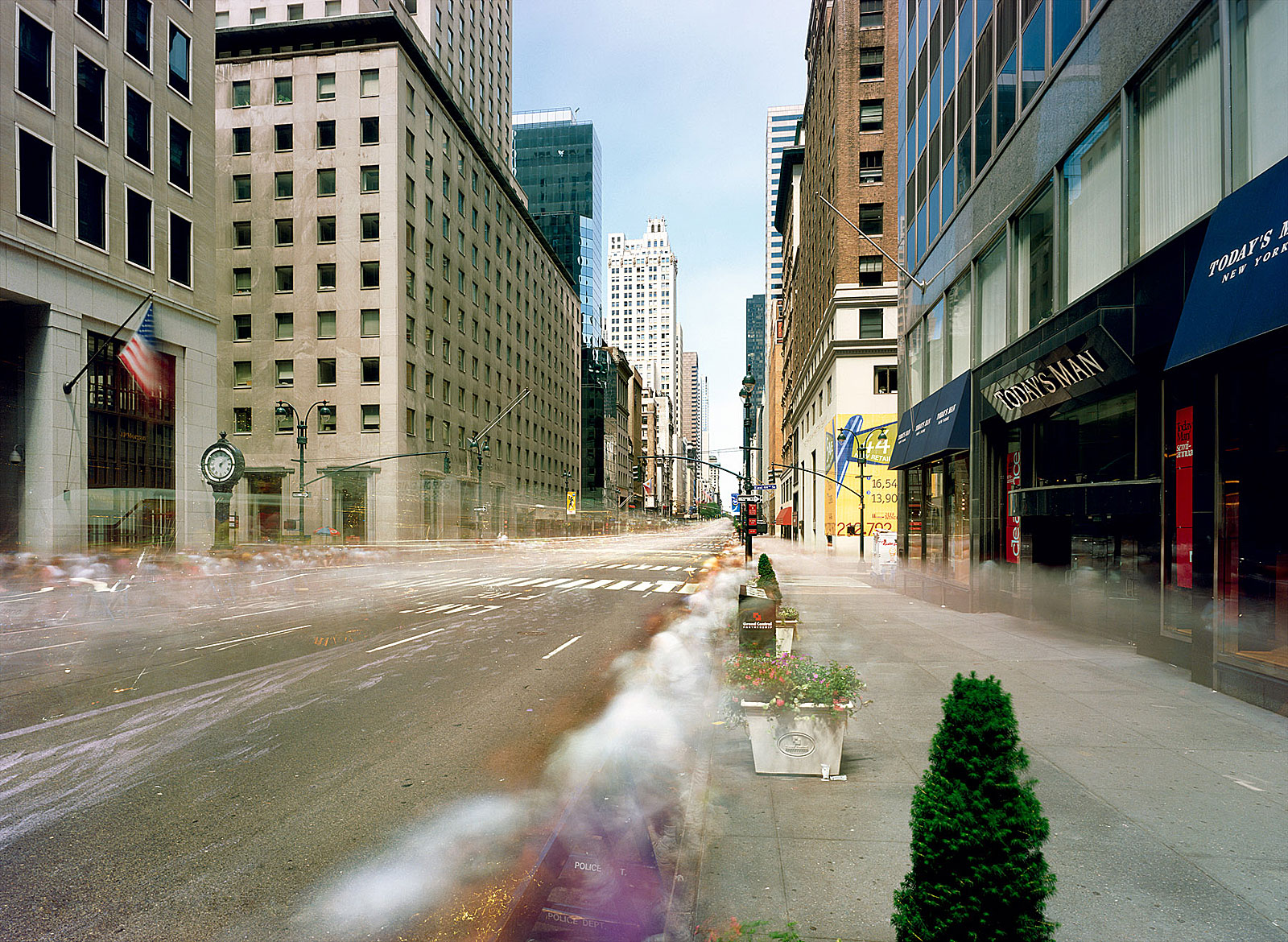
Michael Wesely’s work has an otherworldly feel to it. As if we are looking at the ghosts of people who have died, or of people who have yet to be born.
There is a sense that places and buildings are permanent but that people are transitory, here briefly before disappearing again. Which is true when you look at our existences compared to that of the world that we live in.
The planet we live on has been around for billions of years but humanity only for a short, blink and you missed it time.
Wesely’s New York 1998 series shows this clearly. Photographs of the Gay Pride Parade, city streets, bars and other venues. People can be faintly seen, like wisps of smoke, but the buildings are there, solid structures. The world around us is shown as more solid than we are.
As the world faces the Coronavirus pandemic and towns and cities around the world are placed into lockdown, with people not able to leave their homes or move about freely, Wesely’s images have a prescience to them and a precursor to the images that we see on our television screens on a daily basis.
Maarten Vanvolsem

Maarten Vanvolsem has sought to find ways to take photography beyond freezing a moment in time and to capture time as an element of the photograph. Making what is a 2-D representation of a 3-D subject into a 4-D representation.
Vanvolsem has achieved this through the medium of strip photography.
Strip photography is a technique by which an image is captured as a sequence of one-dimensional images, that are made over a period.
Images captured in this way will seem distorted. Movement of people and objects within the image space will be shortened or extended depending on their speed and direction of motion.
Images capture in this way add a touch of dynamism to what the viewer sees.
In his article Motion! On how to deal with the paradox in dance photography, Vanvolsem (2008), explores how we can make something appear to move in a still image.
Most photographers when taking photographs of performers on stage will freeze the movement producing a still image. These images, however, do not give a true sensation of the performer’s efforts on stage. A performance is not a series of individual movements but also the flow between these movements. Slow movements, fast movements, each add to the story unfolding before the audience. With dance there is an energy that is hard to portray in a single image with no sense of time.
In his image Contraction of Movement 3, Vanvolsem has brought the focus on the dancer and their movements. It is impossible to not see this as an image that is not a single instant in time. Even the fastest dancer would not be able to move fast enough for the camera to record the movement while also removing the focus from their surroundings.
By adding the element of time to images, especially those of performers, we give viewers a glimpse into what the audience sees on stage before them.
Wong Kar-Wai’s Chungking Express
Mike D’Angelo’s article ‘How Wong Kar-Wai turned 22 seconds into an eternity’, D’Angelo, M. (2013), is an interesting analysis of a scene within the film Chungking Express.
Within the scene, which can be viewed on YouTube, WONG KAR-WAI IN SLOW MOTION (2018), and is one of a series of clips highlighting Wong Kar-Wai’s use of slow motion in his movies, a male police officer and a woman shop assistant are the focus of the viewers attention while around them blurry people move back and forth.
D’Angelo’s analysis of the scene is interesting in that it shows an evolving appreciation of the scene. At first, he sees the scene as being focussed on the young woman who is attracted to the police officer who has been visiting the shop to buy food for a while. This, however, ignores what happens in the run up to this scene.
While writing the article D’Angelo realised that there was another interpretation for the scene when you look at what happens just prior to this sequence. The police officer has just been given a letter by his ex-girlfriend and decides not to open it until he has finished his coffee.
By slowing the actions of the two characters, while allowing the rest of the world go by as a blur, Wong Kar-Wai produces a sense that the characters are prolonging a moment in time. The police officer delaying opening the letter, the young woman delaying the moment he leaves to return to duty.
What the scene highlights for me is the importance of context. Without any context this could seen as a young shop assistant watching a police officer taking a break. The use of slow motion suggesting the humdrumness of their lives.
To capture the same with just a photograph would be a lot more challenging. Although it is possible to have two figures standing motionless, while other people move by, as a long exposure photograph is taken would give a similar image, there would be no context. To provide context would require other images or text, would require telling a story through a sequence of images.
Francesca Woodman

Woodman was an American photographer who studied at the Rhode Island School of Design between 1975 and 1977. In 1981 Woodman committed suicide. Her work since her death has been seen favourably.
The images ‘Space², Providence, Rhode Island’ McAteer, S. (2013a and 2013b) show the artist in an empty room. Both images show parts of Woodman clearly, her feet in one and her whole body except for her head in the other.
In both images, Woodman has hidden her face using movement during a long exposure that results in blurring. It is as if she is hiding her identity despite using herself as the model.
There is something reminiscent of Cindy Sherman in the way that Francesca Woodman uses herself as the model in her images, but where Sherman hides her identity using make-up and costume, Woodman hides her identity is a much simpler way.
Both Space images are multi-layered. The walls and floor provide a boundary, a sense that the person is restricted in some way. The window providing a means of escaping those boundaries.
The clear, motionless parts of her body could be seen to represent being held in place, unable to break free of the things that hold you in place. The blurred movement representing the desire to move beyond what is holding you back.
Both images are symbolic of the difficulties that it can be for female artists to move beyond being a student. They are also symbolic of the struggles faced by women in a lot of fields, including photography where the most well known of photographers are male.
In ‘Self Deceit’, Badger, G. (s.d.), a naked figure moves in front of a mottled wall. A mirror positioned to the side of the figure reflects the feet and lower legs of another figure, who is presumably the photographer. Although the moving figure is identifiable as a woman, via the dark triangular patch in the groin area, the identity of the photographer cannot be determined, in fact with any clues to their gender being ambiguous at most.
A lot of images that I’ve looked at, where blurring is used, it is to provide a sense of motion or speed. Wong Kar-Wai and Francesca Woodman show that it can also be used in other ways, for instance to stretch out time, remove identity or provide an indication of the psychological state of a person.
References
- Badger, G. (s.d.) Gerry Badger » Francesca Woodman. At: http://www.gerrybadger.com/francesca-woodman/ (Accessed 21/03/2020).
- Chungking Express – Opening Scene (2011) Directed by luxorofilm. At: https://www.youtube.com/watch?v=MH38QAN80vs (Accessed 21/03/2020).
- Chungking Express – Opening Scene (2011) Directed by luxorofilm. At: https://www.youtube.com/watch?v=MH38QAN80vs (Accessed 21/03/2020).
- Contacts: Hiroshi Sugimoto 1 (s.d.) At: https://www.youtube.com/watch?v=J-jLUSa1MA0 (Accessed 22/03/2020).
- Contacts: Hiroshi Sugimoto 2 (s.d.) At: https://www.youtube.com/watch?v=rY3nGoZqw9U (Accessed 22/03/2020).
- D’Angelo, M. (2013) How Wong Kar-Wai turned 22 seconds into an eternity. At: https://thedissolve.com/features/movie-of-the-week/221-how-wong-kar-wai-turned-22-seconds-into-an-eternit/ (Accessed 21/03/2020).
- D-Day and the Omaha Beach landings • Robert Capa • Magnum Photos (2017) At: https://www.magnumphotos.com/newsroom/conflict/robert-capa-d-day-omaha-beach/ (Accessed 17/03/2020).
- Eyes body language (s.d.) At: http://changingminds.org/techniques/body/parts_body_language/eyes_body_language.htm (Accessed 22/03/2020).
- Francesca Woodman (2020) In: Wikipedia. At: https://en.wikipedia.org/w/index.php?title=Francesca_Woodman&oldid=946396118 (Accessed 21/03/2020).
- Friedel_Camera_ENG.pdf (s.d.) (s.l.). At: https://wesely.org/wp-content/uploads/2019/02/Friedel_Camera_ENG.pdf (Accessed 17/03/2020).
- Fuchs_NYC_ENG.pdf (s.d.) (s.l.). At: https://wesely.org/wp-content/uploads/2019/02/Fuchs_NYC_ENG.pdf (Accessed 17/03/2020).
- Gisbourne_Guardini_ENG.pdf (s.d.) (s.l.). At: https://wesely.org/wp-content/uploads/2019/02/Gisbourne_Guardini_ENG.pdf (Accessed 17/03/2020).
- Harten_TimeWorks_ENG.pdf (s.d.) (s.l.). At: https://wesely.org/wp-content/uploads/2019/02/Harten_TimeWorks_ENG.pdf (Accessed 17/03/2020).
- Jäger_Die-überblendete-Natur_ENG.pdf (s.d.) (s.l.). At: https://wesely.org/wp-content/uploads/2019/02/J%C3%A4ger_Die-%C3%BCberblendete-Natur_ENG.pdf (Accessed 17/03/2020).
- Maarten Vanvolsem (s.d.) At: http://kusseneerscom.webhosting.be/portfolio_page/maarten-vanvolsem/ (Accessed 22/03/2020).
- McAteer, S. (2013a) ‘Space2, Providence, Rhode Island’, Francesca Woodman, 1976. At: https://www.tate.org.uk/art/artworks/woodman-space-providence-rhode-island-ar00349 (Accessed 21/03/2020).
- McAteer, S. (2013b) ‘Space2, Providence, Rhode Island’, Francesca Woodman, 1976. At: https://www.tate.org.uk/art/artworks/woodman-space-providence-rhode-island-ar00350 (Accessed 21/03/2020).
- Michael Wesely – Photography (s.d.) At: https://wesely.org/ (Accessed 17/03/2020).
- New York Short Stories – Gay Pride Parade, New York (14.11 – 16.23, 28.06.1998) – Michael Wesely (s.d.) At: https://wesely.org/2019/gay-pride-parade-new-york-14-11-16-23-uhr-28-06-1998/ (Accessed 17/03/2020).
- Robert Frank’s Elevator Girl Sees Herself Years Later : NPR (2009) At: https://www.npr.org/2009/08/30/112389032/robert-franks-elevator-girl-sees-herself-years-later?t=1583152442358&t=1584474251592 (Accessed 17/03/2020).
- Strip photography (2019) In: Wikipedia. At: https://en.wikipedia.org/w/index.php?title=Strip_photography&oldid=932347950 (Accessed 22/03/2020).
- The Art of Strip Photography : Maarten Vanvolsem : 9789058678409 (s.d.) At: https://www.bookdepository.com/Art-Strip-Photography-Maarten-Vanvolsem/9789058678409 (Accessed 22/03/2020).
- Vanvolsem, M. (2008) Motion! On how to deal with the paradox in dance photography. At: http://www.imageandnarrative.be/inarchive/Timeandphotography/vanvolsem.html (Accessed 22/03/2020).
- WONG KAR-WAI IN SLOW MOTION (2018) Directed by Efendi, V. At: https://youtu.be/kDE0YenqsEw?t=49 (Accessed 21/03/2020).
 Jenna Powell - Expressing Your Vision
Leave a comment