
Mandy Barker’s “motivation for the past 10 years has been to raise awareness of plastic pollution in the world’s oceans.”1
We are all familiar with discarded refuse on our beaches and shorelines. When we pay a visit to the seaside it can be hard to miss such sights. In recent years the problem of pollution caused by plastic, and other items, in our rivers, seas and oceans has gained increasing recognition.
In Blue Planet II David Attenborough explored the issue one of the episodes. He discusses the issue in Sir David Attenborough’s plastic message (2018).
Microplastics2 are being found in our sea life, and in the wildlife that depends on it, and as a result will to some level be found in humans.
Images of animals ensnared in plastic can rings, nets and ropes are easy to find online.
Social media brings us videos of divers and other marine users with title such as “These divers noticed something was wrong with this whale3, they were shocked when they looked closer.”
It is not just items like these that are polluting our seas and oceans. It is not just microplastics that are finding their ways into the stomachs of the creatures that inhabit the waters of our planet or use it as a source of nourishment.
Mandy Barker has produced a book that highlights the issues that our planet, our wildlife, and ultimately, we as a species face.
The core of the book is a series of works that Barker has produced over the last decade. Each series makes use of plastic items that have been found in different places around the world.
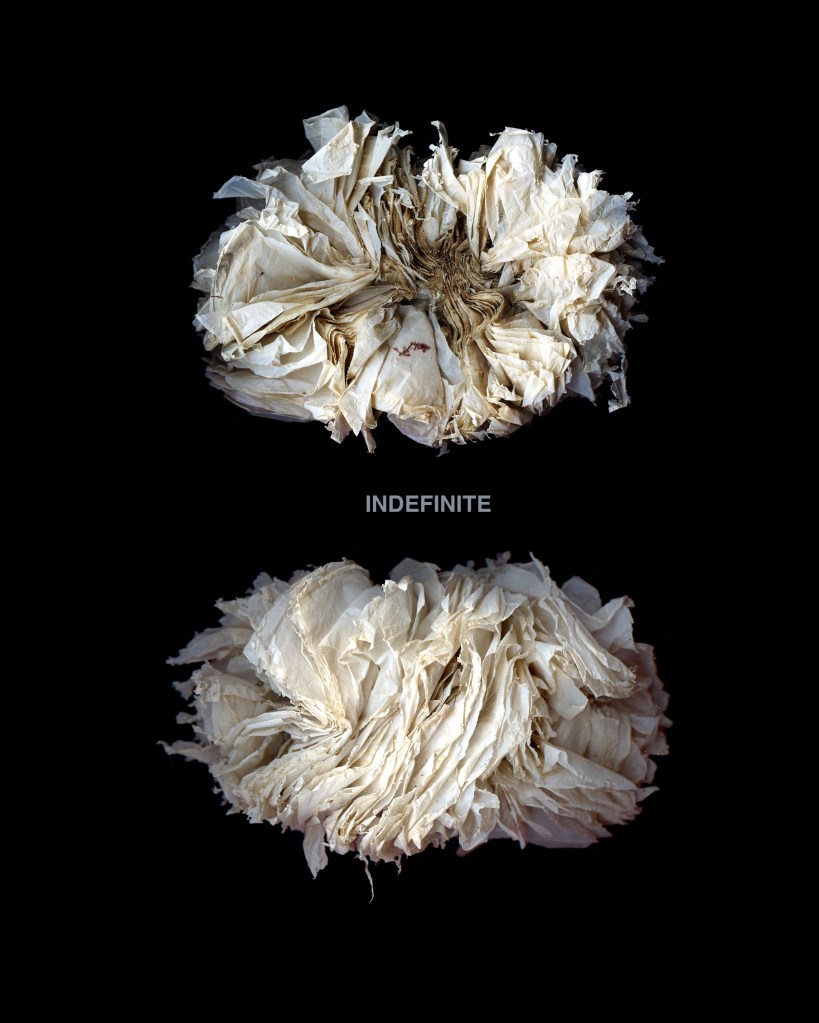
Indefinite
This series shows items found on the sea short. Alongside each item is an estimate of how long it would take to degrade in sea water. From a few years to hundreds of years. Some plastics will take longer to degrade than the time since the Industrial Revolution started.
The worst of the items displayed is polystyrene, which will never degrade if left in the environment.
Soup
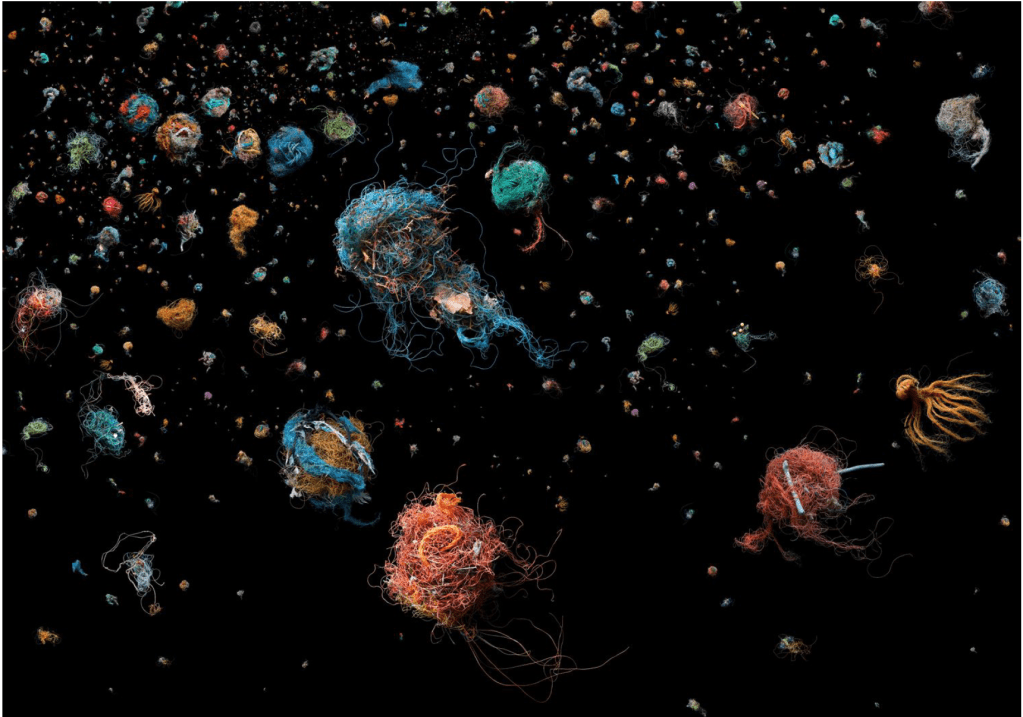
This series is based on the term used to describe plastic suspended in the ocean.
Nature is perfectly capable of bringing large masses of plant life together in the seas and oceans without human intervention. The Sargasso Sea is a perfect example of this.
Mankind, however, has helped by means of dumping plastics and other items into our seas to cause a similar area, the ‘Garbage Patch’ to develop in the Northern Pacific.
Soup is based on items found on shorelines around the world. When looking at the series I always find myself drawn into the images.
Although a variety of objects can be seen in each image, there are some where it is possible to see smaller and larger versions of the same object. As a result, I find myself looking harder at these works to see if I can work out how many unique items there are.
Mandy Barker has achieved the aim of drawing the viewer in when looking at these images.
Looking at the works in the Soup series is also reminiscent of looking at life through a microscope.
Shoal
This series makes use of items washed into the Pacific Ocean after the Thoku earthquake and the Japanese tsunami in 2011. Similar sets of items have been used to mimic groups of fish swimming in the sea.
Penalty
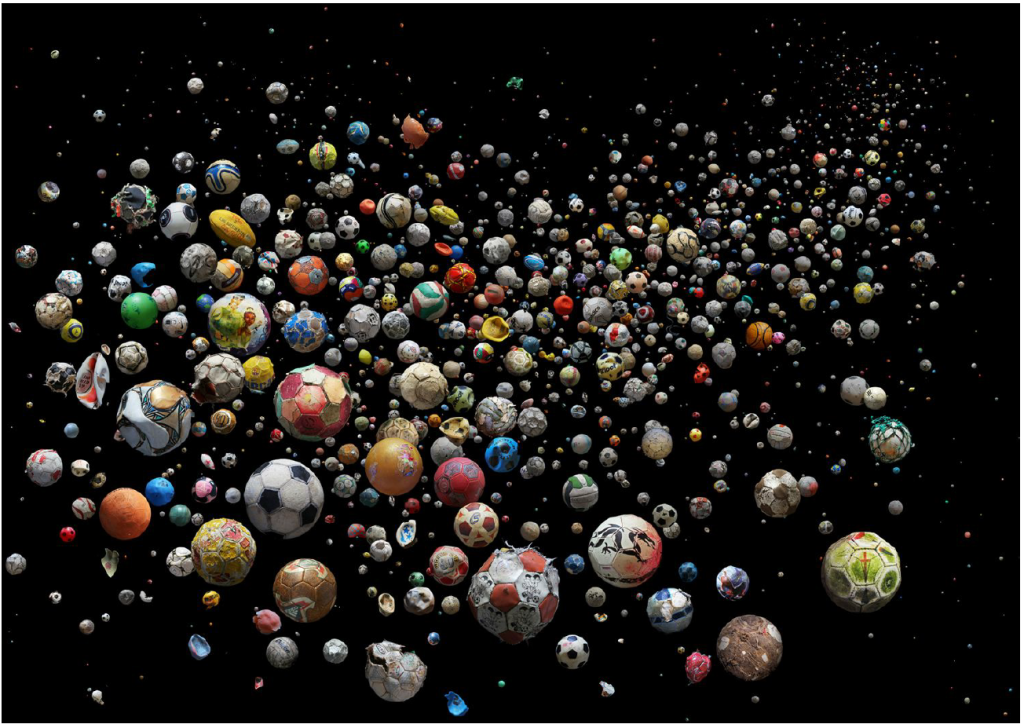
For this series Mandy Barker put out a global request for people to send her footballs found in the sea or on the shoreline. In total she received 992 balls. The series consists of 32 individual images showing a single football, and 4 other images showing a mass of footballs gathered from specific areas of the world and by a single person.
Hong Kong Soup
Like the series Soup this series utilise plastic found on beaches in Hong Kong.
The series provides an insight into the traditions and culture of the Hong Kong people with its linking of some images, via their captions, to traditional Hong Kong food.
Although the series is based on a particular location in the world, the items found, or remarkably similar ones, could be discovered anywhere in the world.
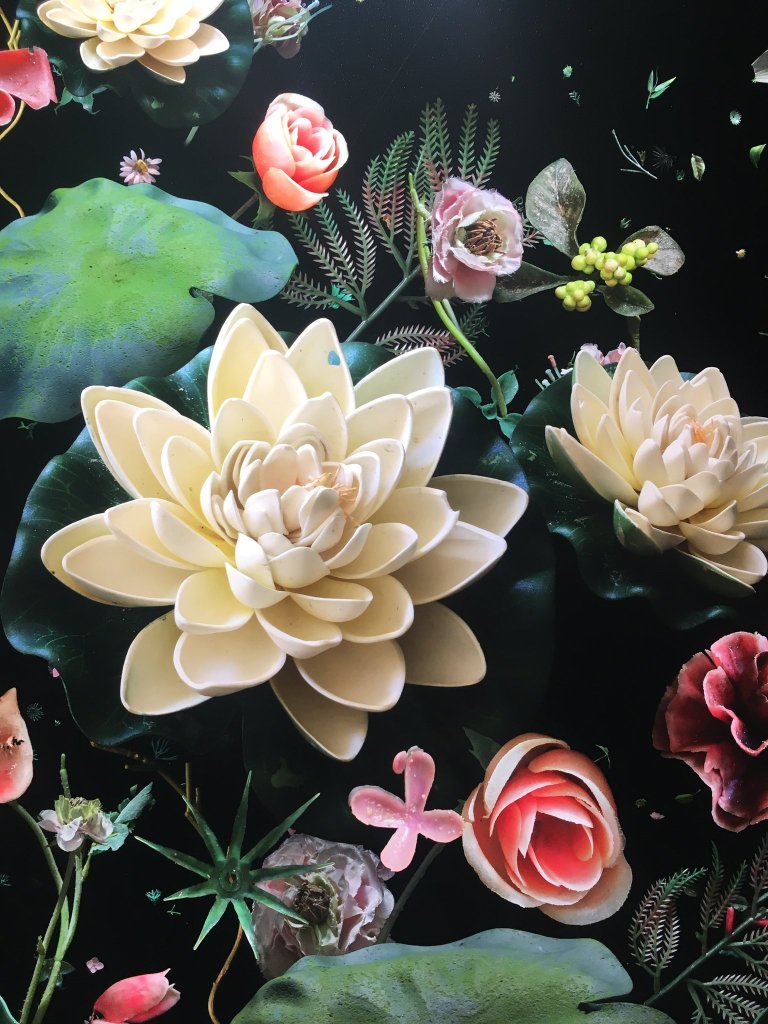
Of all the images in the book, this is my favourite
What makes this book fascinating is not just the subject matter, something that has become more widely discussed in recent years, but the facts and figures given, the additional details that Barker provides.
Altered Ocean provides a clear indication that what started out as an item intended to help the environment has been twisted through overuse, into something that has the potential to destroy it, and which we are going to be dealing with to some degree for centuries to come.
Sten Gustaf Thulin, inventor of the plastic bag, developed it to save the planet by providing an alternative to paper bags which required the destruction of forests.
In an interview for the Independent, Plastic bags were created to save the planet, according to son of engineer who first created them (2019), Raoul Thulin says that his father would find the idea that people throw them away as being bizarre.
Synthetic plastic has been with us for over a century. Since its earliest form, to the many different types that have today, plastic is everywhere we look. It is an important substance that we could not easily do without. However, its use is something that we need to consider, and particularly with regards to its impact on the environment and our ability to re-use and recycle it.
Following an essay by Liz Wells about plastic pollution, Mandy Barker finishes the book by including extracts from her sketchbooks. As someone who still struggles with the concept of sketchbooks for photography, I found this a useful addition. Being able to see examples of how somebody develops projects such as these and getting an idea of the thought processes behind it is a huge benefit to my own work.
References
- Barker, M. (2019) Altered Ocean. (1st Ed) Germany: Overlapse.
- Sir David Attenborough’s plastic message – BBC (2018) At: https://www.youtube.com/watch?v=IW3jEIYBFzg (Accessed 09/05/2020).
- Plastic bags were created to save the planet, according to son of engineer who first created them (2019) At: https://www.independent.co.uk/environment/plastic-bags-pollution-paper-cotton-tote-bags-environment-a9159731.html (Accessed 09/05/2020).
Notes
1: From the forward to Altered Ocean
2: Microplastics are very small pieces of plastic that pollute the environment. Microplastics are not a specific kind of plastic, but rather any type of plastic fragment that is less than 5 mm in length according to the U.S. National Oceanic and Atmospheric Administration. (Source Microplastics (2020) In: Wikipedia. At: https://en.wikipedia.org/w/index.php?title=Microplastics&oldid=955272046 (Accessed 09/05/2020).)
3: Substitute whatever large marine mammal springs to mind that may approach humans for help.
 Jenna Powell - Expressing Your Vision