
Brief
Select an image my any photographer of your choice and take a photograph in response to it. You can respond in any way you like to the whole image or to just a part of it, but you must make explicit in your notes what it is you’re responding to. Is it a stylistic device such as John Davies’ high viewpoint, or Chris Steele Perkins’ juxtapositions? Is it an idea such as the decisive moment? Is it an approach, such as intention – creating a fully authored image rather than discovering the world through the viewfinder?
Add the original photograph together with your response to your learning log. Which of the three types of information discussed by Barrett provides the context in this case? Take your time over writing your response because you’ll submit the relvant part of your learning log as part of Assignment Five.
A photograph inspired by another is called ‘homage’ (pronounced the French or English way). This is not the same as Picasso’s famous statement that ‘good artists borrow, great artists steal’; the point of homage must be apparent within the photograph. It’s also not the same as ‘appropriation’ which re-contextualises its subject to create something new, often in an ironic or humourous way. Instead, the homage should share some deep empathy or kinship with the orginal work. An example is Voctor Burgin’s series The Office at Night (1986) based on Edward Hopper’s famous paiting of the same name.
The hackneyed idea of ‘influence’ is not at issue here. I am not interested in the question of what one artist may or may not have taken from another. I am refering to the universaaly familiar phenomenon of looking at one image and having another image come spontaneously to mind.
http://www.tate.org.uk/research/publications/tate-papers/separateness-things-victor-burgin
You may have already taken some homage photography where you’ve tried not to hide the original inspiration but rather celebrated it. Refer back to your personal archive and add one or two to your learning log together with a short caption to provide a context for the shot.
In all of my work informed by other artists, I enter into a dialogue with the places in which particular artists worked, and with the imagery they created there. The artist and their work become something of a guiding spirit to my own journeys in and around those places.
David Foster : http://www.inside-the-outside.com/everything-seemed-to-be-listening-david-foster
Research
At first thought, an exercise where you are taking photographs that pay homage to another photographer should be easy. In the past I have taken photographs, for my own interest, that are inspired by the work of famous photographers.
For example, Alfred Steiglitz’s collection Equivalents inspired me to take a series of photographs, from the area around my house, of clouds. Although that small project did not go very far, the images that I did capture showed the variety that is available even with something so simple as a cloud.
My initial approach to this exercise was to dig out various books on photographers. I did not want to go to the photographers I would usually consider like Diane Arbus, Sally Mann and Don McCullin. Photographing people and even landscape, at the current time (mid-January 2021; in the middle of the latest lockdown) is not an easy matter. When you are encouraged to stay home and not go out for any more than you need to, wandering the streets and countryside and taking photographs is going to be frowned upon by some people.
Several years ago, a friend asked me to take some photos of her and her mum. During the shoot, we tried to recreate the iconic image of Marlene Dietrich from the film Shanghai Express. The result was edited in Lightroom to deepen the black background. This is one of my two favourite photographs of Tash, the other one she does not like as much but I do because it reflects her personality in the way that I see it, but which others may not see as flattering.
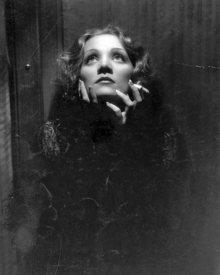
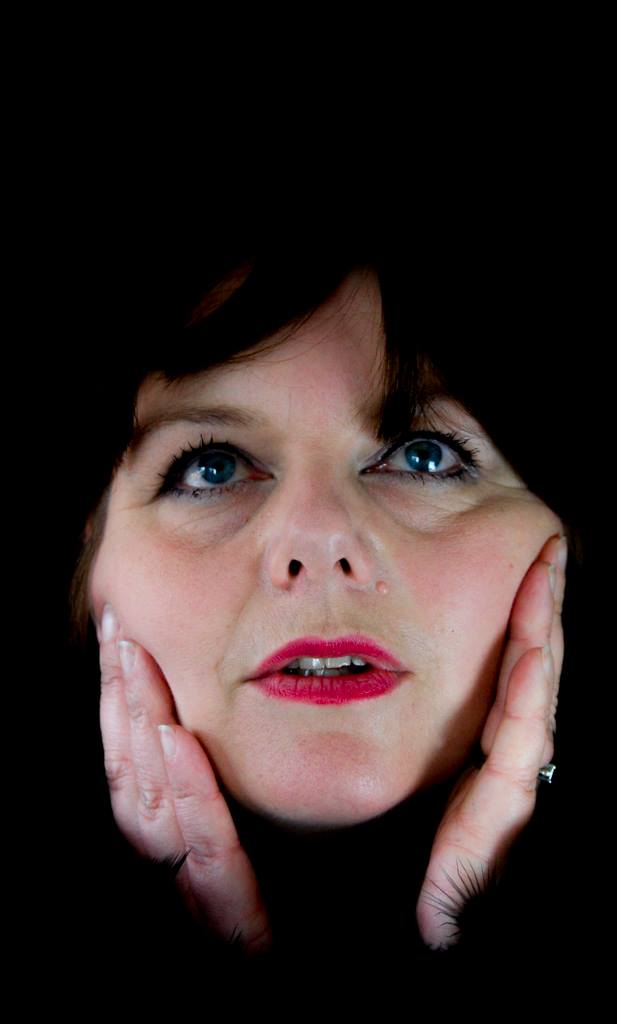
Tash does Dietrich, image taken indoors against a black backdrop.
The other issue that currently impacts on taking photographs that pay homage to another photographer or artist is the pandemic and not being able to travel around freely capturing images.
An idea that came to me while looking out of one of the windows in the office where I work, while waiting for some documents to print out was to take some photographs of the picnic tables and benches at the rear of the building, but doing so from a low angle, or to take photographs of the bicycle shelter on a sunny day when the light it causing the bike stands to create shadows.
The bench and table idea appealed to me because I remember seeing images from a photographer taking in such a way. Trying to remember where I had seen them led me to Google for the images or articles which referred to them. Instead of finding them I found an article on Edvard Munch.
Munch is an artist that I know of because of his painting “The Scream” but I was not aware that he was also a photographer. Looking through the images in the article I found a couple that I thought anybody who is in lockdown would be able to produce their own versions of.

The Back Yard at 30B Pilestredet, Kristiania
1902(?)
Silver gelatin contact print
(Art Blart.com)
The image above has a timeless quality to it but also a sense of sadness. The photograph is dated 1902 but I find myself not seeing this as an image from before the First World War, but an image that reflects the events of World War II.
For me there is a sense of desolation and abandonment to this image. Like images of towns and cities after bombing raids.
There is a sense of sadness about the image, not one of joy or fond memories. It is melancholic. The bare trees, as if ravaged by fire or the heat of a blast stand out, despite the evidence to the contrary the leaves on the ground, the untouched fences bordering the yard, the gazebo structure at the far end of the yard. All these things say that this is a peaceful place, an ordinary place that you could find anywhere, anytime, but there is still a feeling of lifelessness given by the bare trees, the leaves on the floor and the lack of any other sign of life in the garden.

The Courtyard at 30B Pilestredet, Kristiania
1902(?)
Silver gelatin contact print
(Art Blart.com)
Exercise
Paying homage to Munch’s 30B Pilestredet images, I decided that for the exercise I would do some black and white images of my garden and the area in front of my house.
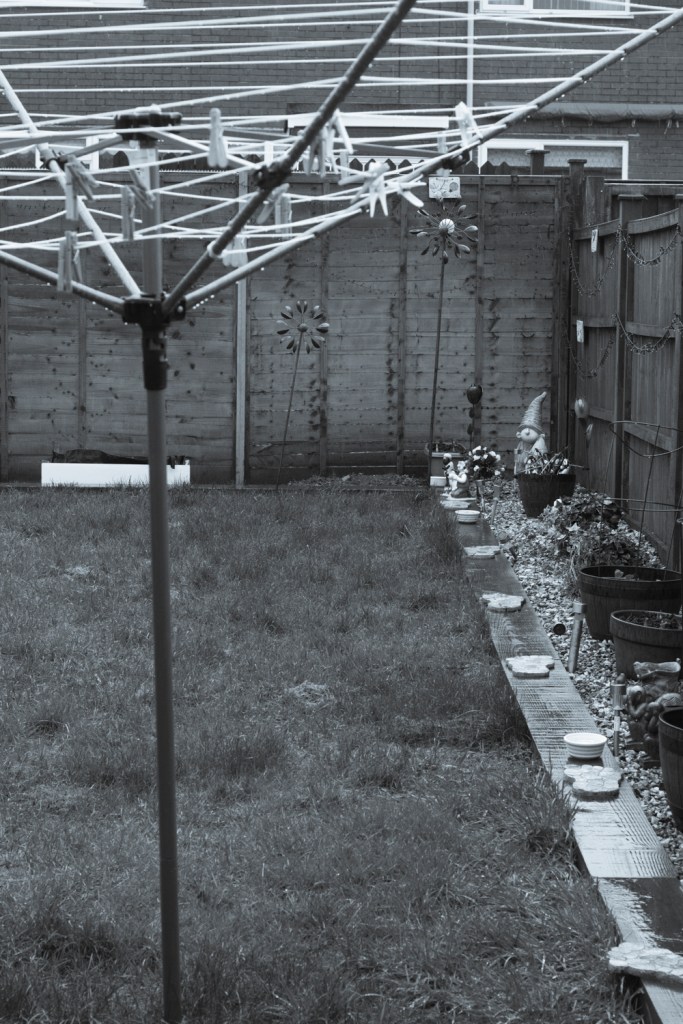
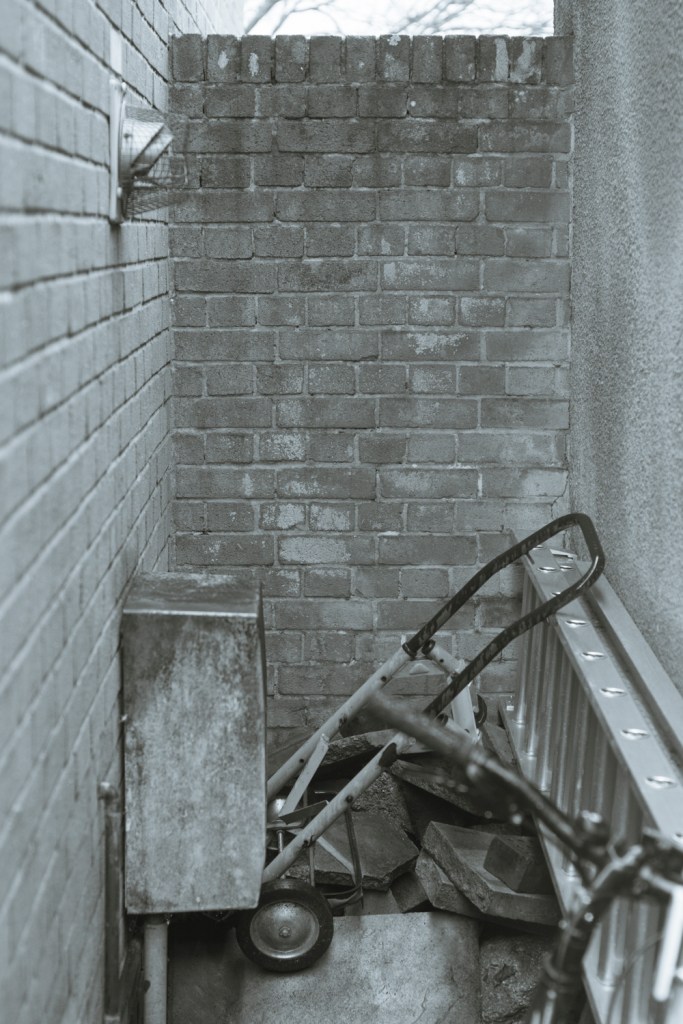
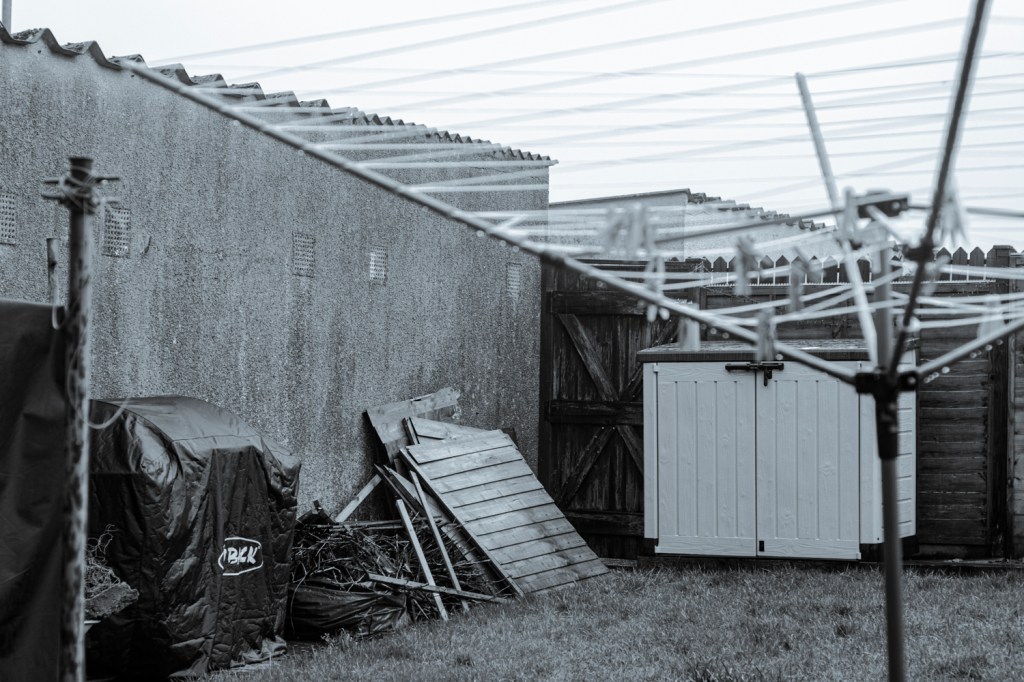
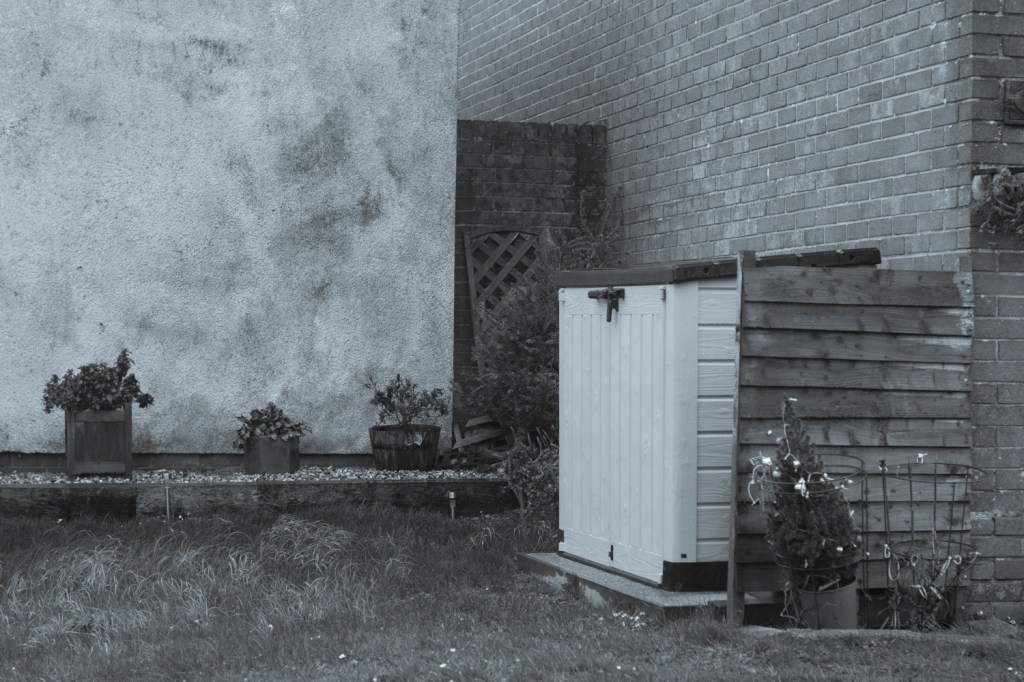
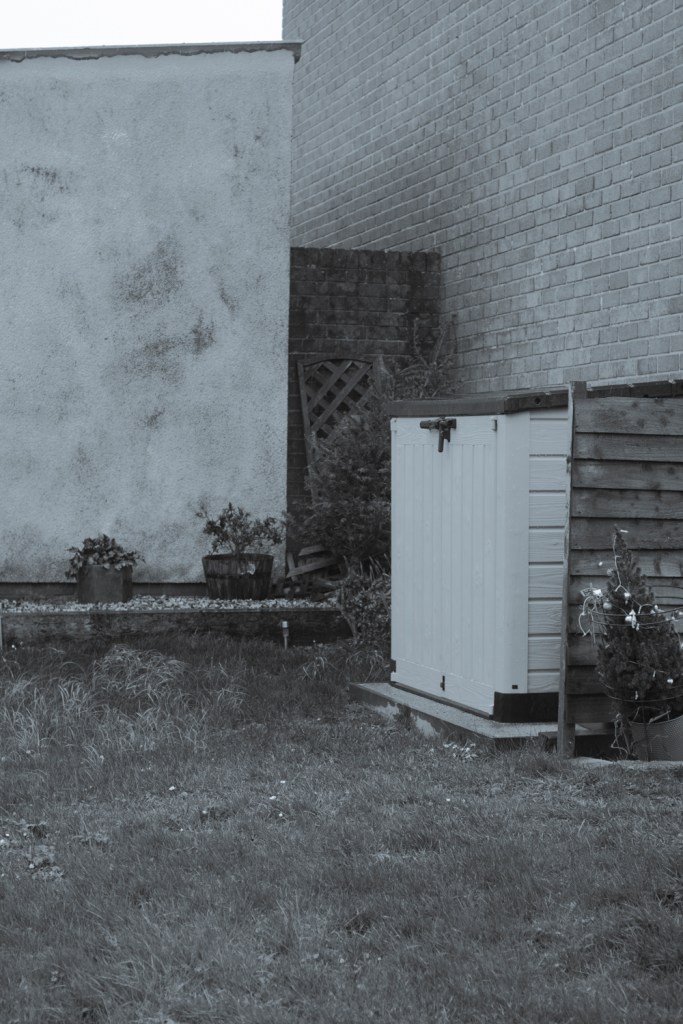
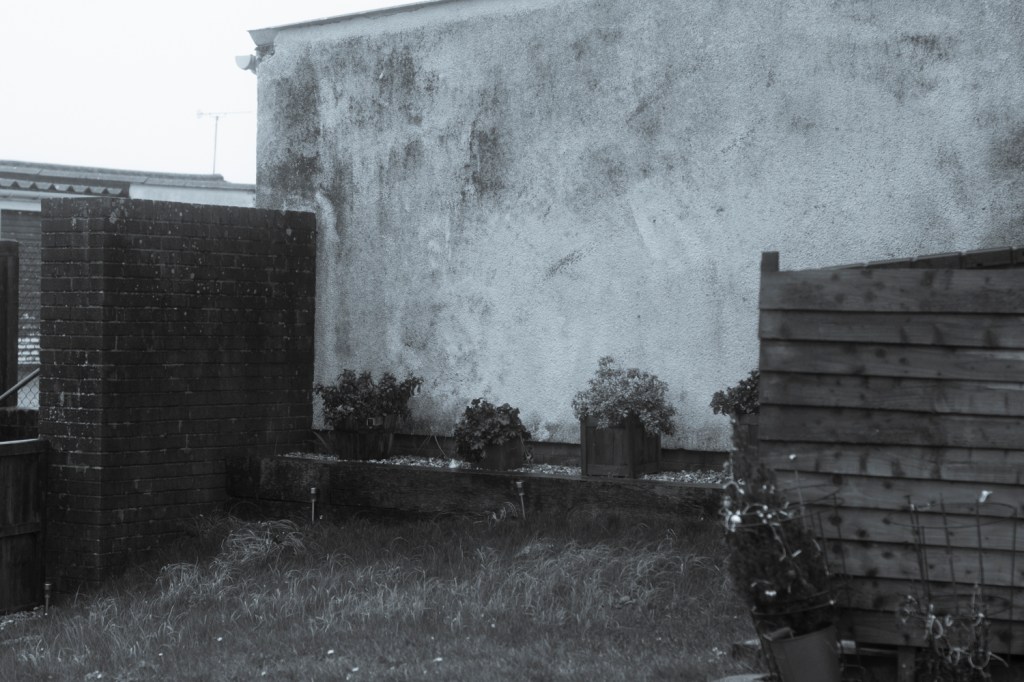
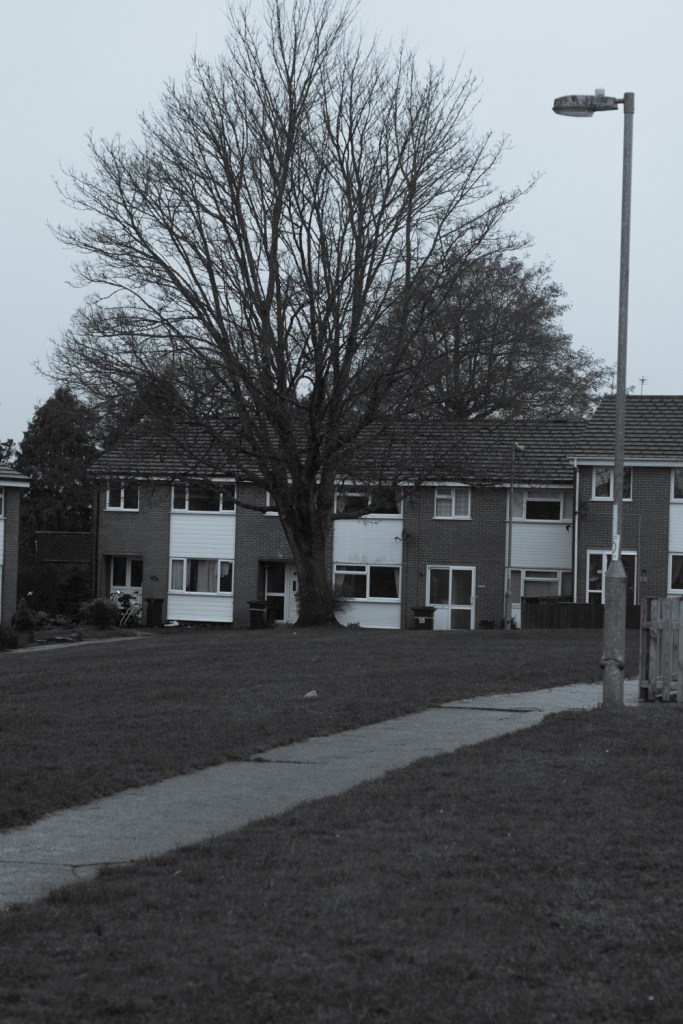
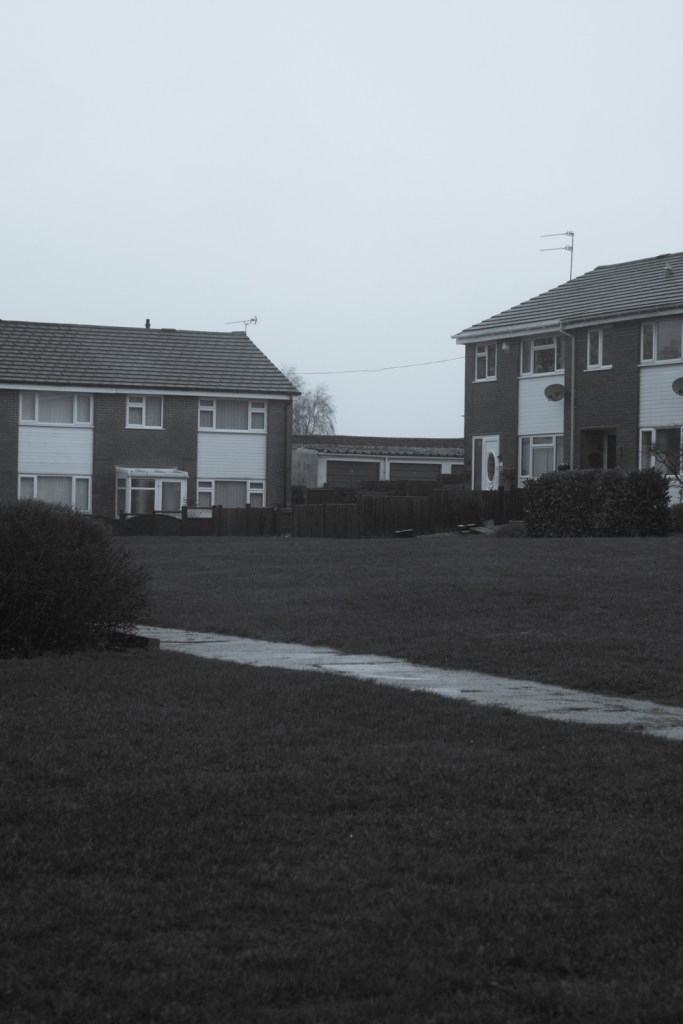
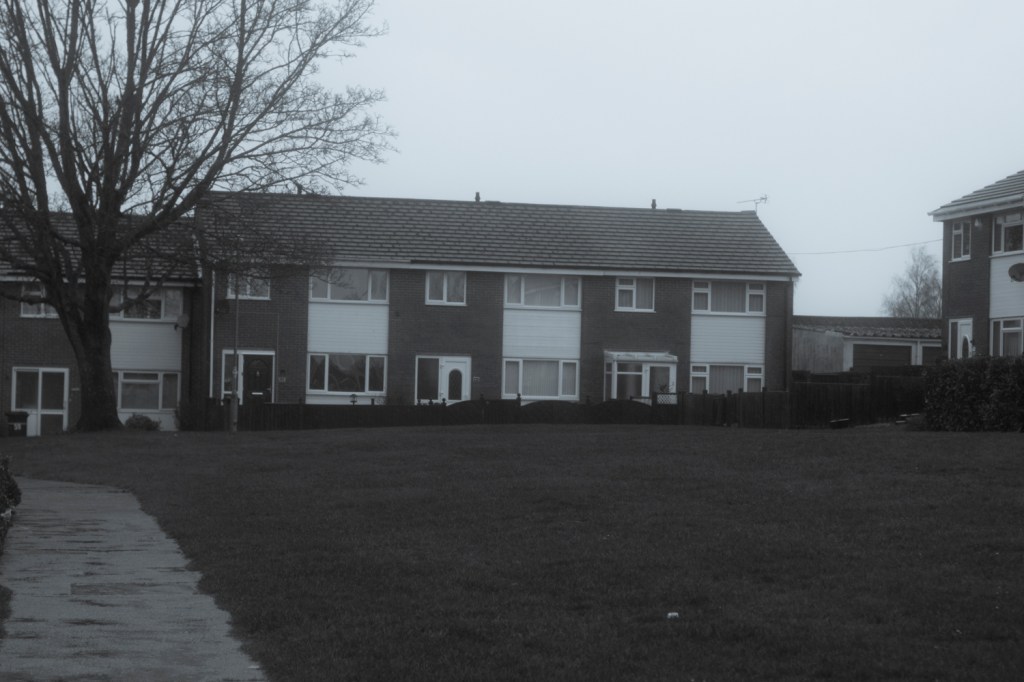
None of the images have the sense of abandonment that Munch’s image of the yard invoked in me, and the images are not timeless. The PVC windows in the houses date them to the late 20th, 21st century.
The images of the Green are typical of what it has been like for the last year, even throughout the summer, when normally the children would be out playing football and running around. Last summer that was a rare sight with most people keeping to themselves.
Of the entire set of images, my favourite is the Trolley. Of the entire set is the only one that invokes a sense of loneliness and abandonment in me, like Munch’s image of the Yard.
References
- avant-garde photography (s.d.) At: https://artblart.com/tag/avant-garde-photography/ (Accessed 20/02/2021).
- Bunyan, D. M. (2021) Exhibition: ‘The Experimental Self: Edvard Munch’s Photography’ at the National Nordic Museum, Seattle. At: https://artblart.com/2021/01/17/exhibition-the-experimental-self-edvard-munchs-photography-at-the-national-nordic-museum-seattle/ (Accessed 20/02/2021).
- EVERYTHING SEEMED TO BE LISTENING | David Foster – Inside the Outside (s.d.) At: https://www.inside-the-outside.com/everything-seemed-to-be-listening-david-foster/ (Accessed 22/12/2020).
- munch-the-back-yard-at-30b-pilestredet.jpg (JPEG Image, 1600 × 1550 pixels) – Scaled (83%) (s.d.) At: https://artblart.files.wordpress.com/2020/12/munch-the-back-yard-at-30b-pilestredet.jpg (Accessed 20/02/2021).
- munch-the-courtyard-at-30b-pilestredet.jpg (JPEG Image, 1206 × 1598 pixels) – Scaled (81%) (s.d.) At: https://artblart.files.wordpress.com/2020/12/munch-the-courtyard-at-30b-pilestredet.jpg (Accessed 20/02/2021).
- Tate (s.d.) The Separateness of Things, Victor Burgin – Tate Papers. At: https://www.tate.org.uk/research/publications/tate-papers/03/the-separateness-of-things-victor-burgin (Accessed 22/12/2020).
- The Alfred Stieglitz Collection | Equivalents (s.d.) At: /stieglitz/equivalents/ (Accessed 15/01/2021).
 Jenna Powell - Expressing Your Vision