
Brief
Revisit one of the exercises on daylight, artificial light from Part 4 (Ex 4.1, Ex 4.2 or Ex 4.3) and develop it into a formal assignment submission. The submission requirement for this assignment is a set of between six and ten high quality photographic prints.
There are many ways to edit and the most valuable one is probably to show your work to friendss, family and your OCA peers for feedback – you are guaranteed to find something new in your work. Another tip is to pin the work up on the wall and live with it for a few days. ‘A Quick Guide to Editing You Photo Series using stickies’ on the IPO (Invisbile Photographer Asia) website, but bear in mind that this is not a narrative assignment – you’re not required to produce a story.
Assessment of photography in any context is an assessment of images and accompanying words so please include a written analysis of your work outlining:
- how you you have developed the assignment from the original exercise in Part 4
- which practitioners you’ve looked at for inspiration and how their work has influenced you
- your technical approach and any particular techniques you incorporated
- the strengths and weakness of particular photographs and your project as a whole (self-assessment)
Conclude your notes with a personal reflection on how you’ve developed the exercise to meet the descriptors of the Creativity criteria. Write 500 – 1000 words.
Assessment
This assignment was based on the work done for Exercise 4.3 Egg or Stone. During the exercise I explored the use of light to reveal the form of an object, by using various aspects of light including quality, contrast, direction, and colour.
When shooting the images for that exercise I made use of natural light from a window to light a series of stones and changed the way the light hit them by moving the objects around so different facets of them caught the light.
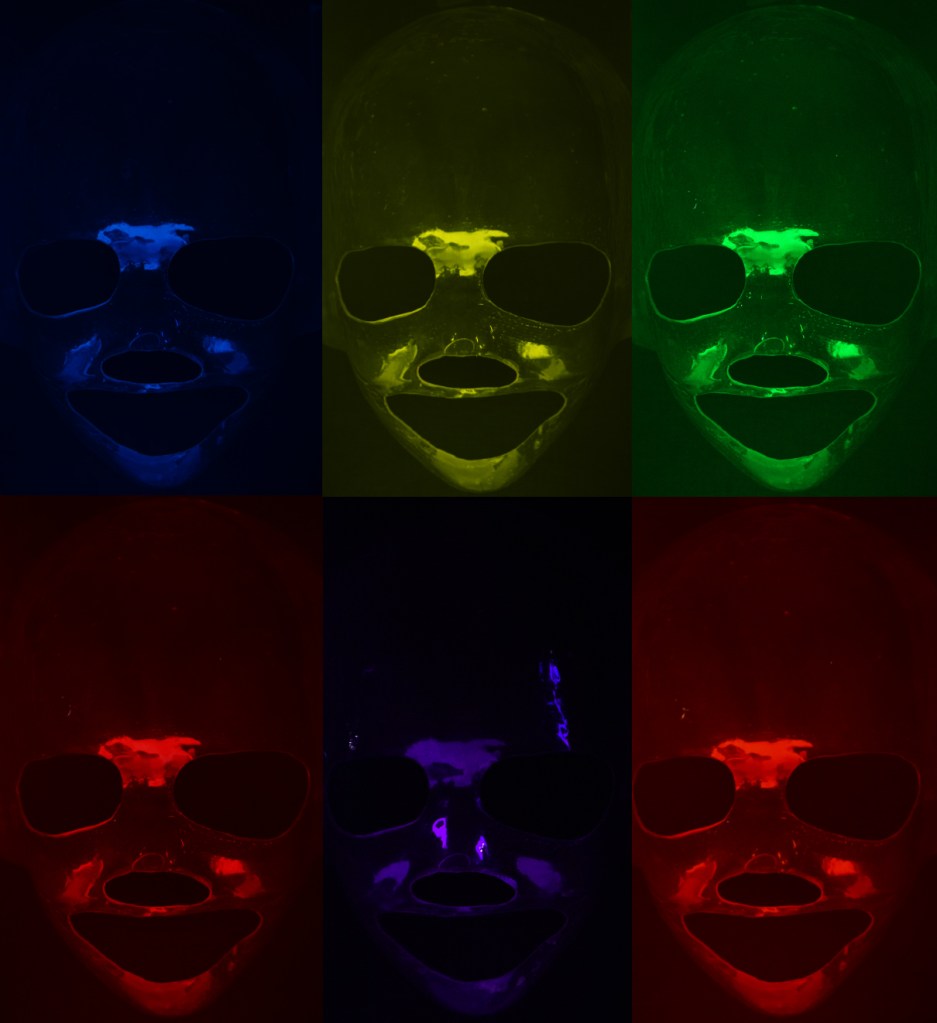
This assignment developed that work by introducing light sources in the form of two small LED lights which could be positioned to direct the light at an object. In addition to this, I added the use of colour by using coloured plastic film in front of the white lights. A range of colours including, yellow, green, blue, and red were used, with combinations of these allowing for other colours.
The main photographer who was my inspiration was Jean-Baptise Huynh, and particularly his image of a crystal skull.
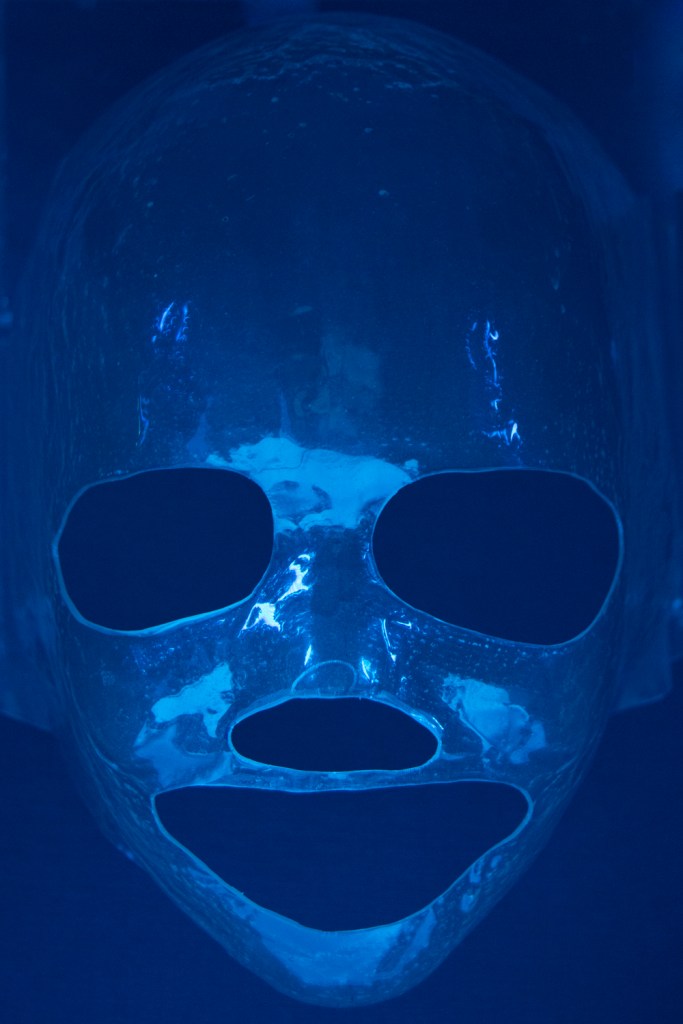
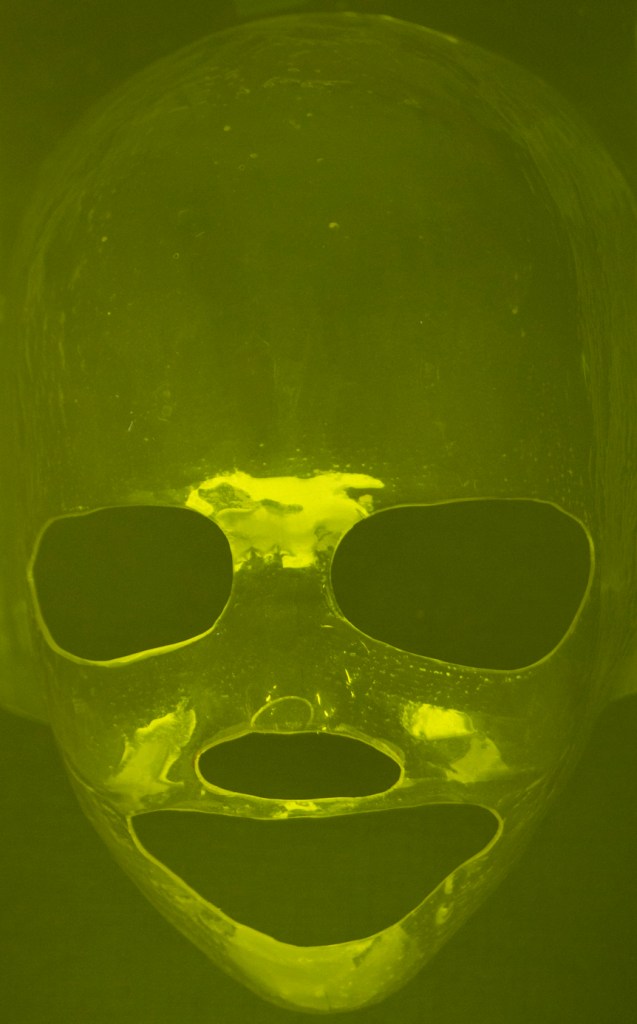
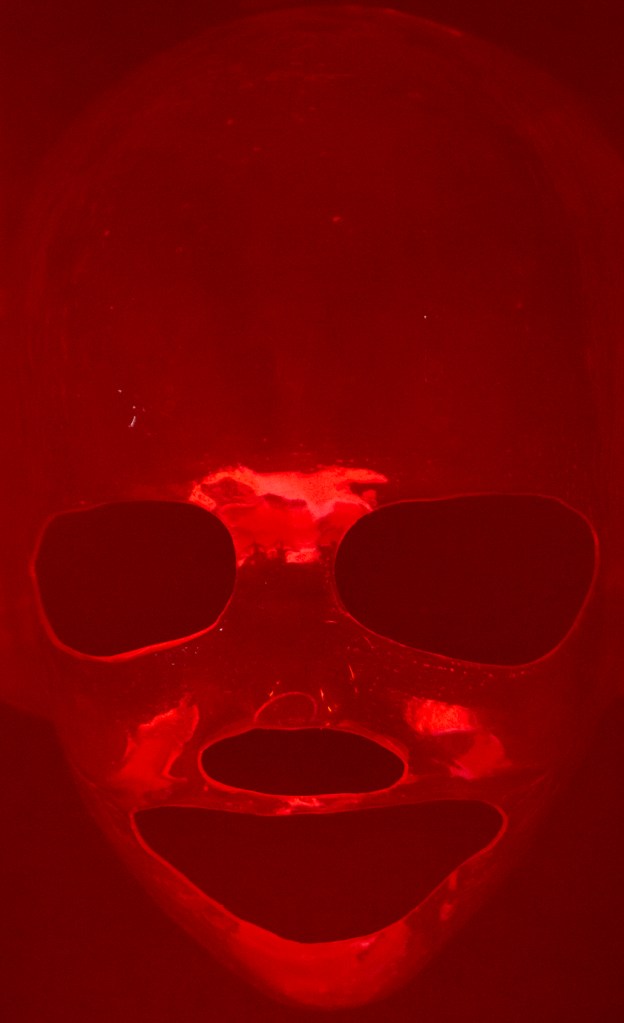
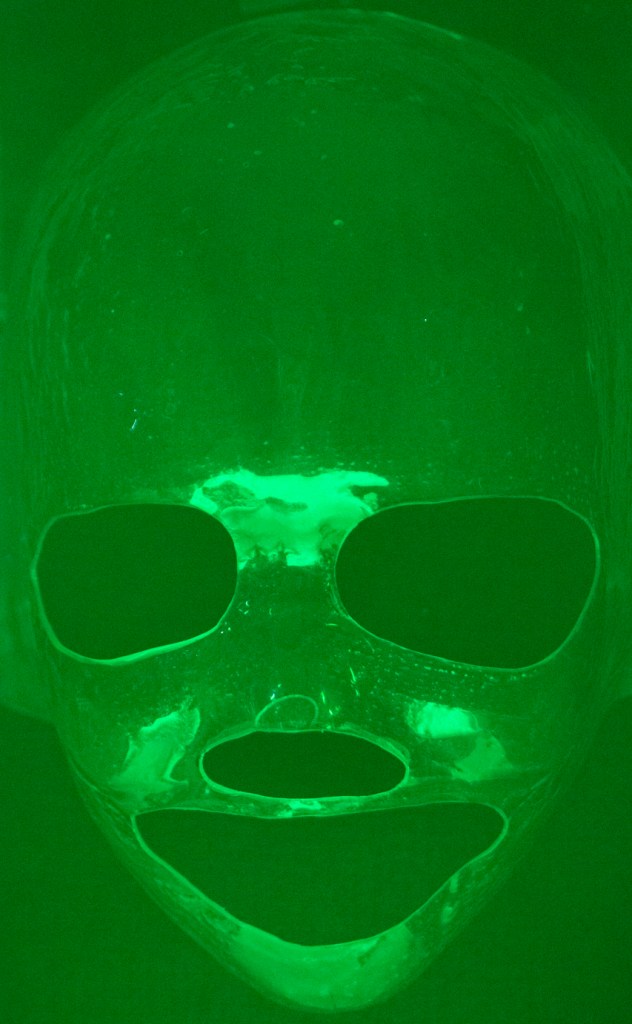
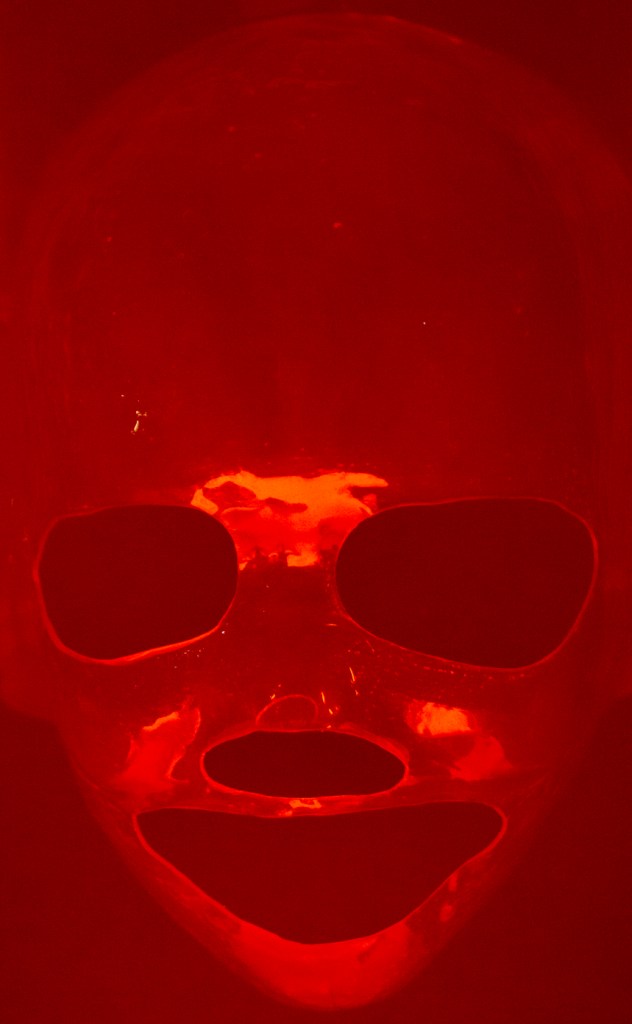
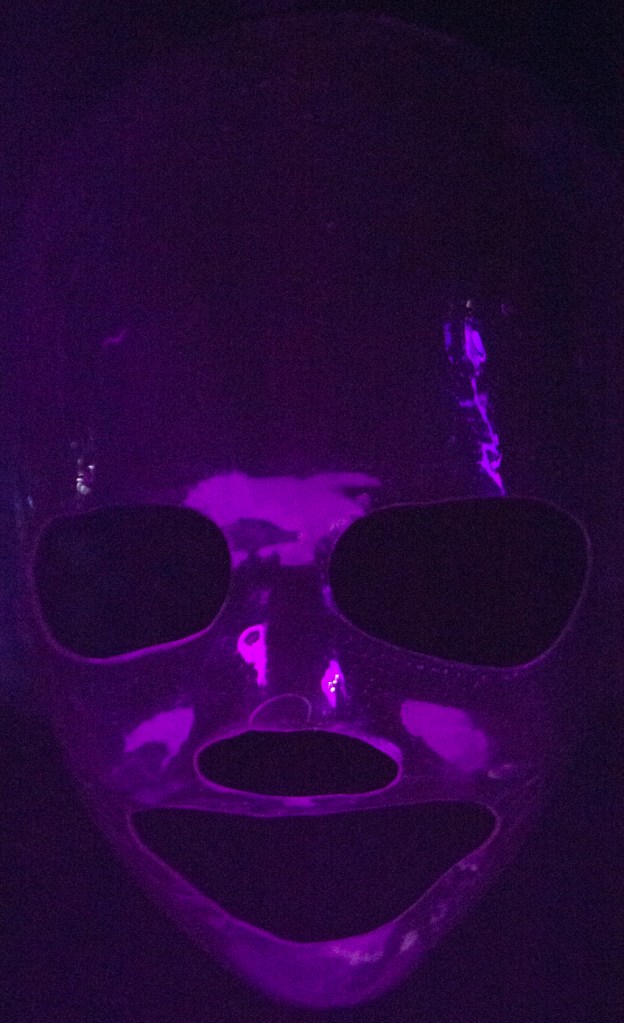
Although I didn’t have a crystal skull too hand, and couldn’t by the time of taking the photographs, get hold of an acrylic model of my son’s skull, I was able to make use of a plastic mould of his head that had been made when he was undergoing radiotherapy.
The other artist that influenced the final 6 image layout was Andy Warhol and his iconic artwork of Marilyn Monroe, and especially the multiple image layouts.
Huynh’s crystal skull image gave me the opportunity to read up on crystal skulls, and to find out a bit more about them. Although Huynh’s image is not illuminated by coloured lights the chance to replicate something similar was a challenge I wanted to undertake.
Warhol’s artwork was very much a last-minute influence as I thought about how best to display the complete set of images.
As stated above, my approach was to make use of small LED lights with coloured plastic filters. These were initially placed so that the light was directed at the skull, which had been attached to a black background. Photographs were taken from directly in front of the skull with the camera handheld. These initial images provided plenty of things to think about.
As a result of the initial experiments I decided that the camera needed to be placed on a tripod, to allow it to be focused on the skull without the camera changing focus during the act of taking the image. At the same time the camera was set so that the mirror was up, and triggering was performed using a remote.
The initial images taken showed that having the lights facing directly at the skull resulted in them being reflected in the clear plastic surface. To get around this the lights were moved so that the light pointed down at a white piece of paper which was used as a reflector. Tweaking the position of the lights removed these reflections.
Other reflections were not as easy to overcome but because of their position they have been left in the images, especially as they are in the same positions in all the photographs. Further experimentation will be needed to remove these for future photographs.
I think that the blue, green and yellow images are interesting, in that the light highlights areas of the skull. For instance, below the eye holes it is possible to see more clearly pin prick markings in the surface of the plastic. In the red and orange images these markings aren’t clear.
The weakest of the images is the purple one, where the top of the skull fades into the background too much.
I think however, when grouped with the other images there is a menacing look to this image, like the face is coming out of the background towards you or is withdrawing into the background.
To develop the work further I think I’d want to take a further set of images where the skull was lit with another dark colour so that there were three bright images and three darker ones. The layout of the images would then be adjusted so that the green image replaced the bottom left image and where it was originally positioned replaced with a third dark image.
Reflecting on this assignment against the Creativity criteria descriptors I believe that I have shown imagination because of the particular item I’ve chosen to photograph, and the way that I’ve attempted to do that using coloured light sources. I’ve experimented with different ways to achieve the end result, including printing the images out on digital transfer film so that they could be displayed in a way that allowed them to be illuminated from behind. I also feel that throughout Part 4 of the course I have been developing my personal voice, as can be seen in some of the material that I’ve been reading and this can be seen in the work produced for this assignment.
Images
Related Reading
The following learning log entries, articles and books influenced the development of the idea for this assigment.
- Crane en Cristal by Jean-Baptiste Huynh on artnet (s.d.) At: http://www.artnet.com/artists/jean-baptiste-huynh/crane-en-cristal-a-08h08-9hyYEF-gvH4pxy0A2 (Accessed 11/10/2020).
- Crystal skull (2020) In: Wikipedia. At: https://en.wikipedia.org/w/index.php?title=Crystal_skull&oldid=982432455 (Accessed 11/10/2020).
- EDITING 101 – A Quick Guide to Editing Your Photo Series using Stickies (2013) At: https://invisiblephotographer.asia/2013/11/18/editing101-quickguidestickies/ (Accessed 11/10/2020).
- Nan Goldin (2020) At: https://jennapowellphotographyeyv.photo.blog/2020/09/01/nan-goldin/ (Accessed 03/11/2020).
- Goldin, N. (2012) The Ballad of Sexual Dependency. (9th ed.) New York: Aperture Foundation.
- Goldin, N. (2019) The Other Side. (1st ed.) Gerhard, Germany: Steidl Druckerei und Verlag.
- Harris, R. (2020) Photography and Death: Framing Death throughout History. Bingley, UK: Emerald Publishing Limited.
- Jenna (2020) I Photograph to Remember. At: https://jennapowellphotographyeyv.photo.blog/2020/09/27/i-photograph-to-remember/ (Accessed 03/11/2020).
- Jenna (2017a) Briony Campbell. At: https://miradglass.wordpress.com/2017/09/30/briony-campbell/ (Accessed 11/10/2020).
- Jenna (2017b) In Sickness and in Health. At: https://miradglass.wordpress.com/2017/10/08/in-sickness-and-in-health/ (Accessed 11/10/2020).
- Languages of Light (2020) At: https://jennapowellphotographyeyv.photo.blog/2020/10/11/languages-of-light/ (Accessed 03/11/2020).
- The languages of light – Jenna Powell – Expressing Your Vision (s.d.) At: https://jennapowellphotographyeyv.photo.blog/2020/08/22/the-languages-of-light/ (Accessed 03/11/2020).
- Linkman, A. (2011) Photography and Death. London: Reaktion. At: www.reactionbooks.co.uk
- Sally Mann – Hold Still (2020) At: https://jennapowellphotographyeyv.photo.blog/2020/09/01/sally-mann-hold-still/ (Accessed 03/11/2020).
- Mann, S. (2016) Hold Still – A Memoir with Photographs. (5th ed.) New York: Hachette Book Group.
- Reflections in Photography — Photo Tips — National Geographic (2013) At: https://www.nationalgeographic.com/photography/photo-tips/pbb-reflections/ (Accessed 13/10/2020).
 Jenna Powell - Expressing Your Vision