
The brief for the final assignment for Express Your Vision is to take a series of photographs of any subject exploring the theme ‘Photography is Simple’.
Equipment
When I started thinking about the theme, I decided that I wanted to get back to basics and do away with all the expensive equipment that we use to capture images. How to do that though? Three ideas came to mind.
- Use a camera phone.
- Use a camera, on full auto with just the kit lens.
- Use a point and click camera.
Each of these has its own pros and cons when taking photographs.
Camera Phone
The advantages of using a camera phone are that it does not take up any room, you can always have it on you, the images are captured digitally and can be uploaded to a computer or the Cloud for storage and processing in photo editing software.
The disadvantages are that you are limited to the quality of camera built into the phone you are using.
Camera with Kit Lens
The advantages of using a camera with a kit lens is that it gives you a bit more freedom with regards to the images that you can capture. The other advantage is that the quality of the image is going to be better than most phones. Using Auto relieves you having to make decisions about what you are shooting, as the camera will pick what it calculates are the best settings for the conditions, leaving the photographer to focus on the scene in front of them.
The disadvantages of using a camera and kit lens is that it takes up a lot more room. Something that could be problematical if you are planning on carrying it with you everywhere you go. The other disadvantage is that using the camera on Auto will get you an image most of the time, but it might not be the one that you saw when you were looking at it and so some post processing would be required, which moves away from the idea that photography is simple.
Point and Click Camera
The advantages of a point and click camera are that they are less cumbersome than a DSLR and therefore easier to carry around with you. They have less settings to worry about, so you just need to focus on the composition of your photograph, and whether the light is right so that the image won’t be over or under-developed.
The disadvantages are that you are limited to the number of photographs on your roll of film, and the number of rolls you have with you. Also, you have no idea whether you’ve managed to capture the scene in front of you, despite how much care you take. Additionally, unless you have access to a darkroom, and have experience developing your own film and prints, you are the mercy of however, you get to develop your film for you.
Which One?
My initial decision was to go with the camera phone because I have always got my phone on me, and you can capture images with it without people realising that is what you are doing, particularly if you are discrete about it and make it look like you are just checking your phone.
However, I have been taking photographs since I was a teenager. The first camera I ever owned was a Keystone Regency 35mm that was given to me by my parents when I was a student at Polytechnic and learning to scuba dive.

To quote the Camera Wiki stub for this camera this is
“A chunky, weather-resistant model from Keystone for 35mm film. The “Optique Color Corrected Lens” is 38mm, f/5.6 and the only adjustment offered is a two-position film speed lever.”
http://camera-wiki.org/wiki/Keystone_Regency, 4th June 2011
No screen to see how the photograph looks, no adjustable aperture or shutter speed and no zoom. The only thing that you have an option with is the ISO of the film you are using, and even then, you are limited to using the same ISO for all your shots until you have finished the roll of film.
I still have that camera, almost 40 years later, so for me it made sense to get back to when my own photography was at its simplest and take the photographs for this assignment using it.
Subject
In the same way that I thought about the equipment I was going to use, I thought about how I was going to link the images I captured.
My initial thought was to link them through the letters of the word Photograph, photography being one letter too long for the 10-photo brief.
When I originally sat down to write this, it has taken me a while to finish up writing these thoughts, I noticed the course title and the words “Your Vision” stared out at me from the screen. Ten letters, which means I could do what I had planned with Photograph but with Your Vision.
In the end I moved away from both these ideas and decided to go with the much simpler one of carrying the camera with me all the time and when I saw something that caught my attention taking a photo.
With the camera being film and not digital, the results of taking each photograph would not be known until the film was developed.
Research
The following research was completed after I had taken the photographs that ended up in my assignment submission. Interestingly, for me, some of the things I found when looking at other photographers was reflected in some of my images.
Ane Hjort Guttu
I was in this state where everything could be art, or not… as if I was inside a zone where all things could be the result of a higher formal awareness: the roads, the chewing gum on the sidewalk, the yellow light over the city on our way home from kindergarten. Or it could be, it didn’t matter any more. Everything became art, and in that same moment nothing.
Morgan Quintance’s interview with Ane Hjort Guttu
Norwegian artist and filmaker, Guttu, is based in Oslo.
I found this interview, FM, R. (s.d.) Studio Visit – 12th June 2016 Ane Hjort Guttu, difficult to engage with, and as a result only managed to pull a few points from it.
One of the first things that I noticed was related to Guttu’s description of Oslo as a place of innocence where everything is getting better but there is a need to support the poor. Guttu, then goes on to say that the sight of beggars was unthinkable before 1995.
I remember when I went to London for a training course, in the late 90s, early 00s, and walking to the underground from my hotel. Lying in a doorway was someone sleeping rough. Commuters walked by without noticing them. The idea that people could find someone sleeping rough such an everyday occurence was a shock.
Two other points came out of the interview for me and relate to the quote. Art should be for everyone, and every item can be art. The last year has resulted in lots of restrictions on people. Lockdown has prevented people from travelling, and for a lot have meant that they have not been able to leave their homes. Artists, and particularly photographers, have had to explore different ways to be creative, including working with the things that they have at home, flowers in the garden, household items. Everything and anything have suddenly developed the potential to be a source of art. The restrictions that we have faced have forced us to look around us with fresh eyes and an awareness of the potential that our own home has for us to be creative.
This increased awareness supports the idea that Photography is Simple because with better awareness of our environment we will find more things that inspire us and our photography.
Michelle Groskopf
Not to sound corny but I go on and on how much street photography has taught me about myself – more than it taught me about people, what it’s taught me about myself. What makes me tick, what I love to look at, what I’m interested in, how resilient I can be, how creative I can be. I wish that for everybody, I wish everybody’s passion led to that kind of self knowledge and self love.
Michelle Groskopf’s interview with Ibarionex for Candid Frame.
Michelle Groskopf is a street photographer whose style is part documentary, part autobiography. In an interview with The Candid Frame, Michelle Groskopf — the candid frame podcast (2016), Groskopf makes the statement above. Starting out as a photographer she did the usual stuff like the Decisive Moment, however, was not enjoying it and so eventually moved away from this to street photography.
Street photography helped her to re-explore her childhood memories and the things that had influence her while growing up in suburbia, big glasses, big hair, hands, and nails. Her photographs aim to exclude a lot of background so that there is less room for interpretation.
Groskopf works with flash, and close-up photography. Not an easy combination and it took her a year to teach herself to the point where she could do this.
During the interview she mentions that a lot of street photographers tend to live in suburbia but do not think that there’s anything interesting there. This is strange because when you choose a place to live, you are going to do so for many reasons, but one of them is going to be because you like the area. If you like an area, then you must find it interesting, and if you find it interesting, then there must be things there that you would find interesting to photograph.
As a queer photographer, in the interview from 2016, Michelle Groskopf, said that she does not photograph the gay community because she is too involved in the community to shoot it.
By 2017 when she did an interview for Bust magazine, Michelle Groskopf Is An Out And Proud Queer Street Photographer: Lady Shooters (s.d.), that seems to have changed
As a queer woman who generally lives on the outside of accepted normalcy, I can admit to experiencing my share of hatred, but this really laid bare the legitimacy of bigotry in this country. As a white woman, it’s my absolute duty to fight that bigotry and to get in the way of this government’s upcoming policies. To fight alongside those who are legitimately afraid for their lives and the safety of those they love. I don’t claim to have much but I do have my camera and a certain amount of visibility which I intend to use as a tool of empowerment and in a way as a peaceful weapon.
Tara Wray, Bust magazine interview
One other point that came out in the interview related to the neighbourhood that you grew up in. As I reflected on that idea I thought about the area where I grew up and what I would photograph if I went back there. One of the things would be the underpass near the secondary school I attended.
I have, semi-fond, memories of doing cross-country running during PE lessons, as a way to get out of playing rugby or any of the other sports where we’d just be standing around, while the in-crowd got on with whatever sport we were doing.
Our cross-country route would take us out of the school gates, through the underpass and along a lane towards the ruin of a 13th century castle, Morlais Castle (2019). Depending on the route that the PE teacher had set us we would either along a track near the castle to a viaduct and down to the Blue Pool at Pontsarn before climbing back up a steep hill to complete the circuit and then return to school.
The last few times I went home, the underpass was being used for fly tipping. The contrast to how it looked during my youth could not have been starker.
These areas would be the ones that I would head to, in order to photograph them, because they are part of my youth, and shaped me and my love of the countryside and nature, and my dislike of seeing them spoiled with rubbish.
Miho Kajioka
It was after the 2011 earthquake and tsunami that Kajioka was reconnected to her photographic art. Two months after the disaster, while reporting in the coastal city of Kamaishi, where over 800 people died, she found roses blooming beside a blasted building. That mixture of grace and ruin made her think of a Japanese poem:
In the spring, cherry blossoms,
In the summer the cuckoo,
In autumn the moon, and in
Winter the snow, clear, cold.
Written by the Zen monk Dogen, the poem describes the fleeting, fragile beauty of the changing seasons. The roses Kajioka saw in Kamaishi bloomed simply because it was spring. That beautiful and uncomplicated statement, made by roses in the midst of ruin, impressed her, and returned her to photography.
https://www.lensculture.com/articles/miho-kajioka-as-it-is
Kajioka’s practice is principally snapshot based. She carries her camera everywhere and photographs what she finds interesting.
The simplicity of Kajioka’s images leaves the viewer with less distractions and allows them to formulate their own thoughts about what they are looking at.

When I look at the image above, my mind sees the mushroom cloud from an atomic explosion. Even though my rational mind is telling me that this is a tree, the rest of my mind tells me that this simple object is something completely different. That Kajioka was born in Japan, the only victim of atomic weapons used in anger during war and reported on the events at the Fukushima nuclear power station, makes this image stronger.

A simple image of a teddy bear on a wall. Nothing to distract the viewer. Looking at the image I find that there is a sense of sadness and loneliness exuded by the bear, as if it has been abandoned or lost by its owner. This image could have been taken anywhere in the world. With no external references it could symbolise all lost bears around the world, waiting for their owners to return.
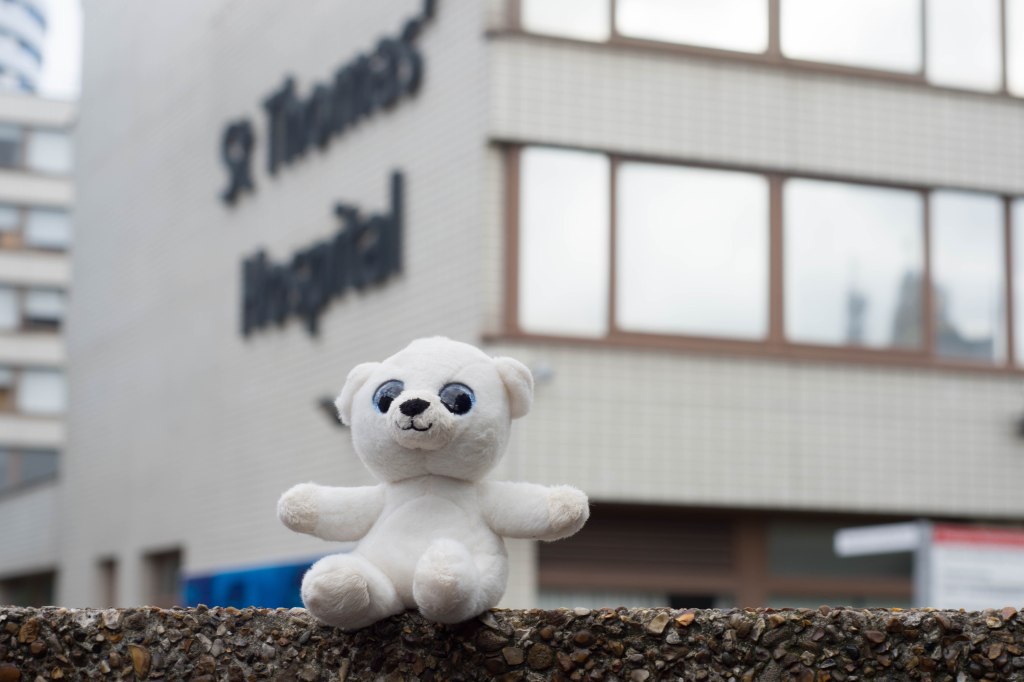
Snowy travels lots of places with me.
In 2017 we were in London, the last time we would go there with Rhys before his death. In 2018 we would return to London when I took part in the London Marathon. During a previous weekend in London while I was taking part in the marathon, Rhys had been taken ill on the Saturday evening. We had ended up in St Thomas’ Hospital where he ended up being kept in for a few days because of an infection. Not the best pre-race preparation. On the Sunday as I was running and reached Big Ben, there was Rhys waving at me from the crowd. The hospital had let him out for a few hours so he could cheer me on. The emotions that choked me as I turned away from him and headed towards Buckingham Palace and the finish in The Mall, gave me the incentive I needed to push on to the end.
One quote from Miho Kajioka struck me profoundly.
Reporting about the tsunami and the Fukushima nuclear disaster in 2011, these experiences changed and reinforced my view of life,” she says. “I thought how tomorrow might never come, how life can end suddenly, and I realised that this was the time to return to art.
Miho Kajioka’s Lightness of Being by Michael Grieve at 1854 Photography (https://www.1854.photography/2020/11/miho-kajiokas-lightness-of-being/)
When I think about my photography over the last five years one of the themes that has run through it is that it has focused on loss, whether that is people or the world around us, the world that we have been carelessly throwing away by polluting it with our waste. The disasters that Kajioka reported on affected a small percentage of people out of the global population, but since the end of 2019, many more people have been affected by the sudden loss of loved ones, almost three million people have found tomorrow never came and life ended suddenly.
Photography does not have to be complicated, as artists and image makers we do not always have to do things the hard way. There is beauty to be found in even the simplest of things. Occasionally we need to step back from the technology, and just go old school, we need to become like children and delight in the world around us, capturing images just for the joy of it. When we give children toy cameras and even their first real cameras, we do not expect them to go around taking images while thinking about composition, light, the Rule of Thirds, the Golden Hour. We do not expect much from them, other than that they have fun and if they take a picture, it’s because something caught their attention that they thought worth taking a picture of.
Daido Moriyama
FOLLOW ME (2019) explores Daido Moriyama’s photography as the author Takeshi Nakamoto journeys around parts of Japan with the photographer. Place covered include Sunamachi, Tsukudajima, Ginza and Haneda Airport, as well as a road trip. In addition to the photographs, the book contains Moriyama’s thoughts on his photography, and tips for people who want to take photographs.
One thing I would recommend your readers do is take shots, lots of shots, of any regular journey they make in their everyday lives… Apart from being great training for taking snapshots, it’s a way for them to understand how their own powers of observation affect what they see, even with the most ordinary things. Taking shots over and over again of the same shopping street will do more than teach them how to take snapshots it will help them become better photographers all round.
Daido Moriyama, How I take Photographs, page 24.
Of all the things in the book, the one thing that leaped out at me was this piece of advice. When Moriyama started out, he used film cameras and would go through lots of rolls during a session. After a long time, he eventually moved to digital.
Reading about how he goes about taking his photographs was interesting. Moriyama will take photographs of something and then move on but may then return to photograph it from a different angle a few moments later because he has seen something different about it. The idea of doing that with film is not one that I think is really feasible for me to do, not unless I was developing and printing the images myself. However, doing this with a digital camera is a completely different thing. In fact, it is something that we, as photographers, should do. Not just look at something from one angle but from multiple angles in case we miss something that we later regret.
Vivian Maier
Vivian Maier was a prolific photographer who while working as a nanny took over 100 thousand photographs. It was only after her death and by a stroke of good fortune that boxes of her work were discovered, and her work came to be known by the wider world.
Maier was in some ways like Diane Arbus, a street photographer, but where Arbus was interested in the unusual, Maier was more interested in the everyday.
Westerbeck, C. and Maier, V. (eds.) (2018) have compiled a collection of Maier’s colour photographs that illustrate how much of a student of human expression and how a quick eye can help you to capture those elusive movements. In addition to Maier’s photographs of other people, she produced many images which included her reflection.
To have taken as many photographs as she did, and still be unknown on her death, she must have honed the ability to blend into the background and not be noticed to incredible levels.
Maier shows us that we should carry a camera with us wherever we go and look for opportunities to capture the everyday but also to study the people around us because they can be the source of interesting images.
Several years ago, I was walking through Bristol’s Broadmead shopping area. I was pushing my son in a wheelchair. As we reached the bottom of the hill leading down from the castle I glanced across the road and could see a cyclist helping a homeless chap who was lying on the ground. It was a perfect image, but my camera was out of reach and my hands were full with the wheelchair so I wasn’t able to stop and take a photograph. Something I regret.
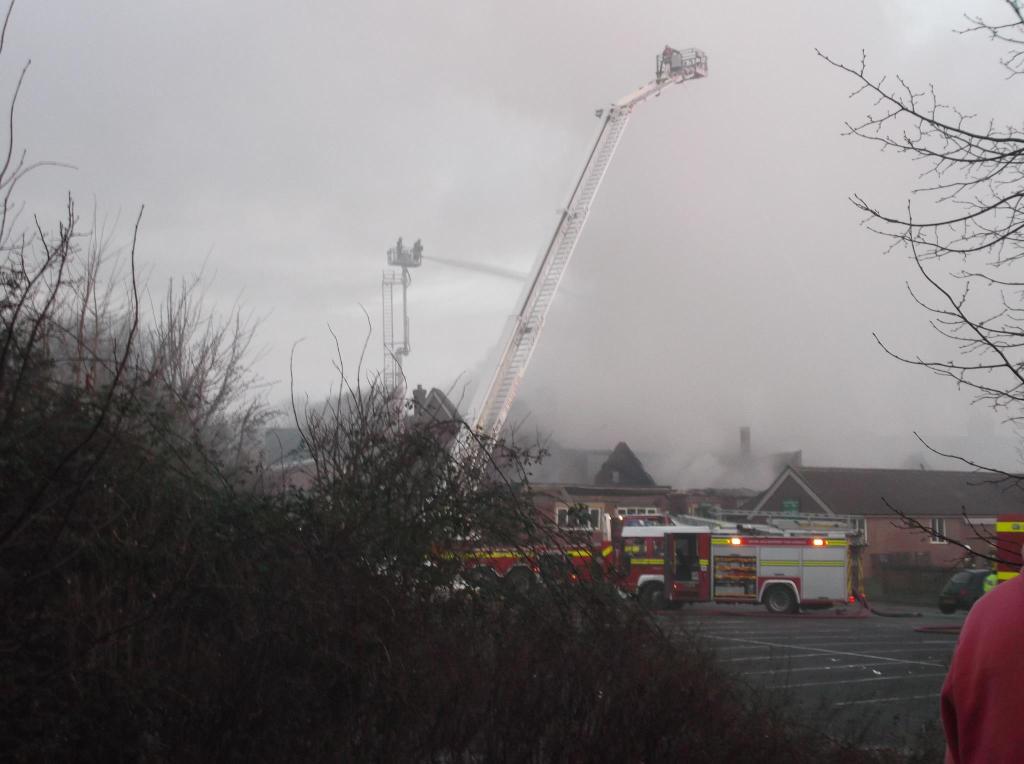
Since then, I have always had either my DSLR, my phone or a compact digital camera on me for those times when I might need to take a photograph of something. Like this one, taken while going out for a bike ride.
References
- Ane Hjort Guttu (s.d.) At: https://www.southlondongallery.org/exhibitions/ane-hjort-guttu/ (Accessed 21/03/2021a).
- Ane Hjort Guttu (s.d.) At: https://groundwork.art/artists/ane-hjort-guttu/ (Accessed 21/03/2021b).
- Ane Hjort Guttu and Sveinung R. UnnelandGhost In The Machine – Announcements – Art & Education (s.d.) At: https://www.artandeducation.net/announcements/367042/ane-hjort-guttu-and-sveinung-r-unnelandghost-in-the-machine (Accessed 21/03/2021).
- DAIDO MORIYAMA, FOLLOW ME: how i take photographs. (2019) Place of publication not identified: LAURENCE KING Publishing.
- Exposure: Photographer Michelle Groskopf (2019) At: https://www.creativereview.co.uk/photographer-michelle-groskopf/ (Accessed 21/03/2021).
- FM, R. (s.d.) Studio Visit – 12th June 2016 Ane Hjort Guttu. At: https://www.mixcloud.com/Resonance/studio-visit-12jun2016-ane-hjort-guttu_studio-visit/?play=fb (Accessed 04/04/2021).
- Grieve, M. (2020) Miho Kajioka’s Lightness of Being. At: https://www.1854.photography/2020/11/miho-kajiokas-lightness-of-being/ (Accessed 21/03/2021).
- LensCulture, M. K. | (s.d.) as it is – Photographs and text by Miho Kajioka. At: https://www.lensculture.com/articles/miho-kajioka-as-it-is (Accessed 21/03/2021).
- Michelle Groskopf (2016) At: https://www.luciefoundation.org/bio/michelle-groskopf/ (Accessed 21/03/2021).
- Michelle Groskopf — the candid frame podcast (2016) At: https://www.ibarionex.net/thecandidframe/tag/Michelle+Groskopf (Accessed 21/03/2021).
- Michelle Groskopf Photography (s.d.) At: https://mgroskopf.com (Accessed 21/03/2021).
- Miho Kajioka – Overview (s.d.) At: https://ibashogallery.com/artists/29-miho-kajioka/overview/ (Accessed 21/03/2021).
- Photography, T. C. F. C. on (s.d.) TCF Ep. 312 – Michelle Groskopf – The Candid Frame: Conversations on Photography – Podcast. At: https://podtail.com/en/podcast/the-candid-frame-a-photography-podcast/tcf-ep-312-michelle-groskopf/ (Accessed 21/03/2021).
- The Candid Frame #312 – Michelle Groskopf (s.d.) At: https://www.ibarionex.net/thecandidframe/2016/2/29/the-candid-frame-312-michelle-groskopf (Accessed 21/03/2021).
- Westerbeck, C. and Maier, V. (eds.) (2018) Vivian Maier: the color work. New York, NY: Harper Design, an imprint of HarperCollins Publishers.
- Michelle Groskopf Is An Out And Proud Queer Street Photographer: Lady Shooters (s.d.) At: https://bust.com/arts/18663-michelle-groskopf-is-an-out-and-proud-queer-street-photographer-lady-shooters.html (Accessed 25/04/2021).
- Morlais Castle (2019) In: Wikipedia. At: https://en.wikipedia.org/w/index.php?title=Morlais_Castle&oldid=882728669 (Accessed 25/04/2021).
 Jenna Powell - Expressing Your Vision