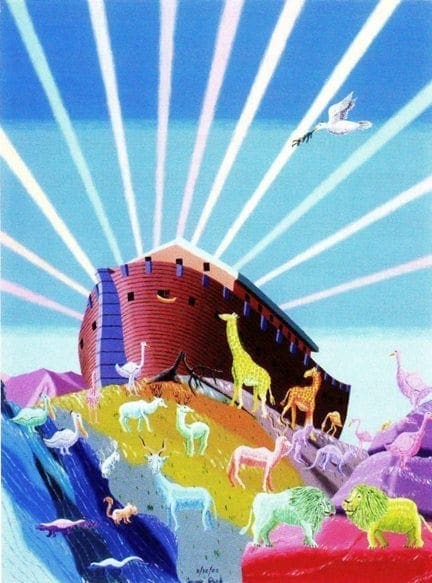
Expressing Your Vision Reflective Evaluation

The following video is what I have put together for my assessment as my reflection on the module.

After reflecting on what I’d produced in the video I decided that I would go for a written evaluation. The following is what I will be submitting.

Expressing Your Vision Reflection

Jenna Powell / Student Number 516808

Expressing Your Vision

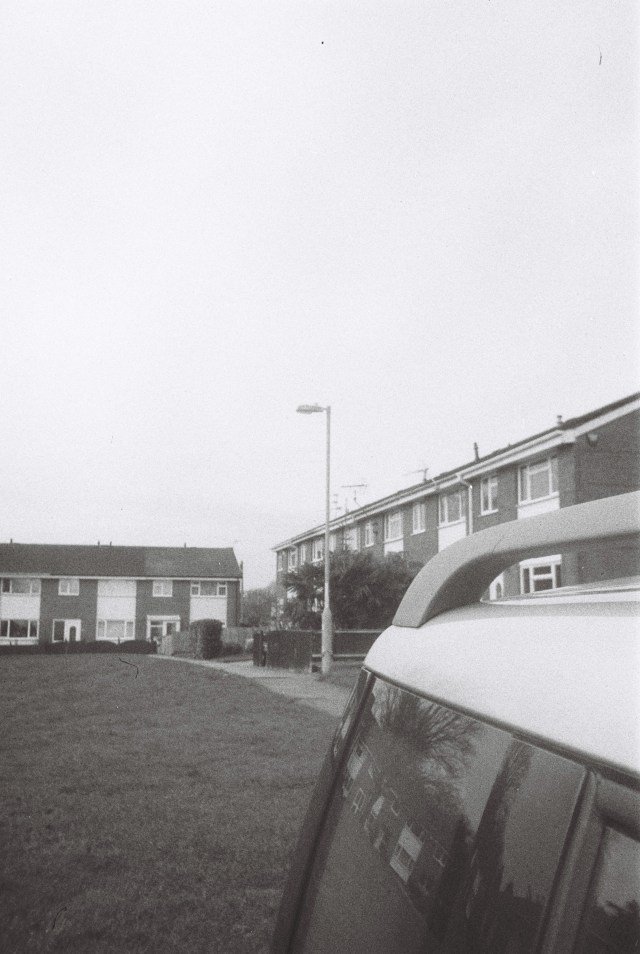
Matthew Winterlich

September 2021

This is my reflection on the work that I undertook for the Open College of the Arts Photography Degree module Expressing Your Vision (EYV).

During this reflection I want to consider what I learned about myself and my photography.

I started the course prior to the Coronavirus pandemic and because of this had all the freedoms we enjoyed with respect to moving around, being able to be around people and not having restrictions placed upon us. As a result, my early work was not restrained by location, and I was able to take photographs around my home area and when away for work or pleasure.

I was able to go out and get materials that I might need to take photographs at home.

Then in spring 2020 we went into lockdown due to the pandemic.

Life became harder, restrictions made taking photographs more challenging because everyone found themselves unable to move about as freely, as we had been able to pre-pandemic.

These restrictions, however, forced me to think about ways to work within the restrictions to meet the aims of each exercise and assignment.

One of the hardest things to work around, however, was not being able to go to exhibitions. Even so, exhibitions are not the only way to study photographers and artists work, there are always books, especially photobooks, and catalogues that give a way to look at the work of photographers, without being restricted to the opening hours of galleries.

When I reflected on the work I produced for the exercises and assessments I found that there were several themes that ran through my work. I had not been aware of it at the time, and certainly not planned it that way. I suppose my subconscious had been doing its thing and, having picked up on the theme, worked in the background linking different aspects of my work in some way.

The first theme I identified was because of feedback I received for assignment 5.

“Although the work appears to be a random observation of things encountered during the day there are a number of potential themes inherent in it.  As an example, the spider’s web sequence suggested looking behind the façade of the ordinary. “

When I looked back at my work for the module, I noticed that I had captured several images that we would normally miss unless we were looking for them. Rubbish hidden within pipes, homeless people living in tents on the streets of London, snails on flowers, the infinite possibilities of water droplets, spider webs.

Figure 1 Themes

The second theme in my work was social justice. I identified this after reflecting on the work that I undertook for the Foundations in Photography and the EYV courses.

Figure 2 Slavery

Figure 3 What can we find when we go out of our way to explore places?

This is one of the first images that I captured as part of EYV. What makes this image special for me is the reflection of the drain cover in the rainwater that was on the concrete below it. I hadn’t set out to capture this. I’d wanted to capture the cover because it wasn’t something I’d noticed before. Capturing the reflection was something that I deliberately included after taking several photographs before noticing it. I’ve seen numerous images where the photographer had captured an object and its’s reflection so I understand that this might be a bit of a cliché as an image.

I don’t believe that there is anything wrong with cliches, especially if you realise that you are doing is a cliché and you are happy to go ahead and do it. Part of learning any skill is learning how to do it according to the rules. Once you know those rules than you can consciously break them. Learning the rules may mean doing things that are like work that has been overdone by others. It is by doing this that you can compare what you have produced with others and see what you’ve done that works or doesn’t, and then make changes to improve it. The Homage exercise later in the course was a great opportunity to explore this in more detail.

After spotting this drain cover, I noticed another one at another location within the town. I’ve not managed to get a photograph of that one that I am happy with, but it is something that I plan to revisit as time allows.

Figure 4 When we go out of our way, we find interesting items.

This was also an image that I captured as part of the Square Mile assignment.

When I found this pipe, I was wandering along the bank of a stream that runs through a nearby housing estate. The pipe goes from somewhere and is a means of taking water from one place to another but where from. It can’t be a house because dumping waste into open water would be illegal. So, if we could trace this back where would it lead to? Does it lead anywhere? The pipe could end 6 inches into the muddy bank, or it could lead back hundreds of feet.

Sometimes the images we capture can lead to more questions that they answer. Whether the questions are ones we have to answer or are ones we leave for the viewer are decisions we make as part of the process of developing a project.

This image required editing in Lightroom and Photoshop until I was satisfied with it. The original image was too dark, and the pipe just blended in too much with the mud and ground surrounding it. Editing the image allowed me to bring out the details that I wanted.

Figure 5 What lies beneath

Another image from the first assignment. This was a lot trickier to take than I’d expected.

I’d spotted the pipe and because it was at a height where I could look inside, I’d noticed that there were objects inside.

The interior of the pipe was dark, and I needed to make use of flash to illuminate it.

I needed several test shots to get an idea that there might be a worthwhile picture. Getting the camera lens and the flash into a position where a successful image could be captured took further shots.

The image has been edited in Lightroom and it wasn’t until I was editing it that I noticed the faint traces of a spider’s web.

Developing the material for assignment 1 I made the conscious decision to look for things that people would normally miss. At the same time, I set out to follow the course of a stream that fed into the river that flows through the town where I live. In the end I only explored a small area of what I’d planned because where I started ended up being so fruitful for images.

Figure 6 If we don’t remember the past, we are doomed to repeat it. If we reflect on what has gone before we have a chance to be better.

Like many people I am aware of slavery. I know about the slave trade, but it was something that growing up was historical. My hometown wasn’t part of the slave trade. Its industries were centered on iron making and coal mining. The people that lived there were came from all over, but also went all over, the world. In the last few years, since the killing of George Floyd, slavery has been a topic that has been in the UK news. Edward Colston’s statue in Bristol was pulled down and thrown into the harbour, Cecil Rhodes statue at Oxford University needed netting fitting in front of it to protect it from damage. These men were lauded during their lifetimes, when slavery was not seen in the way that we view it now. Rather than concentrating on monuments to slave traders, and giving them more prominence, we should be letting them fade into history while quietly removing them. At the same time, we should be bringing to the public’s attention monuments to slaves and those that worked towards freeing them. Slavery might be illegal in the UK and many other countries, but that doesn’t mean that it has been eradicated completely.

I’ve been to London many times, but it wasn’t until I was doing one of the assignments for EYV and looking at monuments that I came across this memorial to slaves. It’s located out of the way and unless you knew it was there you could walk by and miss it.

Trying to take photographs of this was more difficult than I thought it would be. Almost like it was designed to make it as hard as possible to capture, in contrast to how easy it must have been for slaver traders to capture, and slave owners to recapture when they escaped, some of the slaves that it represents.

The words on the pillars show that it’s not just physical slavery that we should be conscious of, but also slavery to other concepts like money and addiction.

Figure 7 Droplet

One of the exercises I really enjoyed during the module was Exercise 3.1 entitled Freeze. The brief for the exercise was to use fast shutter speeds to try to isolate a frozen moment of time in a moving subject.

This was an opportunity for me to explore something that I’ve seen in photographs but never would have considered trying for myself.

I found that I was able to do all the work for the exercise from home. There was a fair amount of research for this exercise. Looking at photographers who had captured moments in time, finding photographer who had worked with water droplets and looking at the equipment and liquids they had used. I was surprised that it was possible to by equipment designed to be used with droplet photography. I would have expected it to be a niche area but there are companies making equipment that you can use.

In my case I put together a low tech set up that would allow me to get droplets to fall where I wanted them, but which still relied on me triggering the shutter at the right time.

Different liquids were tried, both with and without additional colouring being added. The resulting images are something I’m happy with and I might return to the subject at some point in the future when I can afford something a little bit higher tech so that it’s not as hit and miss as it was while I was doing this exercise.

Figure 8 Without light there is no darkness.

Throughout the course I was able to try and get experience with different techniques.

Exercise 4.3 Egg or Stone was another chance to develop technical skills and explore the use of lighting.

I opted to make use of natural light from a window to light a series of stones. I used different shaped stones and rotated them while keeping the camera in the same position, repositioning it to get a different set of images.

The effect of the light hitting the surfaces on the stones, the way the light highlighted parts while casting others into shadow was interesting to explore.

Like other activities within the module, this one has possibilities for further development simply by changing the light source so that is flash or artificial light, or direct sunlight outside.

Figure 9 Brian the Snail

Lockdown brought a lot of restrictions on people. One of which was the inability to travel very far. I also found that some things slowed down. Driving to the supermarket became a pleasant experience because of the lack of cars on the road. There was no hurry. Since we went into lockdown, I have found that my own pace of life has slowed, I drive slower than I used to. Even on high-speed roads I tend to stick to the speed limit, or even go just under it, rather than the couple of miles per hour over it that I would have done before.

Life has slowed.

I’ve had more time to notice things.

Like this snail which I spotted on our garden table in the mornings. It would venture out in the early morning before going back to its hiding place underneath the table. One morning I decided that I would capture it for posterity.

Figure 10 Like being a child again

One of the things that I loved about the homage exercise is that it gave me the chance to explore the way that images taken now could be made to look like images taken decades ago.

In the case of this image, I was paying homage to someone who I hadn’t realised was even a photographer. Edvard Munch had taken photographs of the area where he lived, especially the gardens and the fronts of his homes.

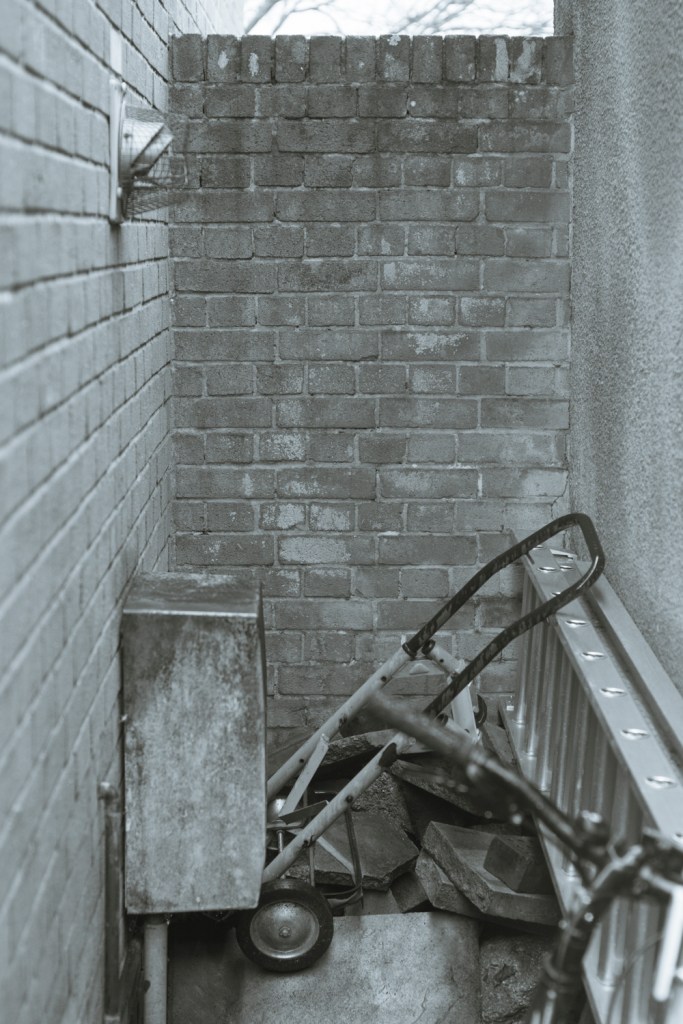
Paying homage to Munch’s work I took several images around my home and garden, using Black and White so that they were more in keeping with Munch’s. Of all the images I took this one was my favourite. I could say that it’s because it is a simple image. I could say that it’s because of the discarded look to the trolley. However, its none of them in the end. This image takes me back to my childhood. It takes me back to visiting my Nan’s house on a Saturday afternoon. Not because there was anything like this at her house but because it reminds me of the way that you would come out of the kitchen and there was a shed in front of you. The path from the garden gate leading between house and shed to the back garden.

The image brings up memories and those memories make me smile and in turn trigger more memories of visiting my Nan. Memories like the one that just came to mind of drinking tea and finding some of the skin from the milk was in my tea. Certainly, a yuck moment but one I remember fondly.

Someone else seeing this image wouldn’t have the same reaction, unless they were of a certain age, and from a certain social and economic background, but for someone of a similar background I wonder what thoughts and memories this image would trigger.

Figure 11 Claws Out

For the last 15 months I have had a lot of dealings with my neighbour’s cats. While exploring The Decisive Moment I managed to capture the indecisive moment with the help of one of the cats. Normally when the cats are climbing my garden fence, they are moving so fast that I don’t get to see much of what is happening with their paws. On this occasion the cat had paused before making the leap for the top of the panel and I was able to clearly see her claws gripping the piece of wood that she was holding on to. Small she might be, but you can understand why you wouldn’t want to bump into one of her bigger cousins.

Figure 12 Incy Wincy Spider…

A friend loves spider’s webs and because of that I found myself driving home one cold day and noticed spider’s webs glistening on some traffic lights. I’d not noticed them before but having gone through EYV and having gone through lockdown on the day in question I was more aware of things than I once would have been.

As part of my final assignment for EYV I had limited myself to using an old 35mm camera I’d been given by my parents as a teenager. I’d wanted to go back to basics for the assignment. I’d taken several photos by the time I got to taking this and the one that follows. I’d been trying to keep my eyes open and be more aware of my surroundings so that I might see things that would be worth taking photographs of. I set out on this occasion to photograph the webs I’d seen on the traffic light. In the end I found myself noticing far more webs around the area and the shoot ended up focusing on these.

I think this shows that even when we have pre-conceived ideas about what we are setting out to do, we, and certainly I do, need to be open to what other opportunities present themselves.

Figure 13 Thoughtful

Photographing people is something I struggle with. Not the act of photographing someone but given people direction, getting them to pose for me. Its why I prefer photographing people when they are doing things that they would normally do. My niece was looking particularly thoughtful when I managed to capture her with my camera. I’m glad I did as I was able to make use of this photo during one of the exercises when I decided that I would experiment with cyanotypes.

One of the things that I found during EYV was that as my knowledge of photography has grown, I’ve become more aware of different ways to make images. Some of which hark back to the beginning of photography. The exercises have allowed me the chance to experiment with some of these techniques, to see how difficult these techniques are, but also to get the glimmering of the possibilities that they provide.

Throughout the module several areas were highlighted by my tutor as worth considering for further exploration.

Assignment 1

Culverts – After working on Assignment 1 I came across a group on Facebook who celebrated manhole covers. The idea of doing something similar for culverts occurred when I found a second one further down the course of the stream that was central to the area I explored during the assignment.

Architectural studies – Some of the images for Assignment 1 had a feel that they were architectural studies. Hilla and Bernd Becher are known for their work documenting industrial structures in different parts of the world. Their grid like display of images of similar structures could be a way to group a series of studies of items like pipes, culverts, and tunnels.

Miniature landscapes – Several of the images appeared like miniature landscapes and this could be something that could be built on.

Following the stream – My initial plan for this assignment was to follow a stream that meandered through the town until it fed into the River Yeo. That is still a project that I need to complete. With the benefit of hindsight, I’ve become aware of groups that are interested in protecting the streams and river, some of which run guided walks. The project has several possibilities, for instance the area around the stream and river changes according to the season so it would be possible to follow the course, each season throughout the year, documenting what it looks like.

Assignment 2

The feedback for assignment 2 highlighted the images of the tents belonging to homeless people and the monument to the suffragette movement, and a child playing around some monuments and statues. The link between past and present, or even the contrast between them is something that could be further developed. With the image of the tents and the monument there are several topics that could be explored, the contrast between where we were and where we are now. How some people are still disenfranchised in society. Where women, once didn’t have the vote, they do now but we still have part of society who aren’t able to have their voice heard and this might be something worth exploring further.

Assignment 4 

The feedback for assignment 4 suggested a couple of ways to improve on the submission. One of these I have already thought about and that is the individual images. I would like to redo the images using specific colours and to overlay the images with other images that represent countries for which the colour used with the image relates to death or mourning. Colours have different meaning in different parts of the world. Including symbology from these societies with what in some ways is a modern version of the death mask, would be a good way to draw a link between the colour, it’s symbolism and the societies what are associated with it.

Assignment 5

The feedback from assignment 5 was that there was the potential for a body of work exploring what lies behind the façade of the ordinary. What lies hidden or in unseen is a theme that has run through a lot of my work and so it makes perfect sense to draw this together in a single project.

Throughout the Expressing Your Vision module I was able to explore lots of different techniques. Exercise 3.1 – Freeze and Project 1 – The Frozen Moment, provided me the change to explore droplet photography and high-speed photography, and the work of Harold Edgerton. Edgerton was born the same day as me, over 60 years before me so there was a resonance for me with his work.

In Exercise 4.4 – Personal Voice I had the opportunity to explore another new technique, cyanotypes. When completing several of the exercises and assignments for EYV I set myself an objective. In Exercise 4.4. the objective was to produce images without using a camera, in assignment 5 I set out to use an automatic camera that my parents gave me when I was at university, and to shoot black and white film. Setting limitations and objectives made me think about the techniques that I wanted to use. In Personal Voice I learned how to produce cyanotypes, how to go about experimenting with them without having to invest in lots of chemicals and how to produce digital negatives using a printer so that I had an image to use for the cyanotype. There was a lot of trial and error before I produced something that I was happy with.

When not exploring techniques, I was able to examine and reflect on the work of various photographers and artists. My own interests came through in my reflections on the work of Mandy Barker, Nan Goldin, Sally Mann and Pedro Meyer. Through these photographers I was able to look at the affect that we have on the environment as a species (Mandy Barker) and look at how other photographers have dealt with memoirs (Goldin, Mann and Meyer).

Since completing the module, and starting Context and Narrative, I have found that where my interest lay towards landscapes rather than people, I still don’t feel comfortable directing people when photographing them, my interests are more towards telling a story through images. Something that the work of people like Goldin, Mann and Meyer have shown me is possible, and which I want to develop further.

References

Exercise 3.1 – Freeze, https://jennapowellphotographyeyv.photo.blog/2020/02/27/exercise-3-1-freeze/

Project 1 – The Frozen Moment, https://jennapowellphotographyeyv.photo.blog/2020/02/27/project-1-the-frozen-moment/

Exercise 4.4 – Personal Voice, https://jennapowellphotographyeyv.photo.blog/2020/09/27/exercise-4-4-personal-voice/

Mandy Barker, https://jennapowellphotographyeyv.photo.blog/2019/09/29/altered-ocean/

Nan Goldin, https://jennapowellphotographyeyv.photo.blog/2020/09/01/nan-goldin/

Sally Mann, https://jennapowellphotographyeyv.photo.blog/2020/09/01/sally-mann-hold-still/

Pedro Meyer, https://jennapowellphotographyeyv.photo.blog/2020/09/27/i-photograph-to-remember/
Colour

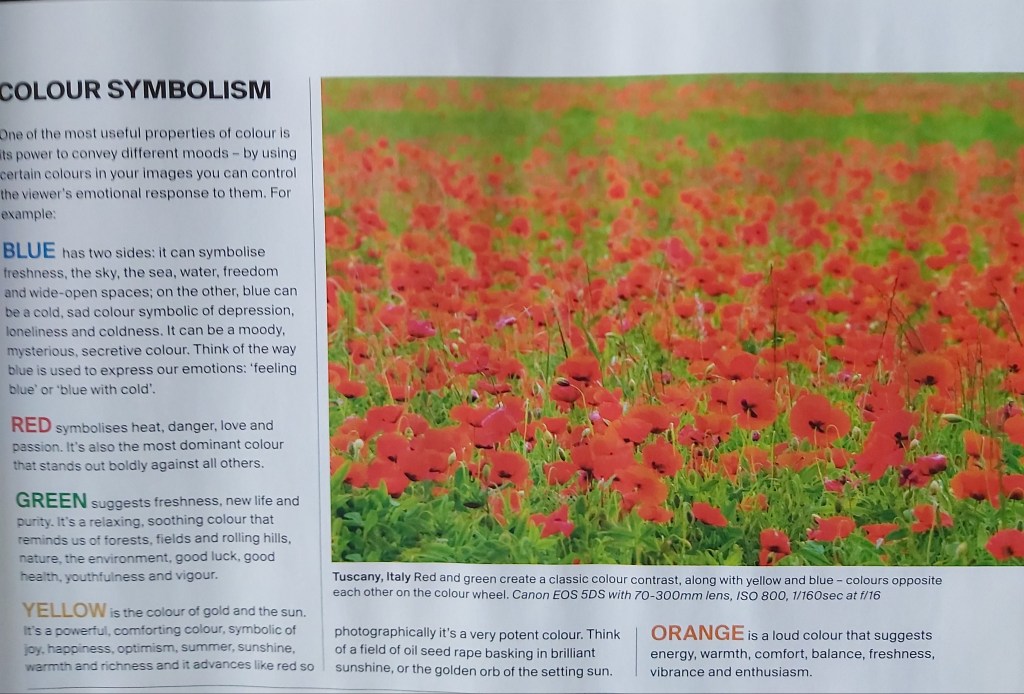
The feedback for assignment 4 gave some suggested reading about colour and I have been exploring that through the websites provided and also several books and an article in Outdoor Photography magazine issue 263.

Article from issue 263 of Outdoor Photography magazine
Colour Symbolism, Outdoor Photography magazine, Issue 263

When we think of certain objects we immediately associate a colour with them. Sky – blue, danger – red, snow – white, the sun – yellow, night – black, grass – green. No matter where you go in the world or the age of a person you talk to, the colours linked to these items are universally the same. Ok, if you never seen grass or snow you might not associate those colours with them, so maybe not universally the same.

When it comes to concepts, however, the colour associated with some topics is different depending on culture. For instance in the Western world the colour black is associated with mourning, however, in Eastern countries it is white, in other areas around the world it is red, purple, blue yellow or even brown.

Degrees, S. (2015) An International Guide to the Use of Color in Marketing and Advertising. At: https://www.six-degrees.com/an-international-guide-on-the-use-of-color-in-marketing-advertising/ (Accessed 20/02/2021).

Josef Albers book the Interaction of Color, Albers, J. (2013), is based on the course on colour that he taught at Black Mountain College. The book teaches how to look at colour and how, by combining colours is it possible to see different things. The book is made up of a number of chapters which explore colour in different ways. Each chapter suggests exercises that the reader can perform, with colour plates at the end of the book so that you can see, without the need to re-create the exercises, what Albers describes.

At the point that I’m writing this I’ve reached chapter 16, and admit that, despite it being a bit heavy going, the colour plates make it worth the effort when you can actually see the effects that Albers describes.

In her book Color: a course in mastering the art of mixing colors, Edwards, B (2004, Dr. Edwards is aiming to teach painting students how to harmonize the colour they use to best effect. The book describes what Dr Edwards is aiming for the reader to learn, before providing a series of exercises before reinforcing this through practical experience.

For photographers the ideas are useful knowledge, particularly when discussing the impact that colour can have on the psyche. The main part of the book that I found useful was where Dr Edwards describes how colours mean different things to different people and different cultures.

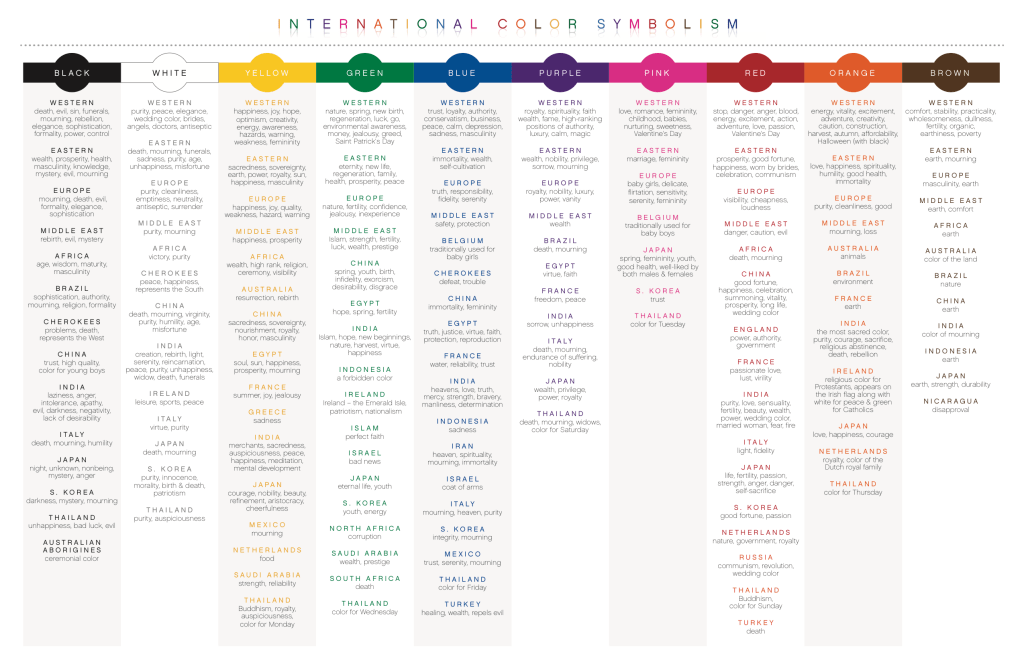
Where the ideas in Dr Edwards book, and charts like An International Guide to the Use of Color in Marketing and Advertising, above, come in useful for me in the short term is in the rework for assignment 4.

Looking at the colour symbolism chart above, it is possible to see which colours different cultures associate with death and mourning. In assignment 4 I made use of different colours to illuminate the mask of my son’s face. When reworking the assignment I plan to use colours associated with death and mourning to illuminate the mask and then to overlay this on images and symbols that are linked to the particular culture.

For instance green is associated with death in South Africa, therefore the mask would be illuminate with green light and then this image overlaid on symbols that are linked to South Africa, for example images of Nelson Mandela, apartheid, and more recent post-apartheid images. In China, white is associated with death and so the mask would be illuminated with a white light, and then overlaid on symbols that were linked to China.

References

  1. Albers, J. (2013) Interaction of color. (50th anniversary edition ; 4th edition) New Haven [Connecticut]: Yale University Press.
  2. Edwards, B. (2004) Color: a course in mastering the art of mixing colors. New York: Jeremy P. Tarcher/Penguin.

Photography is Simple – Ideas and Thoughts

The brief for the final assignment for Express Your Vision is to take a series of photographs of any subject exploring the theme ‘Photography is Simple’.

Equipment

When I started thinking about the theme, I decided that I wanted to get back to basics and do away with all the expensive equipment that we use to capture images. How to do that though? Three ideas came to mind.

  • Use a camera phone.
  • Use a camera, on full auto with just the kit lens.
  • Use a point and click camera.

Each of these has its own pros and cons when taking photographs.

Camera Phone

The advantages of using a camera phone are that it does not take up any room, you can always have it on you, the images are captured digitally and can be uploaded to a computer or the Cloud for storage and processing in photo editing software.

The disadvantages are that you are limited to the quality of camera built into the phone you are using.

Camera with Kit Lens

The advantages of using a camera with a kit lens is that it gives you a bit more freedom with regards to the images that you can capture. The other advantage is that the quality of the image is going to be better than most phones. Using Auto relieves you having to make decisions about what you are shooting, as the camera will pick what it calculates are the best settings for the conditions, leaving the photographer to focus on the scene in front of them.

The disadvantages of using a camera and kit lens is that it takes up a lot more room. Something that could be problematical if you are planning on carrying it with you everywhere you go. The other disadvantage is that using the camera on Auto will get you an image most of the time, but it might not be the one that you saw when you were looking at it and so some post processing would be required, which moves away from the idea that photography is simple.

Point and Click Camera

The advantages of a point and click camera are that they are less cumbersome than a DSLR and therefore easier to carry around with you. They have less settings to worry about, so you just need to focus on the composition of your photograph, and whether the light is right so that the image won’t be over or under-developed.

The disadvantages are that you are limited to the number of photographs on your roll of film, and the number of rolls you have with you. Also, you have no idea whether you’ve managed to capture the scene in front of you, despite how much care you take. Additionally, unless you have access to a darkroom, and have experience developing your own film and prints, you are the mercy of however, you get to develop your film for you.

Which One?

My initial decision was to go with the camera phone because I have always got my phone on me, and you can capture images with it without people realising that is what you are doing, particularly if you are discrete about it and make it look like you are just checking your phone.

However, I have been taking photographs since I was a teenager. The first camera I ever owned was a Keystone Regency 35mm that was given to me by my parents when I was a student at Polytechnic and learning to scuba dive.

To quote the Camera Wiki stub for this camera this is

“A chunky, weather-resistant model from Keystone for 35mm film. The “Optique Color Corrected Lens” is 38mm, f/5.6 and the only adjustment offered is a two-position film speed lever.”

http://camera-wiki.org/wiki/Keystone_Regency, 4th June 2011

No screen to see how the photograph looks, no adjustable aperture or shutter speed and no zoom. The only thing that you have an option with is the ISO of the film you are using, and even then, you are limited to using the same ISO for all your shots until you have finished the roll of film.

I still have that camera, almost 40 years later, so for me it made sense to get back to when my own photography was at its simplest and take the photographs for this assignment using it.

Subject

In the same way that I thought about the equipment I was going to use, I thought about how I was going to link the images I captured.

My initial thought was to link them through the letters of the word Photograph, photography being one letter too long for the 10-photo brief.

When I originally sat down to write this, it has taken me a while to finish up writing these thoughts, I noticed the course title and the words “Your Vision” stared out at me from the screen. Ten letters, which means I could do what I had planned with Photograph but with Your Vision.

In the end I moved away from both these ideas and decided to go with the much simpler one of carrying the camera with me all the time and when I saw something that caught my attention taking a photo.

With the camera being film and not digital, the results of taking each photograph would not be known until the film was developed.

Research

The following research was completed after I had taken the photographs that ended up in my assignment submission. Interestingly, for me, some of the things I found when looking at other photographers was reflected in some of my images.

Ane Hjort Guttu

I was in this state where everything could be art, or not… as if I was inside a zone where all things could be the result of a higher formal awareness: the roads, the chewing gum on the sidewalk, the yellow light over the city on our way home from kindergarten. Or it could be, it didn’t matter any more. Everything became art, and in that same moment nothing.

Morgan Quintance’s interview with Ane Hjort Guttu

Norwegian artist and filmaker, Guttu, is based in Oslo.

I found this interview, FM, R. (s.d.) Studio Visit – 12th June 2016 Ane Hjort Guttu, difficult to engage with, and as a result only managed to pull a few points from it.

One of the first things that I noticed was related to Guttu’s description of Oslo as a place of innocence where everything is getting better but there is a need to support the poor. Guttu, then goes on to say that the sight of beggars was unthinkable before 1995.

I remember when I went to London for a training course, in the late 90s, early 00s, and walking to the underground from my hotel. Lying in a doorway was someone sleeping rough. Commuters walked by without noticing them. The idea that people could find someone sleeping rough such an everyday occurence was a shock.

Two other points came out of the interview for me and relate to the quote. Art should be for everyone, and every item can be art. The last year has resulted in lots of restrictions on people. Lockdown has prevented people from travelling, and for a lot have meant that they have not been able to leave their homes. Artists, and particularly photographers, have had to explore different ways to be creative, including working with the things that they have at home, flowers in the garden, household items. Everything and anything have suddenly developed the potential to be a source of art. The restrictions that we have faced have forced us to look around us with fresh eyes and an awareness of the potential that our own home has for us to be creative.

This increased awareness supports the idea that Photography is Simple because with better awareness of our environment we will find more things that inspire us and our photography.

Michelle Groskopf

Not to sound corny but I go on and on how much street photography has taught me about myself – more than it taught me about people, what it’s taught me about myself. What makes me tick, what I love to look at, what I’m interested in, how resilient I can be, how creative I can be. I wish that for everybody, I wish everybody’s passion led to that kind of self knowledge and self love.

Michelle Groskopf’s interview with Ibarionex for Candid Frame.

Michelle Groskopf is a street photographer whose style is part documentary, part autobiography. In an interview with The Candid Frame, Michelle Groskopf — the candid frame podcast (2016), Groskopf makes the statement above. Starting out as a photographer she did the usual stuff like the Decisive Moment, however, was not enjoying it and so eventually moved away from this to street photography.

Street photography helped her to re-explore her childhood memories and the things that had influence her while growing up in suburbia, big glasses, big hair, hands, and nails. Her photographs aim to exclude a lot of background so that there is less room for interpretation.

Groskopf works with flash, and close-up photography. Not an easy combination and it took her a year to teach herself to the point where she could do this.

During the interview she mentions that a lot of street photographers tend to live in suburbia but do not think that there’s anything interesting there. This is strange because when you choose a place to live, you are going to do so for many reasons, but one of them is going to be because you like the area. If you like an area, then you must find it interesting, and if you find it interesting, then there must be things there that you would find interesting to photograph.

As a queer photographer, in the interview from 2016, Michelle Groskopf, said that she does not photograph the gay community because she is too involved in the community to shoot it.

By 2017 when she did an interview for Bust magazine, Michelle Groskopf Is An Out And Proud Queer Street Photographer: Lady Shooters (s.d.), that seems to have changed

As a queer woman who generally lives on the outside of accepted normalcy, I can admit to experiencing my share of hatred, but this really laid bare the legitimacy of bigotry in this country. As a white woman, it’s my absolute duty to fight that bigotry and to get in the way of this government’s upcoming policies. To fight alongside those who are legitimately afraid for their lives and the safety of those they love. I don’t claim to have much but I do have my camera and a certain amount of visibility which I intend to use as a tool of empowerment and in a way as a peaceful weapon.

Tara Wray, Bust magazine interview

One other point that came out in the interview related to the neighbourhood that you grew up in. As I reflected on that idea I thought about the area where I grew up and what I would photograph if I went back there. One of the things would be the underpass near the secondary school I attended.

I have, semi-fond, memories of doing cross-country running during PE lessons, as a way to get out of playing rugby or any of the other sports where we’d just be standing around, while the in-crowd got on with whatever sport we were doing.

Our cross-country route would take us out of the school gates, through the underpass and along a lane towards the ruin of a 13th century castle, Morlais Castle (2019). Depending on the route that the PE teacher had set us we would either along a track near the castle to a viaduct and down to the Blue Pool at Pontsarn before climbing back up a steep hill to complete the circuit and then return to school.

The last few times I went home, the underpass was being used for fly tipping. The contrast to how it looked during my youth could not have been starker.

These areas would be the ones that I would head to, in order to photograph them, because they are part of my youth, and shaped me and my love of the countryside and nature, and my dislike of seeing them spoiled with rubbish.

Miho Kajioka

It was after the 2011 earthquake and tsunami that Kajioka was reconnected to her photographic art. Two months after the disaster, while reporting in the coastal city of Kamaishi, where over 800 people died, she found roses blooming beside a blasted building. That mixture of grace and ruin made her think of a Japanese poem:

In the spring, cherry blossoms,

In the summer the cuckoo,

In autumn the moon, and in

Winter the snow, clear, cold.

Written by the Zen monk Dogen, the poem describes the fleeting, fragile beauty of the changing seasons. The roses Kajioka saw in Kamaishi bloomed simply because it was spring. That beautiful and uncomplicated statement, made by roses in the midst of ruin, impressed her, and returned her to photography.

https://www.lensculture.com/articles/miho-kajioka-as-it-is

Kajioka’s practice is principally snapshot based. She carries her camera everywhere and photographs what she finds interesting.

The simplicity of Kajioka’s images leaves the viewer with less distractions and allows them to formulate their own thoughts about what they are looking at.

BK0001 – Miho Kajioka

When I look at the image above, my mind sees the mushroom cloud from an atomic explosion. Even though my rational mind is telling me that this is a tree, the rest of my mind tells me that this simple object is something completely different. That Kajioka was born in Japan, the only victim of atomic weapons used in anger during war and reported on the events at the Fukushima nuclear power station, makes this image stronger.

BK0018 – Miho Kajioka

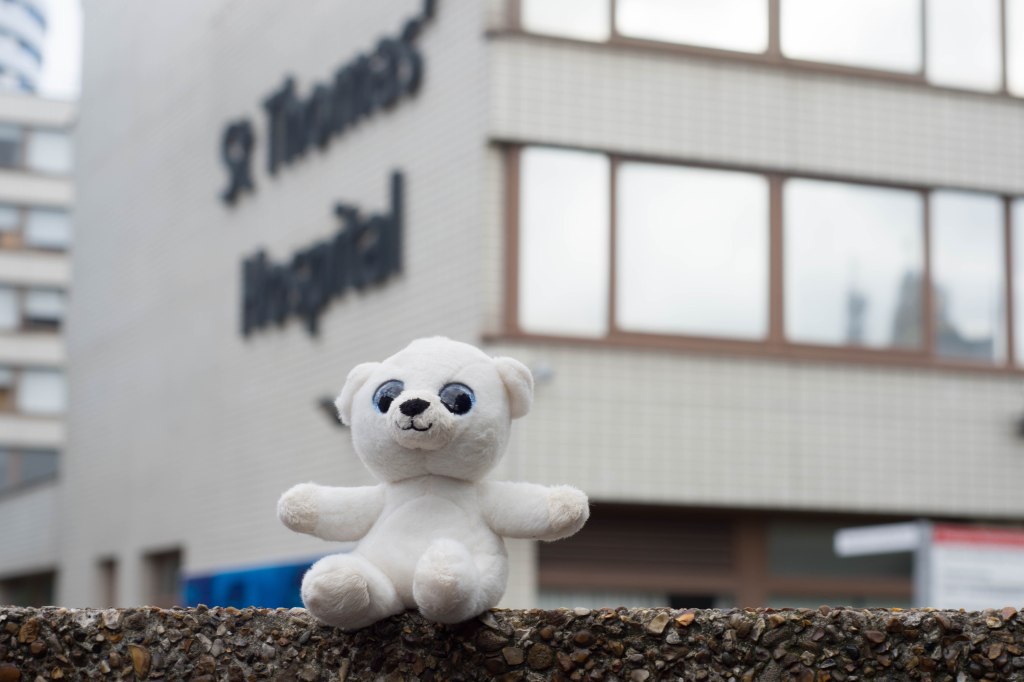
A simple image of a teddy bear on a wall. Nothing to distract the viewer. Looking at the image I find that there is a sense of sadness and loneliness exuded by the bear, as if it has been abandoned or lost by its owner. This image could have been taken anywhere in the world. With no external references it could symbolise all lost bears around the world, waiting for their owners to return.

Snowy at St Thomas’ Hospital
Snowy travels lots of places with me.
In 2017 we were in London, the last time we would go there with Rhys before his death. In 2018 we would return to London when I took part in the London Marathon. During a previous weekend in London while I was taking part in the marathon, Rhys had been taken ill on the Saturday evening. We had ended up in St Thomas’ Hospital where he ended up being kept in for a few days because of an infection. Not the best pre-race preparation. On the Sunday as I was running and reached Big Ben, there was Rhys waving at me from the crowd. The hospital had let him out for a few hours so he could cheer me on. The emotions that choked me as I turned away from him and headed towards Buckingham Palace and the finish in The Mall, gave me the incentive I needed to push on to the end.

One quote from Miho Kajioka struck me profoundly.

Reporting about the tsunami and the Fukushima nuclear disaster in 2011, these experiences changed and reinforced my view of life,” she says. “I thought how tomorrow might never come, how life can end suddenly, and I realised that this was the time to return to art.

Miho Kajioka’s Lightness of Being by Michael Grieve at 1854 Photography (https://www.1854.photography/2020/11/miho-kajiokas-lightness-of-being/)

When I think about my photography over the last five years one of the themes that has run through it is that it has focused on loss, whether that is people or the world around us, the world that we have been carelessly throwing away by polluting it with our waste. The disasters that Kajioka reported on affected a small percentage of people out of the global population, but since the end of 2019, many more people have been affected by the sudden loss of loved ones, almost three million people have found tomorrow never came and life ended suddenly.

Photography does not have to be complicated, as artists and image makers we do not always have to do things the hard way. There is beauty to be found in even the simplest of things. Occasionally we need to step back from the technology, and just go old school, we need to become like children and delight in the world around us, capturing images just for the joy of it. When we give children toy cameras and even their first real cameras, we do not expect them to go around taking images while thinking about composition, light, the Rule of Thirds, the Golden Hour. We do not expect much from them, other than that they have fun and if they take a picture, it’s because something caught their attention that they thought worth taking a picture of.

Daido Moriyama

FOLLOW ME (2019) explores Daido Moriyama’s photography as the author Takeshi Nakamoto journeys around parts of Japan with the photographer. Place covered include Sunamachi, Tsukudajima, Ginza and Haneda Airport, as well as a road trip. In addition to the photographs, the book contains Moriyama’s thoughts on his photography, and tips for people who want to take photographs.

One thing I would recommend your readers do is take shots, lots of shots, of any regular journey they make in their everyday lives… Apart from being great training for taking snapshots, it’s a way for them to understand how their own powers of observation affect what they see, even with the most ordinary things. Taking shots over and over again of the same shopping street will do more than teach them how to take snapshots it will help them become better photographers all round.

Daido Moriyama, How I take Photographs, page 24.

Of all the things in the book, the one thing that leaped out at me was this piece of advice. When Moriyama started out, he used film cameras and would go through lots of rolls during a session. After a long time, he eventually moved to digital.

Reading about how he goes about taking his photographs was interesting. Moriyama will take photographs of something and then move on but may then return to photograph it from a different angle a few moments later because he has seen something different about it. The idea of doing that with film is not one that I think is really feasible for me to do, not unless I was developing and printing the images myself. However, doing this with a digital camera is a completely different thing. In fact, it is something that we, as photographers, should do. Not just look at something from one angle but from multiple angles in case we miss something that we later regret.

Vivian Maier

Vivian Maier was a prolific photographer who while working as a nanny took over 100 thousand photographs. It was only after her death and by a stroke of good fortune that boxes of her work were discovered, and her work came to be known by the wider world.

Maier was in some ways like Diane Arbus, a street photographer, but where Arbus was interested in the unusual, Maier was more interested in the everyday.

Westerbeck, C. and Maier, V. (eds.) (2018) have compiled a collection of Maier’s colour photographs that illustrate how much of a student of human expression and how a quick eye can help you to capture those elusive movements. In addition to Maier’s photographs of other people, she produced many images which included her reflection.

To have taken as many photographs as she did, and still be unknown on her death, she must have honed the ability to blend into the background and not be noticed to incredible levels.

Maier shows us that we should carry a camera with us wherever we go and look for opportunities to capture the everyday but also to study the people around us because they can be the source of interesting images.

Several years ago, I was walking through Bristol’s Broadmead shopping area. I was pushing my son in a wheelchair. As we reached the bottom of the hill leading down from the castle I glanced across the road and could see a cyclist helping a homeless chap who was lying on the ground. It was a perfect image, but my camera was out of reach and my hands were full with the wheelchair so I wasn’t able to stop and take a photograph. Something I regret.

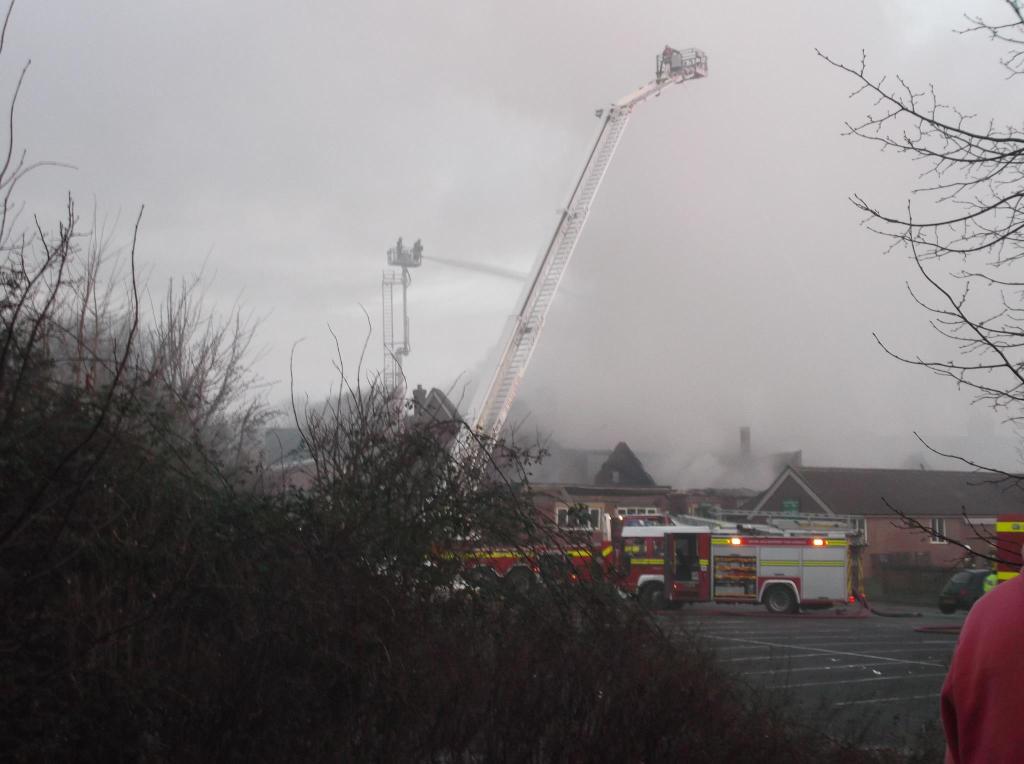
Since then, I have always had either my DSLR, my phone or a compact digital camera on me for those times when I might need to take a photograph of something. Like this one, taken while going out for a bike ride.

Hungry Horse Pub Fire – January 2013

References

  1. Ane Hjort Guttu (s.d.) At: https://www.southlondongallery.org/exhibitions/ane-hjort-guttu/ (Accessed 21/03/2021a).
  2. Ane Hjort Guttu (s.d.) At: https://groundwork.art/artists/ane-hjort-guttu/ (Accessed 21/03/2021b).
  3. Ane Hjort Guttu and Sveinung R. UnnelandGhost In The Machine – Announcements – Art & Education (s.d.) At: https://www.artandeducation.net/announcements/367042/ane-hjort-guttu-and-sveinung-r-unnelandghost-in-the-machine (Accessed 21/03/2021).
  4. DAIDO MORIYAMA, FOLLOW ME: how i take photographs. (2019) Place of publication not identified: LAURENCE KING Publishing.
  5. Exposure: Photographer Michelle Groskopf (2019) At: https://www.creativereview.co.uk/photographer-michelle-groskopf/ (Accessed 21/03/2021).
  6. FM, R. (s.d.) Studio Visit – 12th June 2016 Ane Hjort Guttu. At: https://www.mixcloud.com/Resonance/studio-visit-12jun2016-ane-hjort-guttu_studio-visit/?play=fb (Accessed 04/04/2021).
  7. Grieve, M. (2020) Miho Kajioka’s Lightness of Being. At: https://www.1854.photography/2020/11/miho-kajiokas-lightness-of-being/ (Accessed 21/03/2021).
  8. LensCulture, M. K. | (s.d.) as it is – Photographs and text by Miho Kajioka. At: https://www.lensculture.com/articles/miho-kajioka-as-it-is (Accessed 21/03/2021).
  9. Michelle Groskopf (2016) At: https://www.luciefoundation.org/bio/michelle-groskopf/ (Accessed 21/03/2021).
  10. Michelle Groskopf — the candid frame podcast (2016) At: https://www.ibarionex.net/thecandidframe/tag/Michelle+Groskopf (Accessed 21/03/2021).
  11. Michelle Groskopf Photography (s.d.) At: https://mgroskopf.com (Accessed 21/03/2021).
  12. Miho Kajioka – Overview (s.d.) At: https://ibashogallery.com/artists/29-miho-kajioka/overview/ (Accessed 21/03/2021).
  13. Photography, T. C. F. C. on (s.d.) TCF Ep. 312 – Michelle Groskopf – The Candid Frame: Conversations on Photography – Podcast. At: https://podtail.com/en/podcast/the-candid-frame-a-photography-podcast/tcf-ep-312-michelle-groskopf/ (Accessed 21/03/2021).
  14. The Candid Frame #312 – Michelle Groskopf (s.d.) At: https://www.ibarionex.net/thecandidframe/2016/2/29/the-candid-frame-312-michelle-groskopf (Accessed 21/03/2021).
  15. Westerbeck, C. and Maier, V. (eds.) (2018) Vivian Maier: the color work. New York, NY: Harper Design, an imprint of HarperCollins Publishers.
  16. Michelle Groskopf Is An Out And Proud Queer Street Photographer: Lady Shooters (s.d.) At: https://bust.com/arts/18663-michelle-groskopf-is-an-out-and-proud-queer-street-photographer-lady-shooters.html (Accessed 25/04/2021).
  17. Morlais Castle (2019) In: Wikipedia. At: https://en.wikipedia.org/w/index.php?title=Morlais_Castle&oldid=882728669 (Accessed 25/04/2021).

Photography is Simple

Brief

Take a series of 10 photographs of any subject exploring the theme ‘Photography is Simple’. Each photograph should be a unique view; in other words, it should contain some new information, rather than repeat the information of the previous image.

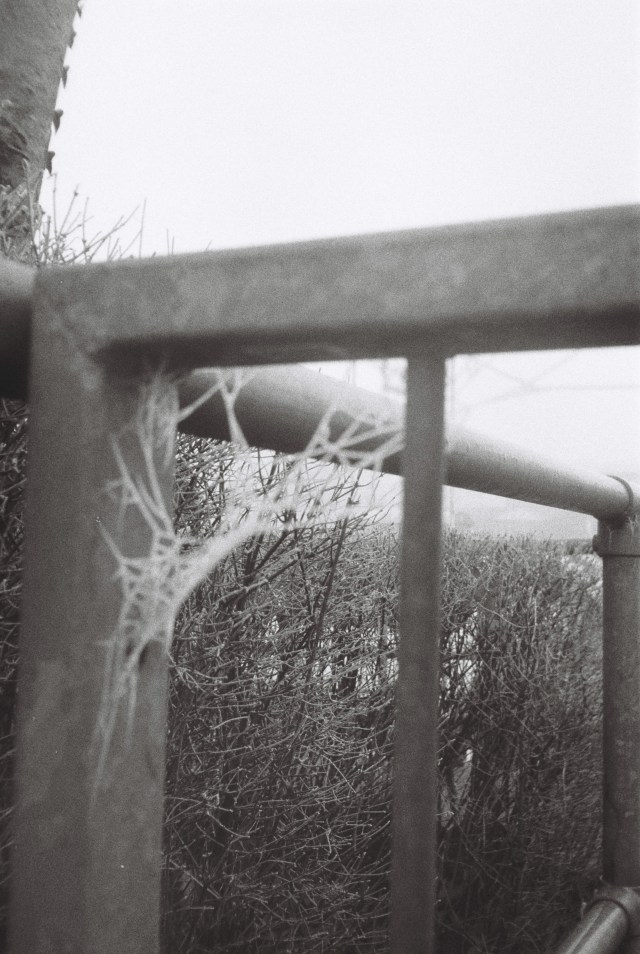
1 – Spider web
2 – Spider web in winter
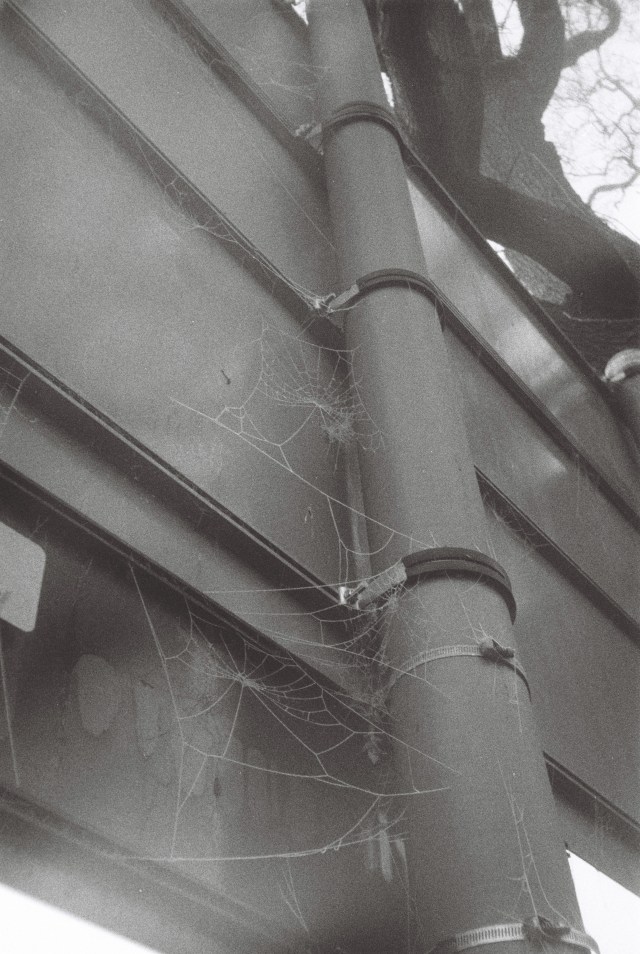
3 – Back of sign post
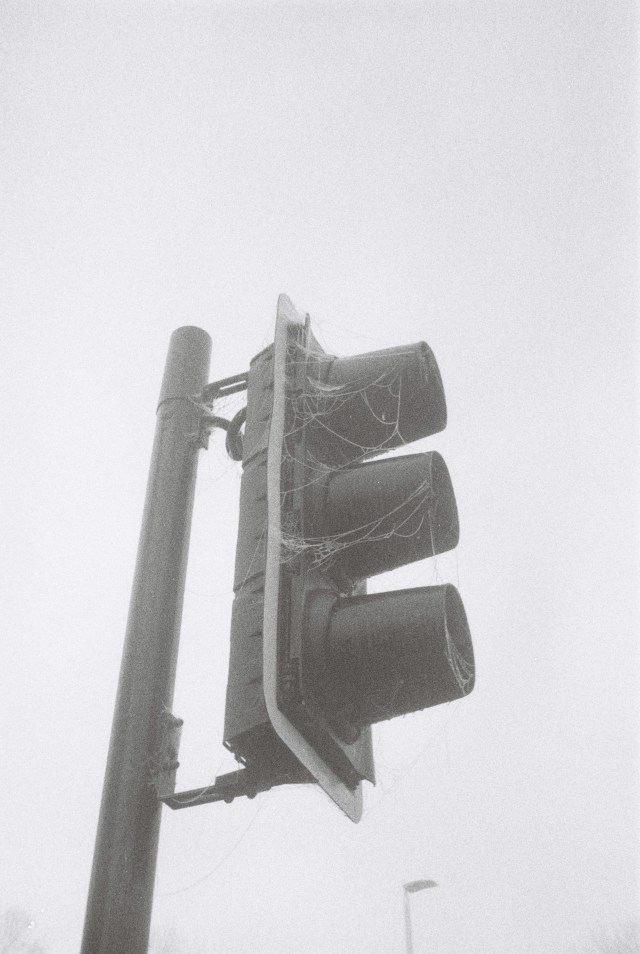
4 – Traffic light
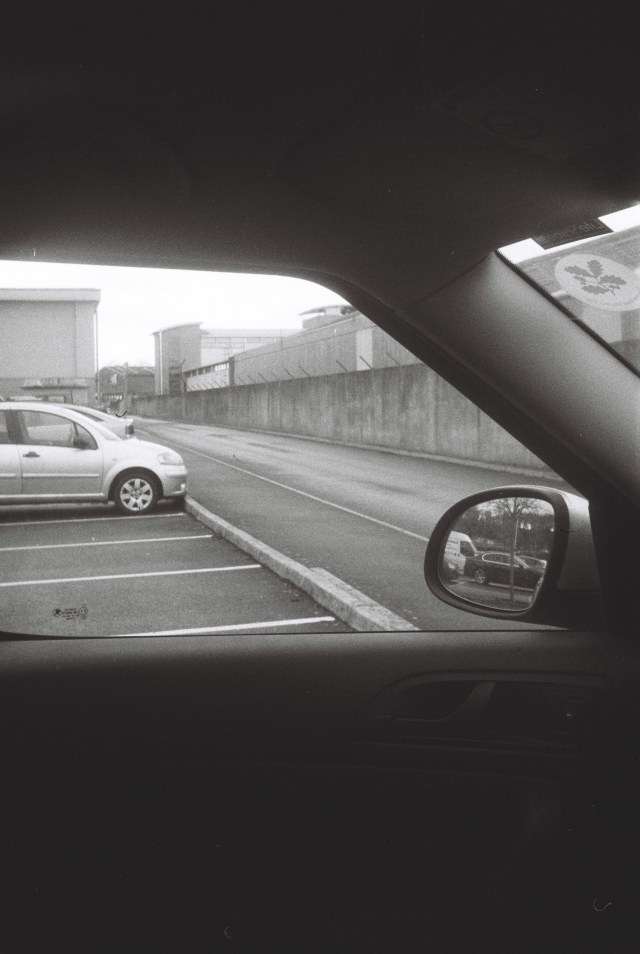
5 – Westlands
6 – Reflecting on home
7 – A multi-level image
8 – Somewhere to rest
9 – In Loving Memory
10 – Squirrel

Notes

This assignment took me back to my youth, before the days of digitial cameras. Although I have, occasionally, used film cameras in recent years, the time that I was doing that most regularly was when I was doing an evening class in black and white photography. The advantage to using film during that course was that I was developing my own film and so could work out which images I wanted to print.

During this assignment I didn’t have access to a darkroom and so when it came time to send off the film for processing I didn’t know what I was going to get back, if I was going to get anything back at all. Of the 38 photographs I took, 33 of them came out with something that the company I sent them to were able to print out.

Of those 33 images, a number of them I was able to rule out using because they were uninteresting or too blurred to be worthwhile using. Still, opening the envelope with the developed film and prints was exciting because I didn’t know just how many photographs would be in there.

Using a basic camera for this activity meant that I didn’t have to worry about the settings I was using. The film speed was defined by the 35mm black and white film I had available. All I had to worry about was finding things to photograph.

So how well do I think I fulfilled the brief.

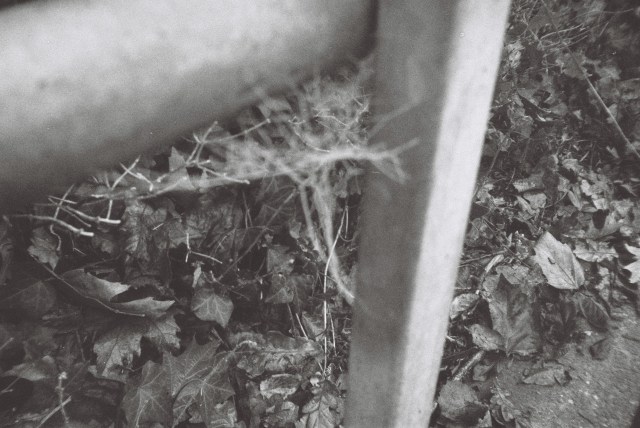
The first set of four images have a theme running through them, spider webs. Why I feel that these fit the brief is because they do build on each other. In image 1, there is vegetation but it is not clear at what of time of year the photograph was taken. In image 2 you get more information because you can see that bushes in the background don’t have leaves, which implies it is autumn or winter. In image 3 you begin to see that spiders will spin webs whereever they can, including the back of road signs. How many times do we look at the back of road signs? As drivers, not very often, and certainly not close up like this. Only when you are on foot can you get this close. The same with image 4, spiders get everywhere.

The reason I took these photographs is because I spotted spider webs on one of the other traffic lights on the roundabout where image 4 was taken. Having noticed them they would be a good subject for photographing. It was only when I got there that I found all the other places where there were webs. If it hadn’t been winter and the cold was making them stand out I wouldn’t have even noticed them.

In image 5 I was waiting for my partner to finish work, and bored I got out my camera and took some photographs of the exit road from her workplace. I wasn’t expecting anything exciting from this photograph but when I saw it I noticed that I’d caught the cars behind me in the wing mirror. Unintentional but something that adds another element to the photo and draws the eye.

In image 6 I was taking a photograph towards my house. Seeing the photo I noticed that I’d caught the reflection of the houses in the side window. Again, this was unintentional, but I think gives an added dimension to the image because what was out of the shot, has been drawn into the image.

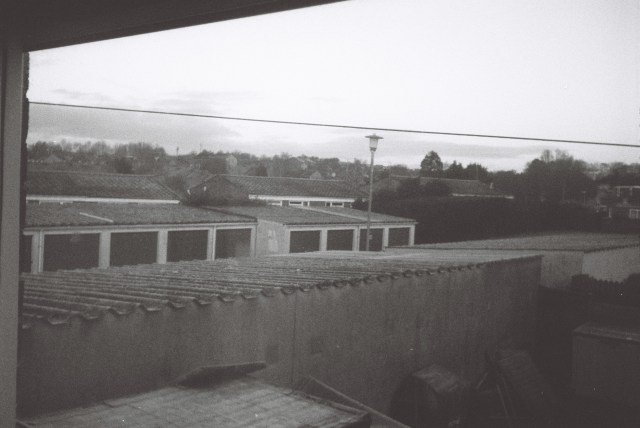
Image 7 was a simple shot out of a bedroom window. What drew me to this is that it has elements that are clearly in the foreground, mid and background, and so has depth. It shows that you don’t have to go very far to find a view that will highlight the different depths that can be within an image.

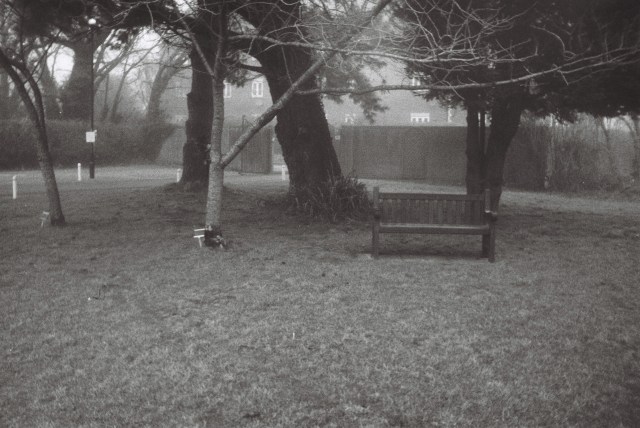
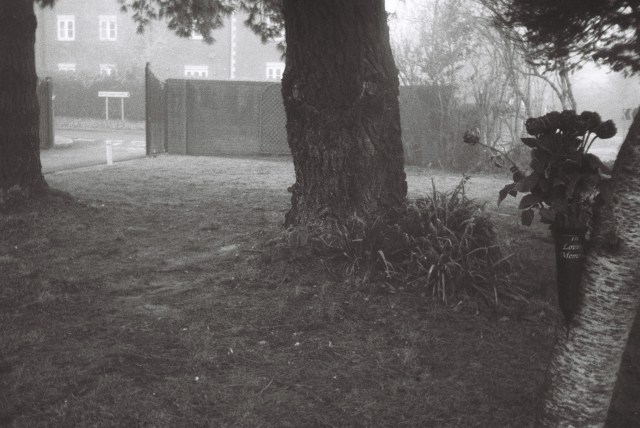
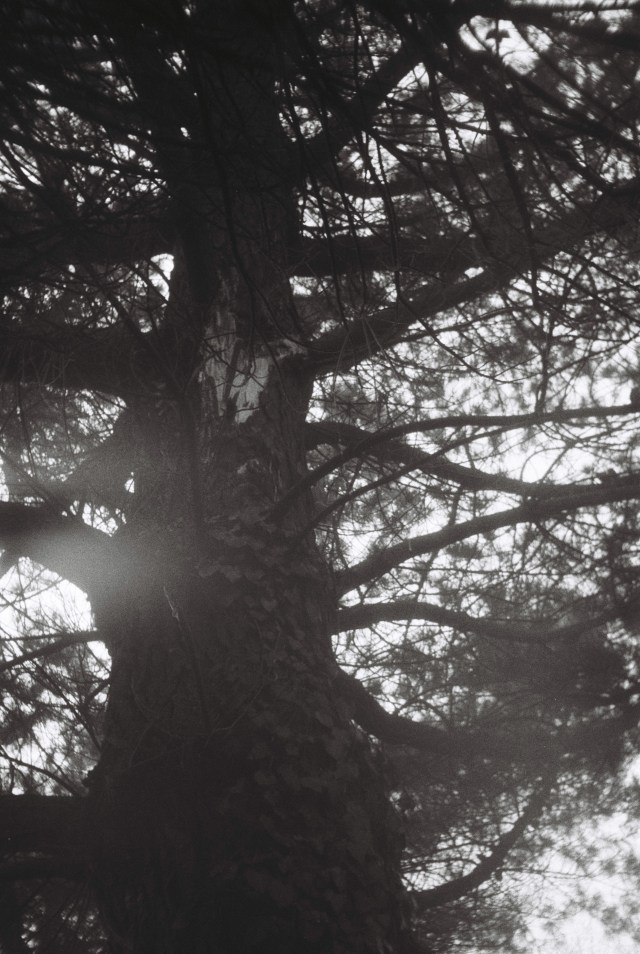
In the last 3 images I was at the crematorium when a squirrel appeared. I took a number of photographs trying to capture it but it always moved out of the way just at the moment I released the shutter. Even though it is the same tree I think each of the photographs adds new information. In image 8, you could be anywhere, even a park. In image 9, you see the In Loving Memory pot on the tree and it can no longer be a park because you don’t normally see pots like that attached to trees. The final image is a close up of the tree, and you can seee the bark on it and get an idea of the texture of the bark. If you look really hard you can just about make out the squirrel in the branches.

Going back to basics was refreshing. It showed me that it doesn’t take the latest gear to take a photograph. You don’t need to go looking for the perfect vista, or spend ages posing someone or arranging something. Photograph is simple. All you need is a pair of eyes, the willingness to use them and to pay attention to your surroundings because there is always something to photograph.

One of the things that I wanted to do with this assignment was not to go out with an idea of what I wanted to photograph. I didn’t want to go out with the plan of capturing a series of images that would build on each other but could still be linked by a theme, for instance going for a walk in the countryside. I delbierately set out with the idea of carrying my camera with me everywhere and taking a snap whenever I saw something that drew my attention. I think with the photographs that I took I achieved that.

There were somethings that I tried to take photographs of, which didn’t work out because of the limitations imposed by the camera. If I’d had a lens that would have allowed me to get closer shots of some objects then I would have had more variety when it came to what I had to chose from.

Also I would have liked to have had more time to take a larger number of photographs, because again it would have given me more variety to chose from.

The other reason that I believe I’ve fulfilled the brief is because by chosing to use film rather than digital, and then finding myself in lockdown because of the pandemic, I wasn’t able to make use of places like Boots, camera shops or supermarkets, in order to get my film processed. Instead I had to find somewhere online where I could send my film to be developed. In the same way as when Kodak first introduced their cameras for people to take photographs with and used the slogan “You Press the Button, We Do the Rest”, I found myself in the same position as those early photographers, taking pictures of their families and travels and then sending of their precious images to someone else to make decisions about how they should be developed and printed.

Exercise 5.1: The distance between us

Brief

Use you camera as a measuring device. This doesn’t refer to the distance scale on the focus ring. Rather, find a subject that you have an empathy with and take a sequence of shots to ‘explore the distance between you’. Add the sequence to your learning log, indicating which is your ‘select’ – your best shot.

When you review the set to decide upon a ‘select’, don’t evaluate the shots just according to the idea you had when you took the photographs; instead evaluate it by what you discover within the frame (you’ve already done this in Exercise 1.4). In other words, be open to the unexpected. In conversation with the author, the photographer Alexia Clorinda expressed this idea in the following way:

Look critically at the work you did by including what you didn’t mean to do. Include the mistake, or your unconscious, or whatever you want to call it, and analyse it not from the point of view of your intention but because it is there.

Exemplars:

Andrea Schwickart: https://eyvlog.wordpress.com/2017/08/21/the-distance-between-us-exercise-5-1

Morris Gallagher: https://morrisgdotorg.wordpress.com/exercises/exercise-5-viewpoint/exercise-5-1-viewpoint-explore-the-distance-between-you/ This link is to a protected blog.

Darryl Godfrey: https://darrylgodfrey.wordpress.com/category/coursework/part-5-viewpoint/

This has been an interesting exercise to work through.

My initial thoughts around the exercise were to do something based on my relationship with the church. I started attending church and became a Christian when I was a teenager. Over the years I’ve stopped attending church other than for weddings and funerals, have started attending church regularly again, got involved with the Parish Church Council, taught Sunday school, but then as a result of my transition found myself becoming distance from the church. The final thing that affected my relationship were a series of events around my son becoming ill that challenged my faith to its limits. As much as I still have a faith and belief in God, I have found that I struggle with the Christianity and the Christian faith when it comes to the buildings where it can be found.

To make the images below into something coherent, the captions of each are very important. They lend context to the images and help to tell a story.

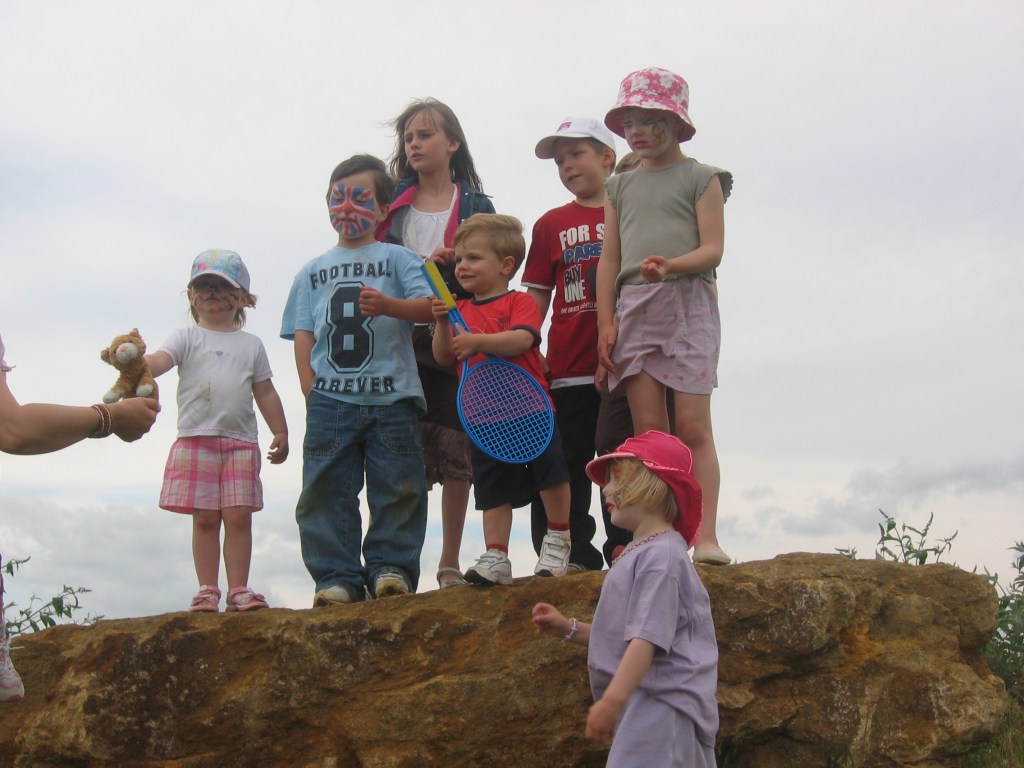
1. For a while I taught Sunday School to some of the most wonderful children. Our church used to get together for scoial events like picnics. My son Rhys is at the back in the white baseball cap and red tee-shirt. When he was older he helped out with the Sunday School.
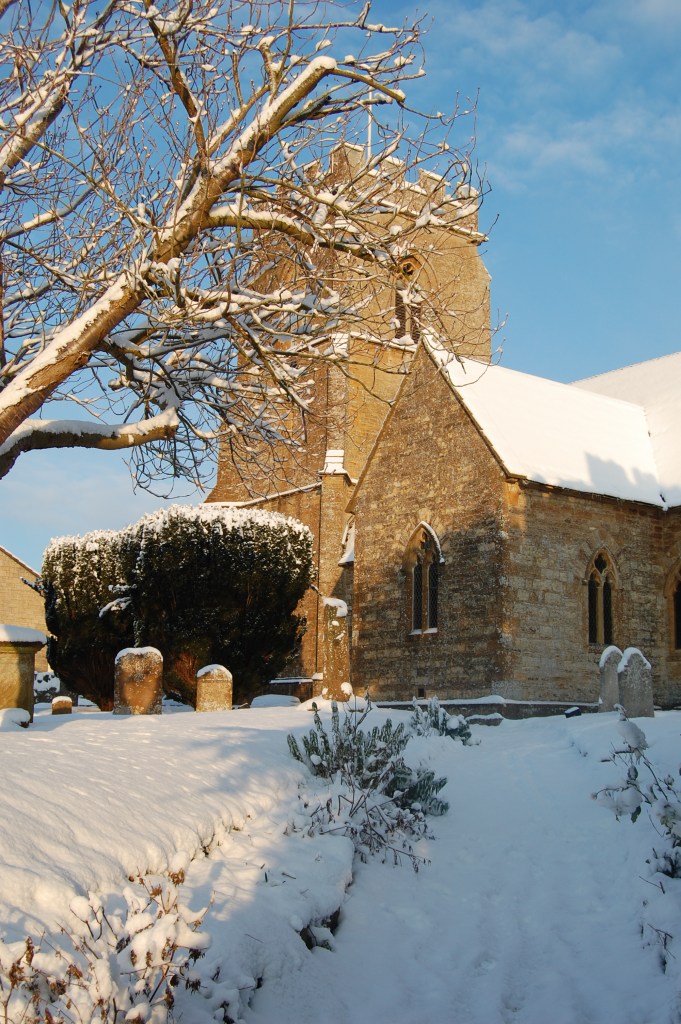
2. In 2008, Yeovil had the worst snow storm we’d experienced. The only way to get to work was to walk. On my way I stopped off and took a series of photos of the church.
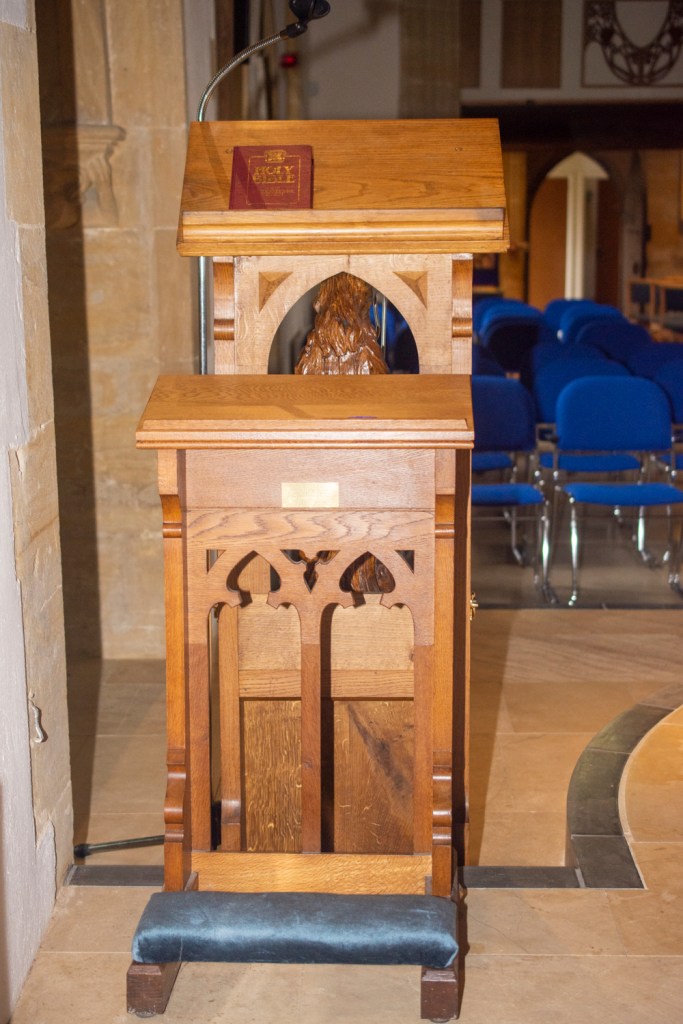
3. Although this photo was taken in October 2017, on the 27th September I was stood at this lecturn in front of a packed church reading the poem “A Child Loaned” at Rhys’s funeral.

“I’ll lend you for a while a child of mine,” He said.
“For you to love the while he lives and mourn for when he’s dead.
It may be six or seven years, or twenty-two or three,
But will you, till I call him back, take care of him for me?
He’ll bring his charms to gladden you, and should his stay be brief,
You’ll have his lovely memories as solace for your grief.”

“I cannot promise he will stay; since all from earth return,
But there are lessons taught down there I want this child to learn.
I’ve looked the wide world over in My search for teachers true
And from the throngs that crowd life’s lanes I have chosen you.
Now will you give him all your love, not think the labor vain,
Nor hate Me when I come to call to take him back again?”

“I fancied that I heard them say, “Dear Lord, Thy will be done!
For all the joy Thy child shall bring, the risk of grief we run.
We’ll shelter him with tenderness, we’ll love him while we may,
And for the happiness we’ve known, forever grateful stay;
But should the angels call for him much sooner than we’ve planned,
We’ll brave the bitter grief that comes and try to understand!”

By Edgar Guest
4. My relationship with the church changed after the funeral.
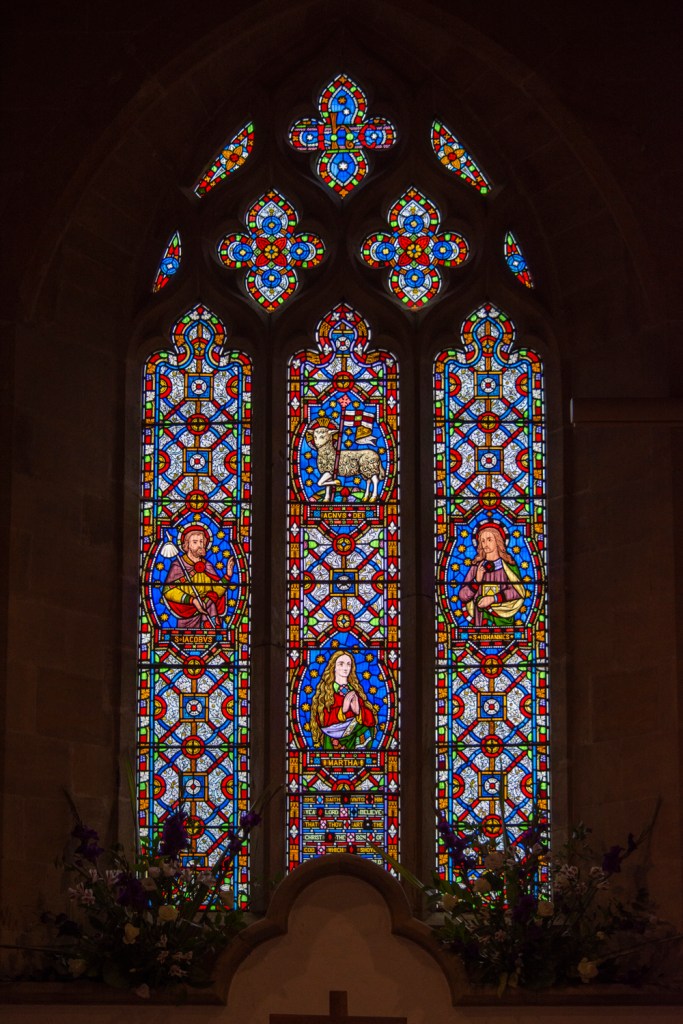
One day in October 2017 I spent a number of hours alone in the church taking photographs of everything I could. Stained glass windows, the bosses in the roof, the pulpit, the lecturn, carvings and plaques. I gave the church a copy of everything, to do with as they wanted.
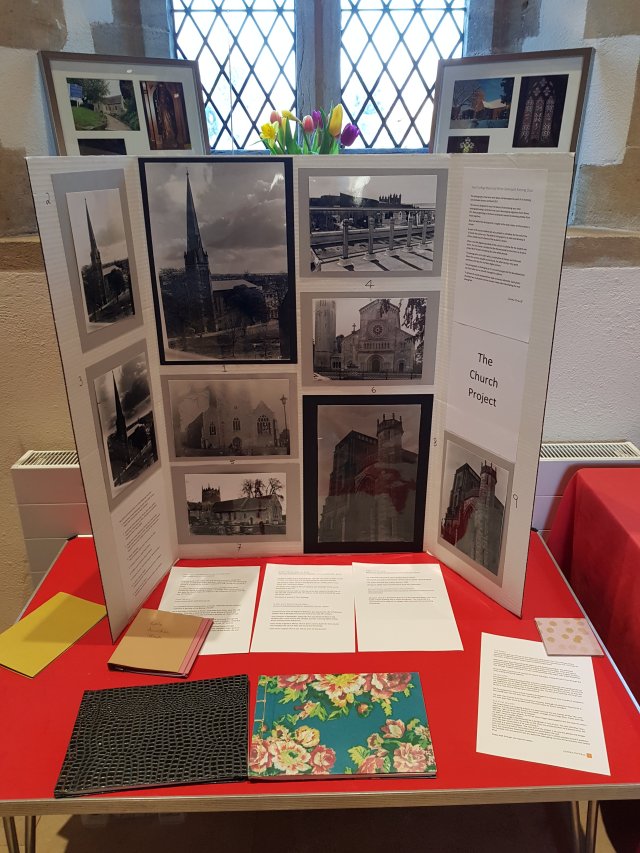
5. In February 2018 I took part in an arts, hobbies and crafts exhibition at the church. For my display I included a couple of framed pictures with some of my photographs of the church, some copies of books I’d made at a Foundations in Photography bookbinding workshop and two mocked up copies of the photobook I was developing telling the story of Rhys’ last months. I also included 35mm photographs I’d taken and developed as part of a project on churches that I was working on.

This was to be one of the last times I set foot in the church. The last time was to spend some time alone praying to God and hoping that one of my friends from the church would just happen to be passing by. Alas that wasn’t to be the case.
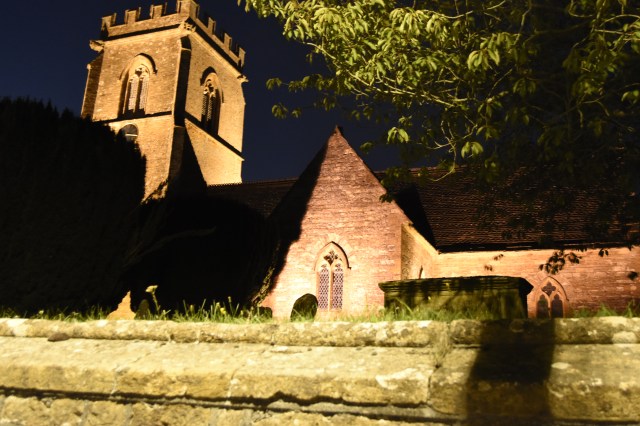
6. Since then, this is the closest I’ve been to the church, with no intention of stepping inside. To me, the building is just someplace to take photos of. Where once it felt like home and it’s people; family, now it feels nothing like that.

The combination of words and photographs are designed to tell a particular story, one of growing to belong someplace but eventually to lose that sense of belonging. Each of the images, if taken standalone allow the viewer to interpret them in any way that they see fit, but when combined with the words I hope that the viewer will find a deeper meaning behind to the images.

Analysing the images

The following bullets relate to each of the images above.

  1. I think the main thing that I wouldn’t have included in this image if I’d noticed is the figure and arm reaching into the scene on the left hand side. I would have waited a fraction longer until they’d moved out of shot. Similarly with the disembodied foot. Looking at the image with regards to what is there, the sky seems just one colour until you notice the clouds just hovering above the rock that the children are standing on.
  2. In the second image, the building at the left of the shot could have been removed by a slight changed of position. Cropping the image would remove it but that would result in the lower branches on the tree no longer coming together. The thing that I’ve noticed with the image that I hadn’t picked up on properly was the tracks in the snow on the left hand side of the image. The tracks going up the path were obvious and showed that someone had walked up to the church that way. The tracks in the snow give a clue to the kind of wildlife that had been there before me.
  3. The thing I notice about this image when looking at it are the things that would have escaped my notice not just when taking the image, but also when in the church normally. The hook-like object on the wall, the signs of wear and tear on the lecturn and the footstool. This is a place that has been used, for centuries in fact, and is still capable of showing you more if you take the time to really look.
  4. This was a really hard photograph to capture. Stain glass windows are beautiful things but trying to get the detail of the window while still having some of the detail of the area surrounding it was a challenge. I had to carefully adjust the image in Photoshop to get it like this.
  5. Looking at this image, the one thing that leaps out at me is the book that is just dropping out of the shot on the left. This is annoying as I took a lot of care with positioning everything in the display.
  6. The one thing I’ve noticed looking at this image is the way that the windows to the right of the grave monument, look like two people. Something that was completely unintentional.

Research Point: Photographs and Context

The following is the result of reading the following by Terry Barrett and some of the points raised: –

‘Photographs and Context’: terrybarrettosu.com/wp-content/uploads/2017/08/B_PhotAndCont_97.pdf

How a photograph is interpreted can easily be different to what the photographer intended. Especially if the photographer is not involved in how their image is used.

When a person gives consent for their image to be used that does not mean that it can be used however, we want to use it. Images should not be used in a way that implies something negative about a person without that person giving their permission. The use of stock photos is an area where a photographer should think carefully about how their image may be used in the future.

Where a photograph is published can add weight to an image. Something that is published in a publication like the Daily Inquirer or the Daily (Sunday) Sport might not be given a lot of credence, but an image published in The Times or some other respected publication could give an image a lot more creditability. For example, Doisneau’s image if published in a tabloid paper might be dismissed as just another case of the paper trying to make something from nothing, whereas if it were used in a reputable publication would be treated a lot more seriously.

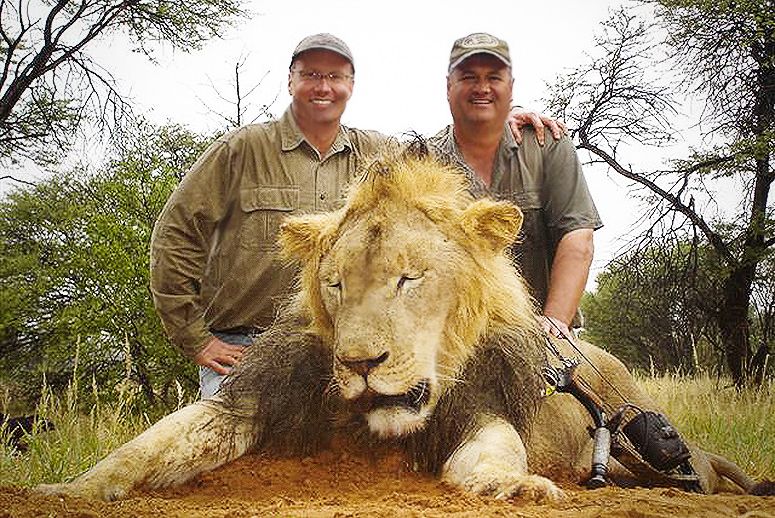
Such images have appeared on social which cause uproar. For instance, images of several hunters posing next to slaughtered animals have resulted in a backlash against the person in the photograph.

The American dentist that was shown posing with the dead body of Cecil the Lion caused a media storm when it came to light.

Cecil the Lion

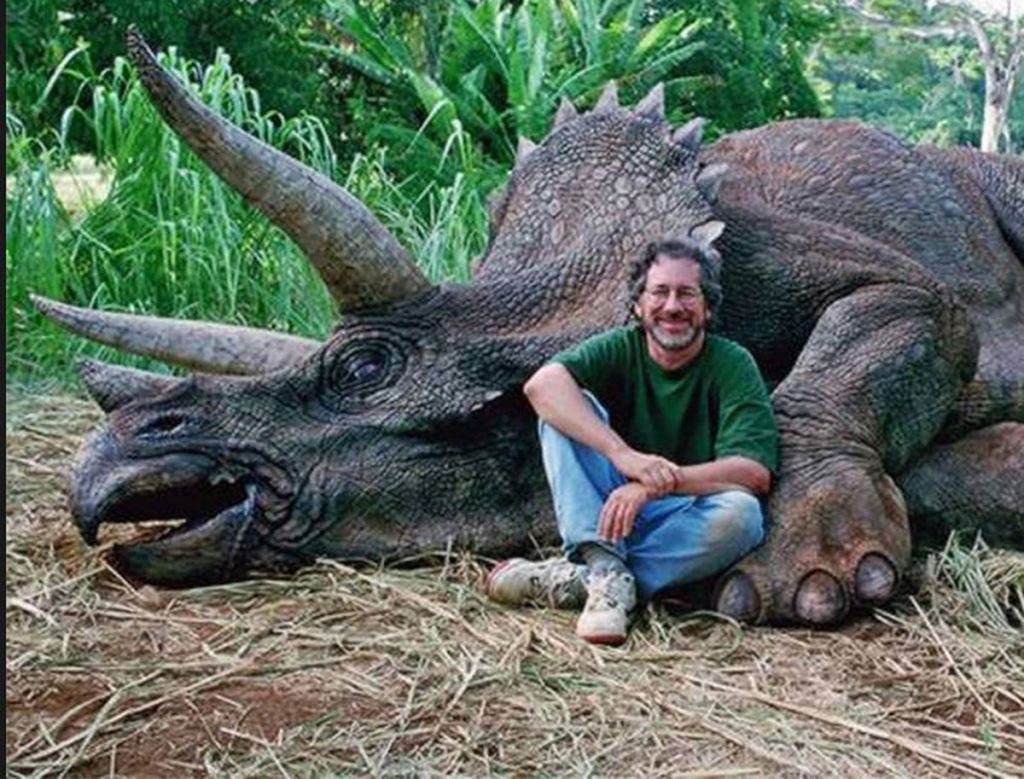
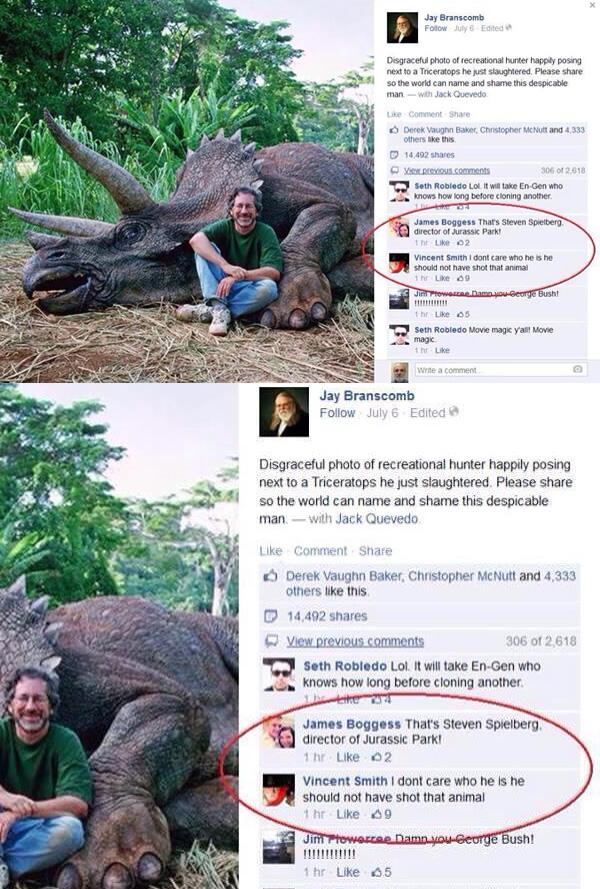
The image of Steven Spielberg posing with a dead Triceratops also caused a storm on social media with people commenting that he should never have killed the animal.

Steven Spielberg and dead Triceratops

Of the two images, one rightly resulted in anger and dismay that someone could take pride in killing another living thing for sport. The other demonstrates that some people will take an image at face value and get upset, without taking the time to think about what they are presented with. It also shows that context is important. An image such as Spielberg’s would not have seemed out of place in one of the Jurassic Park films, but when presented as a simple image suddenly takes on a different, more unacceptable meaning, especially if you don’t have a sense of humour or lack the knowledge that dinosaurs died out 65 million years ago, and Jurassic Park isn’t a documentary but a movie.

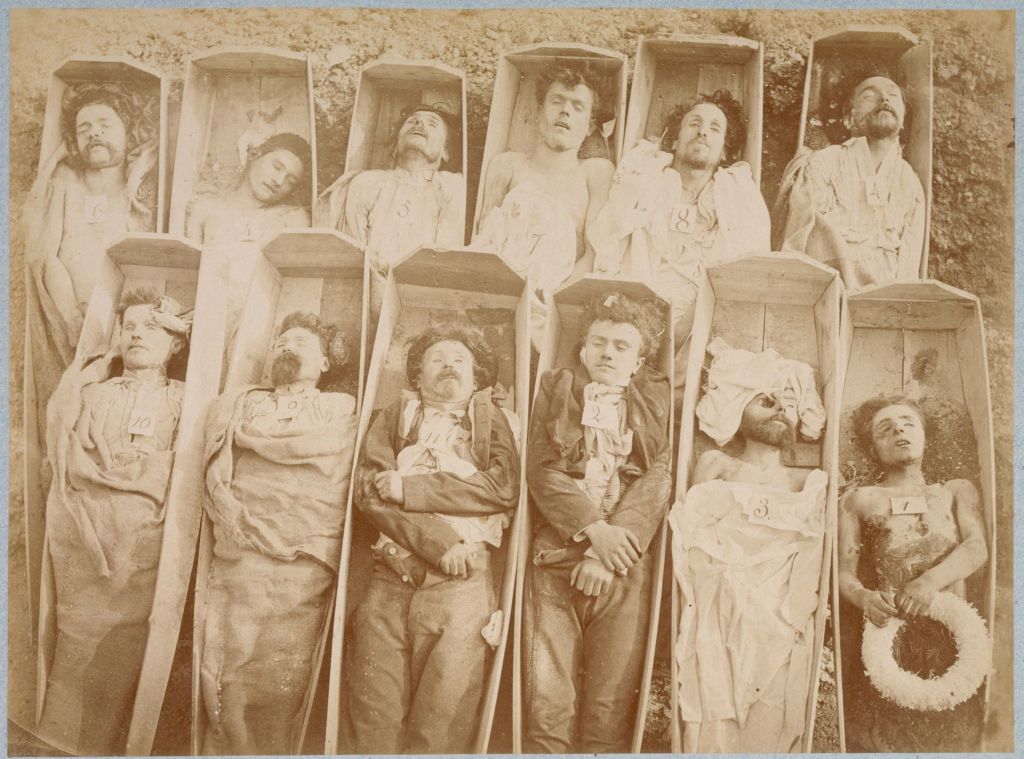
Morts de la Commune, 1871. Photographie d’André Adolphe Eugène Disderi (1819-1889). Paris, musée Carnavalet.

The way we see photographs changes over time. Images that were captured in the early days of photography, such as Dead Communards, 1871, would have had a been a way of providing a record of the death of enemies of the State and a way to make a political statement. Now over a century later, images like this help us to understand the history of photography by highlighting some of its uses.

Images like this, when viewed at the time, would have had a personal impact on some of those that saw them. Here were men who would have been someone’s son, brother, father, husband. Seeing them like this must have been traumatic, especially if, as may have been the case, you did not know that a loved one had been killed but hoped that they had escaped and may one day return. For descendants of these people, seeing the image of someone that they may have been told about by family members because their stories had been passed down the generations, seeing the images in books where some stranger dissects them as a means of discussing a period in photography must be a strange experience.

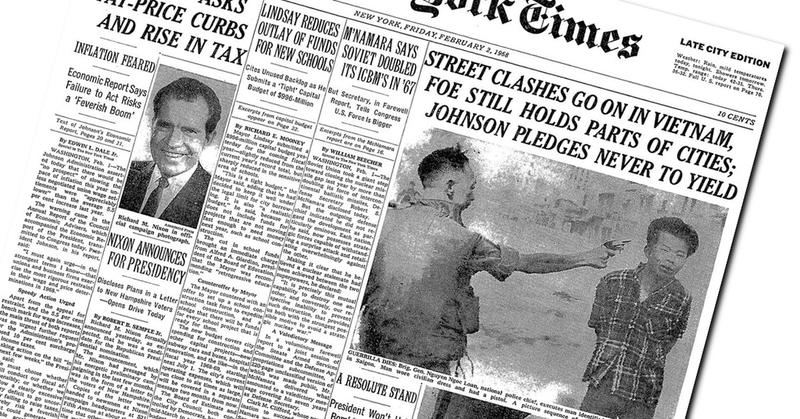
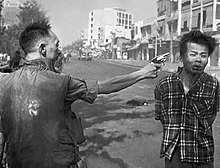
How a photograph is presented, can change depending on how what else we add to it. The photograph by Eddie Adams of Nguyễn Văn Lém being executed when published in a Western newspaper, was one of the triggers for the anti-war movement, but what if the wording around the story had been different, or even in a country with a completely different regime.

Our patriotic soldiers act in our best interests by dealing out justice to our enemies.
In this time of conflict, looking after and providing for those who would harm us is detrimental to our own people.

Such an image could be used to provide support for the actions of a regime. Such a statement might seem far-fetched, but there are people who make statements about those who are on Death Row or serving life sentences in prison for capital crimes. Why should we look after these people and allow them to live when their victims do not have that option?

How we view photographs is complex. It is not just a case of viewing the image but also a case of looking at it in context. An image that might seem perfectly normal in from the viewpoint of today’s society, may when put in the context of its time and place, show something that society frowned upon, and vice versa.

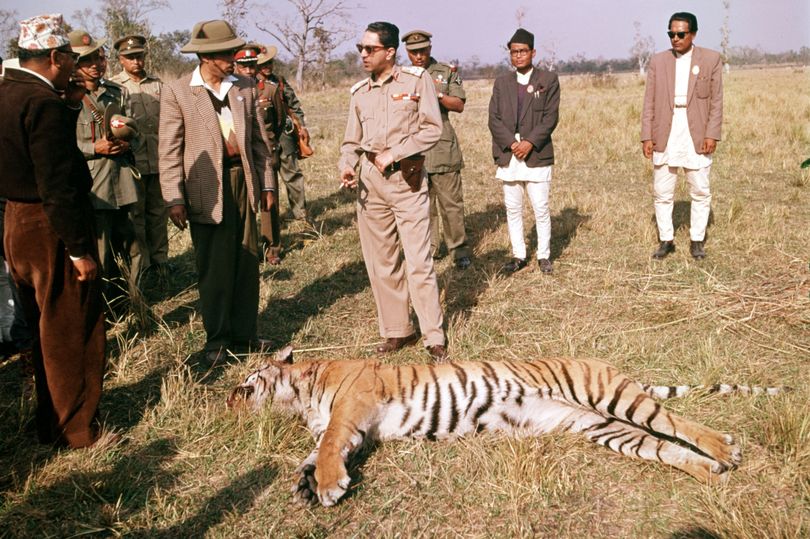
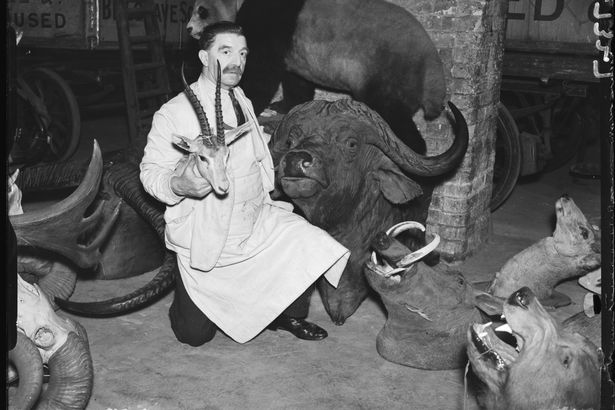
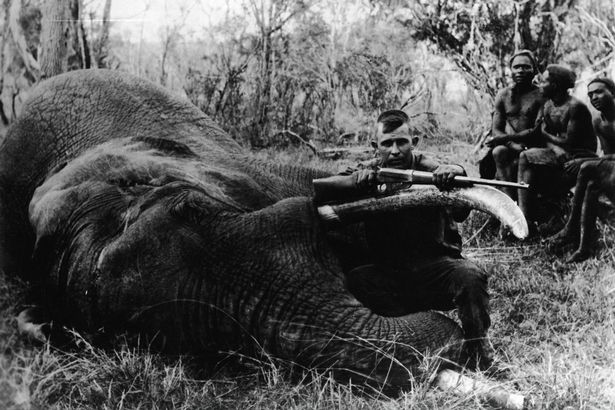
Here we return to the image of hunters with their trophies. Images as below, when put in the context of their time would not have raised an eyebrow and been acceptable to a lot of people, but if these images were from the present day would be far from that.

Images taken from the Irish Mirror 29th July 2015 (https://www.irishmirror.ie/news/cecil-lion-shocking-pictures-reveal-6158818)

Queen’s role: In a 1961 Royal Tour to Nepal Queen Elizabeth II attended a tiger hunt (Image: Getty)
Royal touch: Man with hunting ‘trophies’ taken by Roper for the Daily Herald newspaper on January 6, 1938 – they include a red-fronted gazelle and an African buffalo, both shot on safari by King George VI, an avid hunstsman (Image: Getty)
Collector’s burden: American big game hunter Henry A Snow holds a Winchester M1895 rifle and squats by the mouthparts of an African savannah elephant. Snow collected over 150 mammals and 1,500 birds (Image: Getty)

Images like these, which would have been mementos at the time, are more historical now, and a record of mankind’s, not so dim and distant, past. A past that we continue to see differently as we evolve as a species and become more ethical and understanding of the world around us and out place within it.

Exercise 5.2: Homage

Brief

Select an image my any photographer of your choice and take a photograph in response to it. You can respond in any way you like to the whole image or to just a part of it, but you must make explicit in your notes what it is you’re responding to. Is it a stylistic device such as John Davies’ high viewpoint, or Chris Steele Perkins’ juxtapositions? Is it an idea such as the decisive moment? Is it an approach, such as intention – creating a fully authored image rather than discovering the world through the viewfinder?

Add the original photograph together with your response to your learning log. Which of the three types of information discussed by Barrett provides the context in this case? Take your time over writing your response because you’ll submit the relvant part of your learning log as part of Assignment Five.

A photograph inspired by another is called ‘homage’ (pronounced the French or English way). This is not the same as Picasso’s famous statement that ‘good artists borrow, great artists steal’; the point of homage must be apparent within the photograph. It’s also not the same as ‘appropriation’ which re-contextualises its subject to create something new, often in an ironic or humourous way. Instead, the homage should share some deep empathy or kinship with the orginal work. An example is Voctor Burgin’s series The Office at Night (1986) based on Edward Hopper’s famous paiting of the same name.

The hackneyed idea of ‘influence’ is not at issue here. I am not interested in the question of what one artist may or may not have taken from another. I am refering to the universaaly familiar phenomenon of looking at one image and having another image come spontaneously to mind.

http://www.tate.org.uk/research/publications/tate-papers/separateness-things-victor-burgin

You may have already taken some homage photography where you’ve tried not to hide the original inspiration but rather celebrated it. Refer back to your personal archive and add one or two to your learning log together with a short caption to provide a context for the shot.

In all of my work informed by other artists, I enter into a dialogue with the places in which particular artists worked, and with the imagery they created there. The artist and their work become something of a guiding spirit to my own journeys in and around those places.

David Foster : http://www.inside-the-outside.com/everything-seemed-to-be-listening-david-foster

Research

At first thought, an exercise where you are taking photographs that pay homage to another photographer should be easy. In the past I have taken photographs, for my own interest, that are inspired by the work of famous photographers.

For example, Alfred Steiglitz’s collection Equivalents inspired me to take a series of photographs, from the area around my house, of clouds. Although that small project did not go very far, the images that I did capture showed the variety that is available even with something so simple as a cloud.

My initial approach to this exercise was to dig out various books on photographers. I did not want to go to the photographers I would usually consider like Diane Arbus, Sally Mann and Don McCullin. Photographing people and even landscape, at the current time (mid-January 2021; in the middle of the latest lockdown) is not an easy matter. When you are encouraged to stay home and not go out for any more than you need to, wandering the streets and countryside and taking photographs is going to be frowned upon by some people.

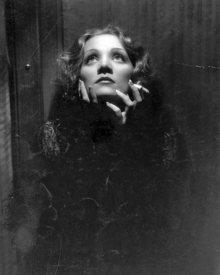
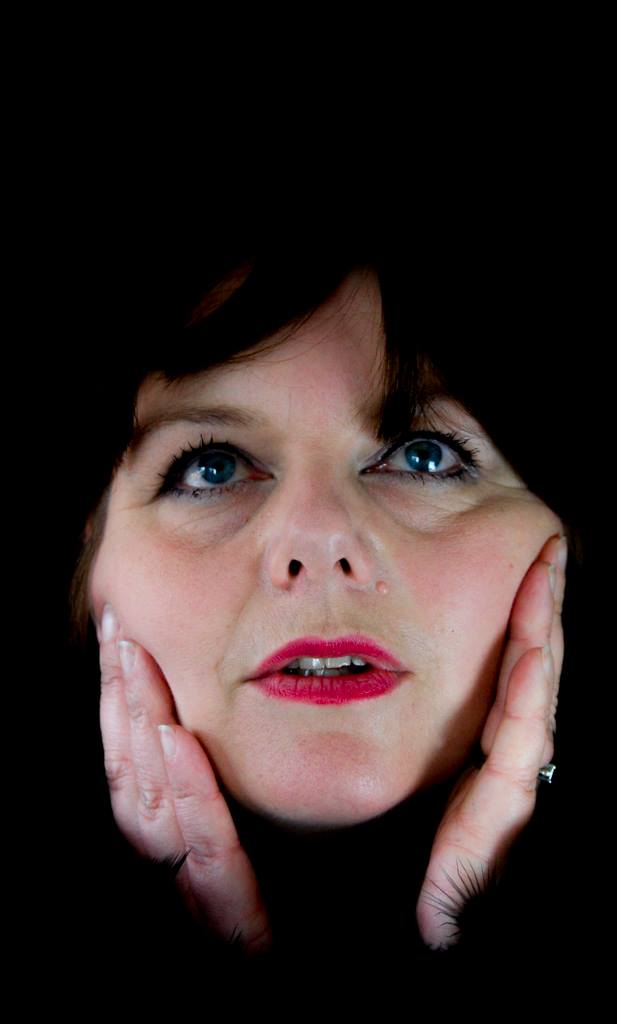
Several years ago, a friend asked me to take some photos of her and her mum. During the shoot, we tried to recreate the iconic image of Marlene Dietrich from the film Shanghai Express. The result was edited in Lightroom to deepen the black background. This is one of my two favourite photographs of Tash, the other one she does not like as much but I do because it reflects her personality in the way that I see it, but which others may not see as flattering.

Marlene Dietrich – Shanghai Express

Tash does Dietrich, image taken indoors against a black backdrop.

The other issue that currently impacts on taking photographs that pay homage to another photographer or artist is the pandemic and not being able to travel around freely capturing images.

An idea that came to me while looking out of one of the windows in the office where I work, while waiting for some documents to print out was to take some photographs of the picnic tables and benches at the rear of the building, but doing so from a low angle, or to take photographs of the bicycle shelter on a sunny day when the light it causing the bike stands to create shadows.

The bench and table idea appealed to me because I remember seeing images from a photographer taking in such a way. Trying to remember where I had seen them led me to Google for the images or articles which referred to them. Instead of finding them I found an article on Edvard Munch.

Munch is an artist that I know of because of his painting “The Scream” but I was not aware that he was also a photographer. Looking through the images in the article I found a couple that I thought anybody who is in lockdown would be able to produce their own versions of.

Edvard Munch (Norwegian, 1863-1944)
The Back Yard at 30B Pilestredet, Kristiania
1902(?)
Silver gelatin contact print
(Art Blart.com)

The image above has a timeless quality to it but also a sense of sadness. The photograph is dated 1902 but I find myself not seeing this as an image from before the First World War, but an image that reflects the events of World War II.

For me there is a sense of desolation and abandonment to this image. Like images of towns and cities after bombing raids.

There is a sense of sadness about the image, not one of joy or fond memories. It is melancholic. The bare trees, as if ravaged by fire or the heat of a blast stand out, despite the evidence to the contrary the leaves on the ground, the untouched fences bordering the yard, the gazebo structure at the far end of the yard. All these things say that this is a peaceful place, an ordinary place that you could find anywhere, anytime, but there is still a feeling of lifelessness given by the bare trees, the leaves on the floor and the lack of any other sign of life in the garden.

Edvard Munch (Norwegian, 1863-1944)
The Courtyard at 30B Pilestredet, Kristiania
1902(?)
Silver gelatin contact print
(Art Blart.com)

Exercise

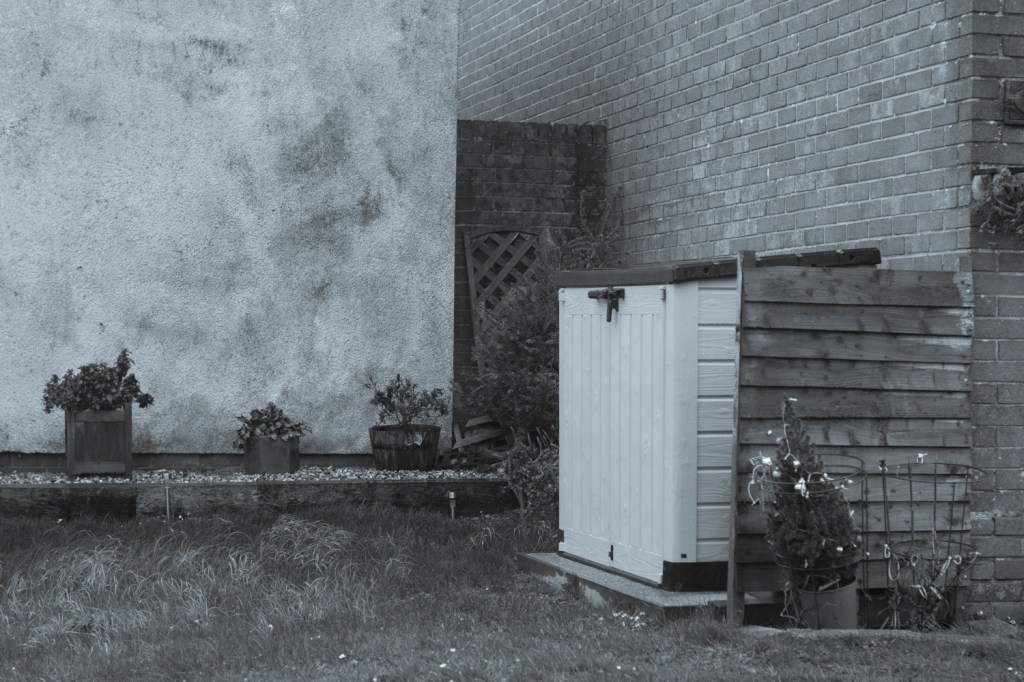
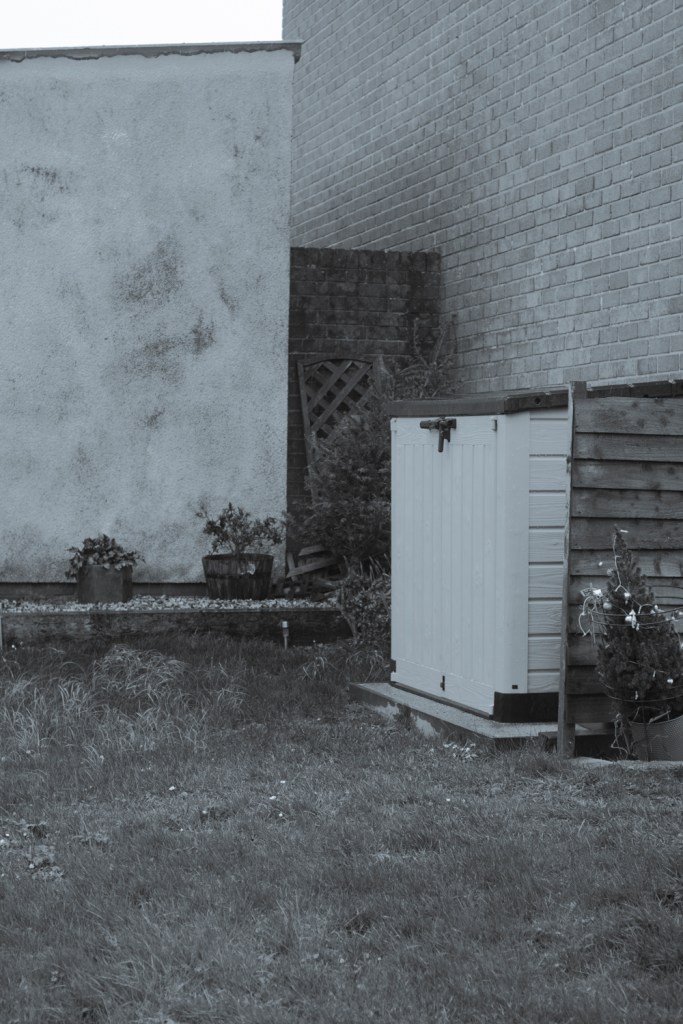
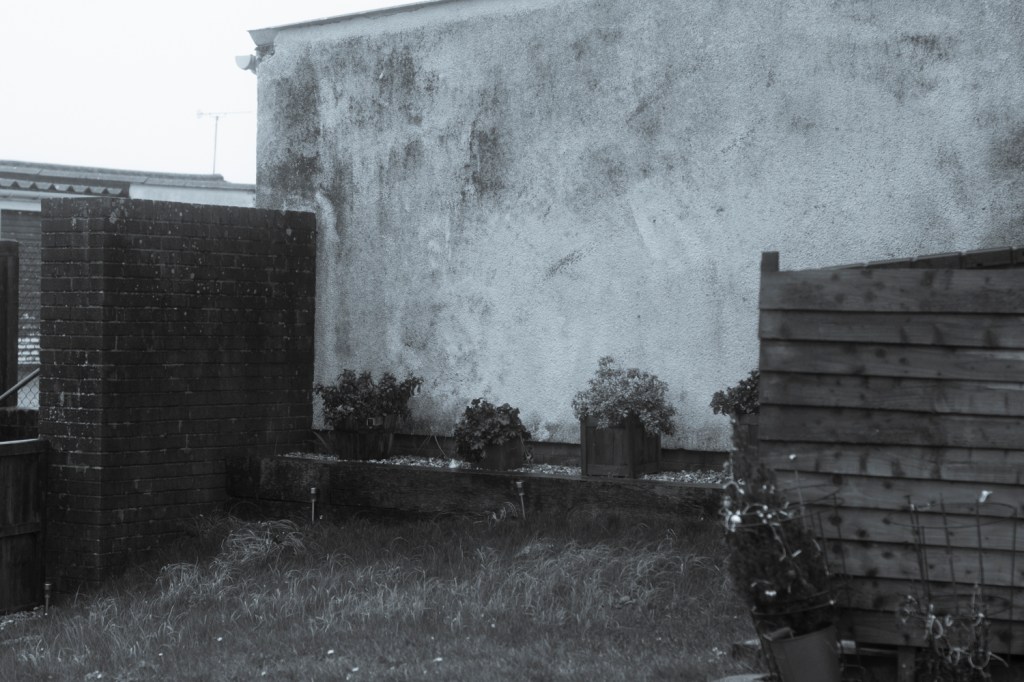
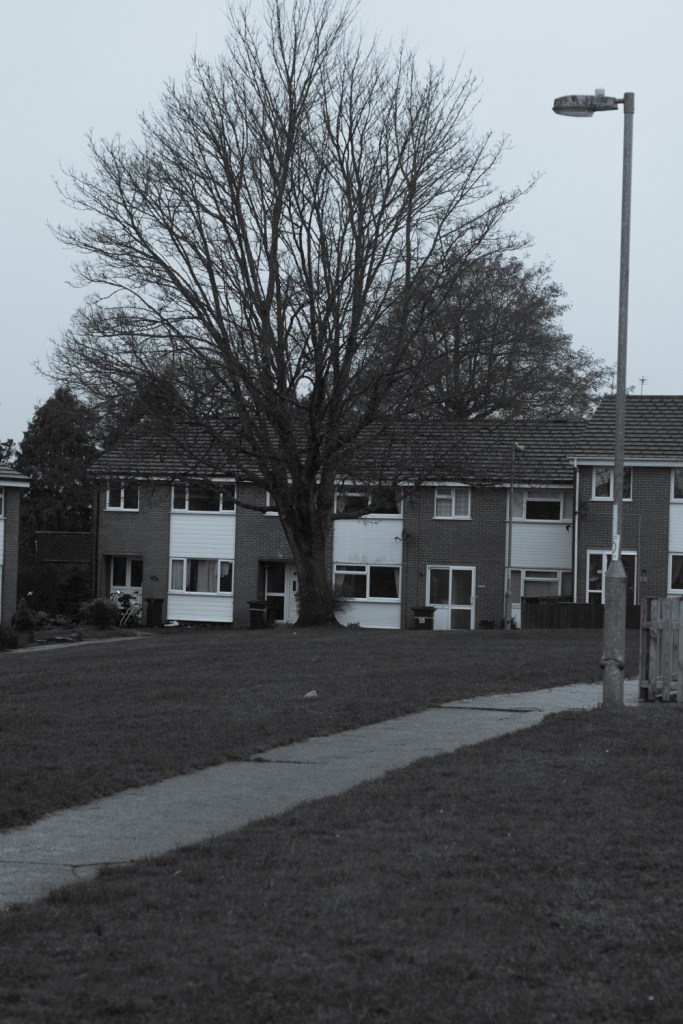
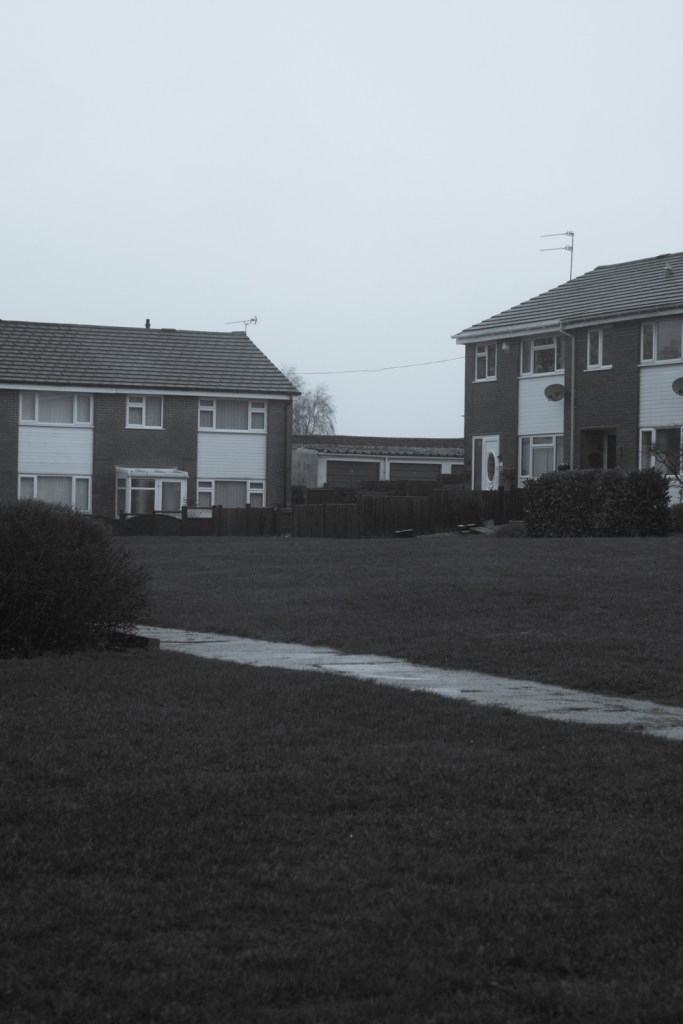
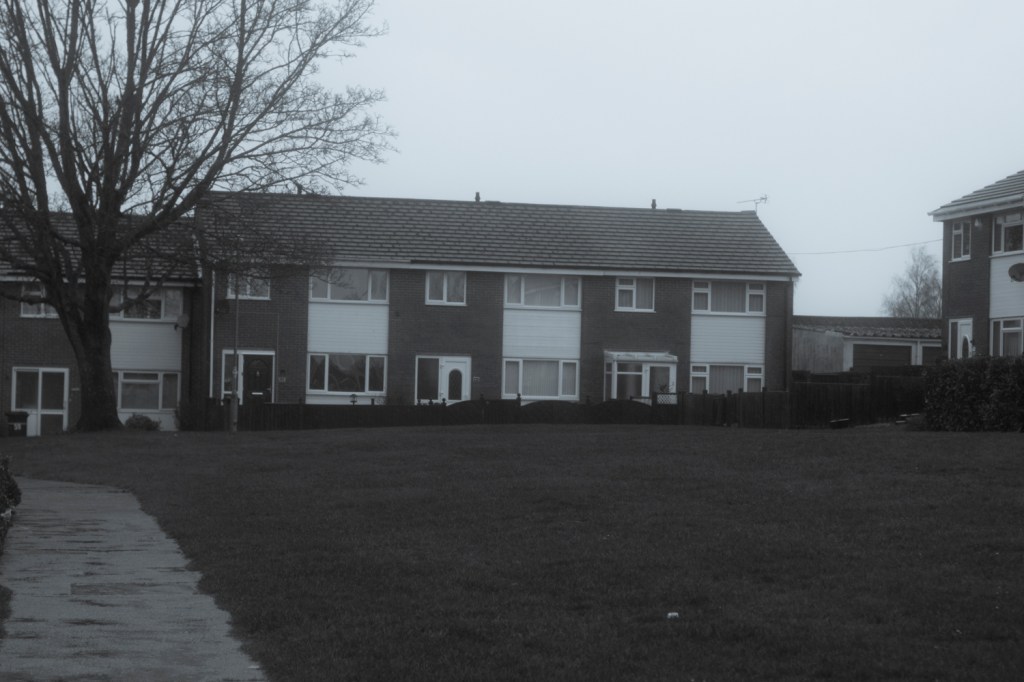
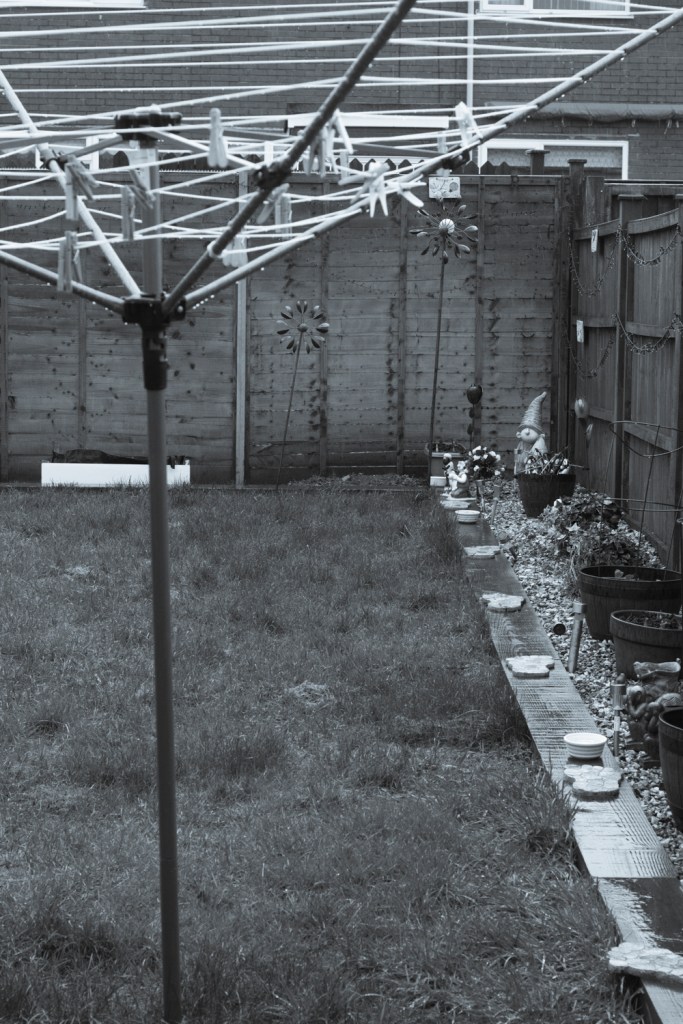
Paying homage to Munch’s 30B Pilestredet images, I decided that for the exercise I would do some black and white images of my garden and the area in front of my house.

The Back Garden at 67 Monks Dale, Yeovil
Trolley at 67 Monks Dale, Yeovil
The Back Garden at 67 Monks Dale, Yeovil
The Front Garden at 67 Monks Dale, Yeovil
The Green at Monks Dale, Yeovil

None of the images have the sense of abandonment that Munch’s image of the yard invoked in me, and the images are not timeless. The PVC windows in the houses date them to the late 20th, 21st century.

The images of the Green are typical of what it has been like for the last year, even throughout the summer, when normally the children would be out playing football and running around. Last summer that was a rare sight with most people keeping to themselves.

Of the entire set of images, my favourite is the Trolley. Of the entire set is the only one that invokes a sense of loneliness and abandonment in me, like Munch’s image of the Yard.

References

  1. avant-garde photography (s.d.) At: https://artblart.com/tag/avant-garde-photography/ (Accessed 20/02/2021).
  2. Bunyan, D. M. (2021) Exhibition: ‘The Experimental Self: Edvard Munch’s Photography’ at the National Nordic Museum, Seattle. At: https://artblart.com/2021/01/17/exhibition-the-experimental-self-edvard-munchs-photography-at-the-national-nordic-museum-seattle/ (Accessed 20/02/2021).
  3. EVERYTHING SEEMED TO BE LISTENING | David Foster – Inside the Outside (s.d.) At: https://www.inside-the-outside.com/everything-seemed-to-be-listening-david-foster/ (Accessed 22/12/2020).
  4. munch-the-back-yard-at-30b-pilestredet.jpg (JPEG Image, 1600 × 1550 pixels) – Scaled (83%) (s.d.) At: https://artblart.files.wordpress.com/2020/12/munch-the-back-yard-at-30b-pilestredet.jpg (Accessed 20/02/2021).
  5. munch-the-courtyard-at-30b-pilestredet.jpg (JPEG Image, 1206 × 1598 pixels) – Scaled (81%) (s.d.) At: https://artblart.files.wordpress.com/2020/12/munch-the-courtyard-at-30b-pilestredet.jpg (Accessed 20/02/2021).
  6. Tate (s.d.) The Separateness of Things, Victor Burgin – Tate Papers. At: https://www.tate.org.uk/research/publications/tate-papers/03/the-separateness-of-things-victor-burgin (Accessed 22/12/2020).
  7. The Alfred Stieglitz Collection | Equivalents (s.d.) At: /stieglitz/equivalents/ (Accessed 15/01/2021).
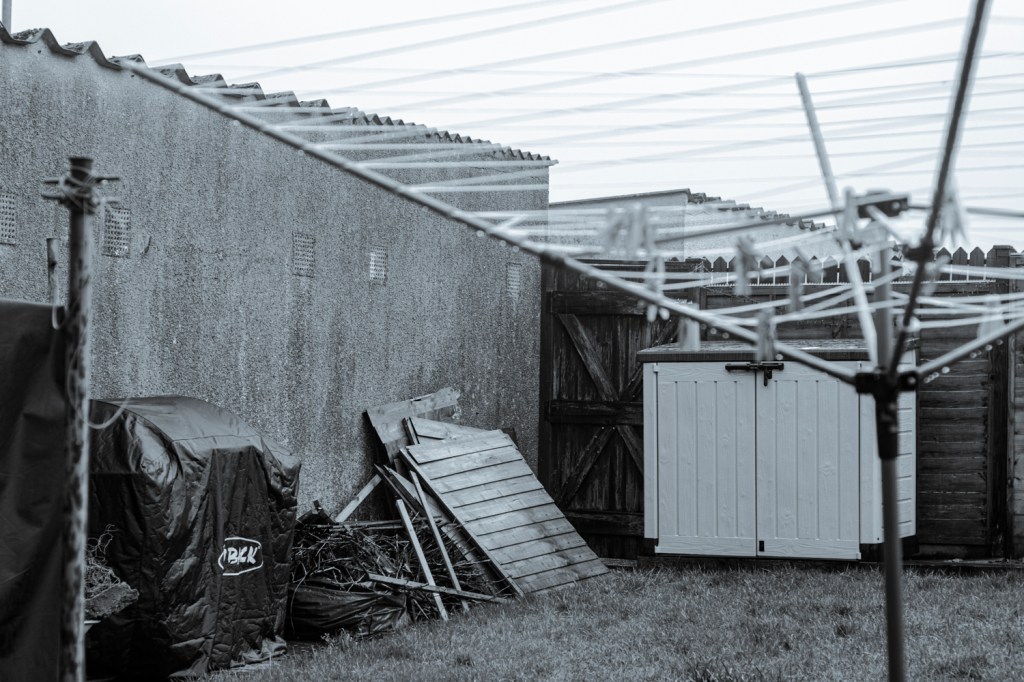
Jessica Park

In his book Uniquely Human (2019) Dr Prizant shares experiences of working with individuals who are on the autism spectrum. One of these individuals is an artist named Jessica Park.

Park is a self-taught artist from Massachusetts in the USA. Her work depicts architecture in bright, vibrant colours using acrylic paints. Her work has been exhibited widely.

Jessica Park has, herself, been featured in publications such as Time Magazine and The New Yorker and has also been part of a film by Dr Oliver Sacks. In 2003, Parks was awarded an honorary Doctor of Fine Arts degree from the Massachusetts College of Liberal Arts.

The majority of Park’s original work is held in private collections, but the Massachussets College of Liberal Arts have produced two books about Park and her art , The Jessica Park Project (2020).

Park’s mother and father were professors who taught English literture and Physics, respectively, and both published authors with her mother publishing two books about her daughter.

Park’s work is so precise it could have been drawn by a computer. The lines are absolutely straight in the walls and roofs of her buildings. The bricks in paintings like The Jessica Building in New Jersey, precisely lined up, even above the archway over the door.

As a teenager, in school, I remember having to draw a picture of an alleyway. The aim was to demonstrate how perspective works. It has been one of those images that when I’ve sat down to draw something over the years, I eventually return to.

At the end of the alleyway are always houses but the precision with which the brickwork in my images is drawn, compared to Park’s, could not be further away, the lines making up walls and roofs are never straight. The only time my drawing of brickwork approaches that of Park is when I try to bring three or four bricks to a viewers attention.

Her mother has suggested that Jessy’s choice of rainbow colors might emanate from a school assignment in which she had to paint a snow landscape in fantasy colors.

Painting the World With a Rainbow: Jessica Park | The Folk Art Society of America (s.d.)

Reading the quote from her mother, Clara Claiborne Park, my going back to the same drawing over the years, has a similar sense to it. One of comfort but also endless possibility. Although the subject of the drawing might be the same each time, there will always be something different about it. The positions of bricks and tiles, the style of the doors and windows, the width of the alley. The positions of doors in the alley. All of these will be different from image to image.

Very rarely have I ever used colour in these images. When I have they are drab greys and browns, never the bright colours that Park uses. Perhaps that is the influence of growing up in a working class home, on a housing estate, in a town in the Welsh valleys, an influence that instills a down-to-earth attitude in you.

Jessica Park’s attention to detail and the accuracy of her work can be seen in the paintings The Great Stained Glass Doors. The floorboards, the brickwork on the floor, the patterns on the windows are identical. It feels like if you overlayed the images that they would match, the only difference being her choice of colours.

It is also her use of colours that makes her paintings so eye catching. To say that the colours aren’t realistic would be untrue. Go to Bristol in the UK, and look up from the city centre and you can see a row of colourfully painted houses. These may not be as colourful as Park’s but they could easily have taken her paintings as their inspiration.

My understanding of autism is very limited but from what I’ve come across when listening to, far more knowledgeable, people, Jessica Park’s work shows a number of qualities that are found in other who have autism. Attention to detail, comfort with repetition, but also shows a sense of individualism and creativity that is part of every human being.

If I take just one thing away from Jessica Park’s work, it is never to underestimate the abilities of any person, no matter who they are, or what conditions they may have that differentiate them for what society says is “normal”. To do so is to deny yourself the chance to see beauty and wonder.

References

  1. Jessica Park | Raw Vision Magazine (s.d.) At: https://rawvision.com/articles/jessica-park (Accessed 30/12/2020).
  2. Painting the World With a Rainbow: Jessica Park | The Folk Art Society of America (s.d.) At: https://folkart.org/mag/jessica-park (Accessed 30/12/2020).
  3. Prizant, Dr. B. M. (2019) Uniquely Human – A Different Way of Seeing Autism. (1st ed.) Great Britain: Souvenir Press.
  4. Snellgrove, C. (2012) Inspiring Story: Self-taught artist with autism, Jessica Park – Parenting Special Needs Magazine. At: https://www.parentingspecialneeds.org/article/inspiring-story-self-taught-artist-with-autism-jessica-park/ (Accessed 30/12/2020).
  5. The Jessica Park Project (2020) At: https://www.mcla.edu/mcla-in-the-community/bcrc/mcla-gallery-51/jessica_park/index.php (Accessed 30/12/2020).

Assignment 4 Feedback

Overall Comments

This is an interesting submission raising issues of what meaning we want to communicate and how this can be done. In this assignment you have outlined your intentions and these has been underpinned by analysis of your thinking and critical process in developing the ideas. The images indicate that you were comfortable working within the selected theme and that you have an obvious empathy with the ideas inherent in the subject. Although the production of these images is relatively straightforward the interpretation of meaning is not so clear to the viewer. From your personal perspective the work is redolent with meaning but how can you relate these experiences and feelings to an audience? From reading your learning log I can see that the work can be interpreted in an autobiographical sense and/or may also be viewed as a portrait. However, if the viewer cannot connect to this aspect of the work it may end up as being seen as simply a series of images of a skull and the symbolism that it denotes in a general sense. At another level the images may symbolically and literally act as a mask and reveal little about any deeper meaning. This mask could be the point of the exercise, as these are personal images perhaps becoming a memento mori with the subject’s meaning remaining invisible to the viewer. The notion of what can or indeed should be revealed in a photograph is an interesting concept and perhaps could form the basis of further research.

Overall aspects of this work may be unresolved but you have not been afraid to challenge yourself in this particular situation by adopting a conceptual approach to the work. This is leading to greater confidence in engaging with new ideas and developing them beyond the immediate.

subject’s meaning remaining invisible to the viewer. The notion of what can or indeed should be revealed in a photograph is an interesting concept and perhaps could form the basis of further research.

Overall aspects of this work may be unresolved but you have not been afraid to challenge yourself in this particular situation by adopting a conceptual approach to the work. This is leading to greater confidence in engaging with new ideas and developing them beyond the immediate.

Feedback on assignment

There is a competent level of technical skill in the work with the use of appropriate equipment.

The individual images are unadorned and composed in a straightforward manner that leaves the viewer time to consider the objects within the image. The final presentation of the work needs to be addressed as the blue images in the set are much too dark. I would also say that although I like the ideas behind the images, I find that the influence of Warhol is too close in the final piece and leaves your intentions a bit unresolved. However, I could see this project developing either with individual images or a multiple image that might include the use of hand written text that would be relevant to the subject matter.

Of course, there are other ways of resolving your intentions in this piece. See further comments under research.

It is good that you experimented with different lighting approaches in making the work. The method that you used harks back to the early days of photography and the additive process. I would like to have seen you investigate in greater detail the potential for mixing colours. The idea for projecting the work opens up some interesting possibilities for future work.

This has been a good attempt to investigate complex ideas and the work has been underpinned by critical analysis and research in an attempt to resolve the issues.

Coursework

You have followed the prescribed exercises and produced some interesting work particularly with the stone and cyanotype images. This evidences a desire to produce meaningful images rather than just illustrating the exercises.

Research

You have engaged with a wide range of research and this is starting to impact upon how you are approaching your work. There is a sense now that you are maturing as a practitioner and eager to engage with demanding projects in a reflective manner.

As you used colour as a dominant theme in the work submitted, I would like to have seen some in-depth research into the nature of colour. This would prompt consideration on the symbolic nature of different colours and how they are interpreted across diverse cultures.

Learning Log

The learning log is developing with good research and activities undertaken pertinent to the assignment. I was taken by the openness in it in relation to personal experience Your comments and responses to research are positive and there are indicators of future projects contained in it. Do develop some of your lines of enquiry as they can lead to interesting ideas that can turn into work. Your remarks in relation to putting off visiting specific places will strike a chord with many particularly at this time. I wonder how we could visualize the concept of missed opportunities?

Pointers for the next assignment / assessment

Continue to select texts for critical reading appropriate to the assignment

Continue to develop your learning log and illustrate with your own work and that of other practitioner. Allow time to consider alternative approaches to the work.

Suggested reading/viewing

http://www.clerkmaxwellfoundation.org/html/first_colour_photographic_image.html

https://blog.scienceandmediamuseum.org.uk/a-short-history-of-colour-photography/

http://www.arttherapyblog.com/online/color-meanings-symbolism/#.X708QC-l3f9

https://www.color-meanings.com/#red

https://www.tate.org.uk/art/art-terms/m/memento-mori

Summary

StrengthsAreas for development
Good development in engagement with prescribed research. Good working of prescribed exercises Exploration of new techniques and approaches to work.Research in greater depth specific areas relevant to own work. Engage in developing technical skills as an ongoing process. Develop reflection as an integral part of practice  

Exercise 5.3: Looking at Photography

Brief

No photos required. Produce a creative response of about 300 words to Cartier-Bresson’s ‘Behind the Gare Saint-Lazare’.

Response

Memory is funny.

When we consider an event from our past, we remember the things that stood out. Those things that stood out. Those things that were so vivid that they etched themselves in out memory. Something we saw, a sound we heard, a small (petrichor, the smell after a rainstorm), the taste or touch of something.

Other things, less memorable things, we forget, or they fade into the background.

Henri Cartier-Bresson’s ‘Behind the Gare Saint-Lazare’ is like a memory.

If you know the image, try and picture it now. What do you see?

Do you see the figures? How many do you see? The image is most well-known because of the running figure, their feet off the ground at the moment the image froze them forever in time.

Did you picture the person in the background, the railings, the bike, the buildings?

Did you picture them reflected in the water lying on the ground? Did you? Are you sure that they are all reflected? Maybe you need to take another look at the photograph. Just to refresh your memory.

The running figure, the man, the railings, the bike. All these are reflected in the water. The buildings are missing though. Like they had somehow ben forgotten or faded with the passage of time.

Even some of the items in the foreground are not reflected. Almost like they were of no real importance.

But they were. The curved pieces of metal were important to the person who made them. Their time and energy went into making them. The labourers who spent days and weeks raising the buildings, the clockmaker who fashioned the clock at the top of one of the buildings, these things were important to them because they were the fruits of their labours.

The camera captures what it sees, it is a passionless observer of events. One that can show us that what we think we remember is not necessary the case.

Memory is funny.

Link to image at MoMa

https://www.moma.org/collection/works/98333

Design a site like this with WordPress.com
Get started