You have interpreted this assignment in relation to Cartier Bresson and the concept of the decisive moment. From your own research it is apparent that you are aware of other ideas in making images and also of critical views regarding the concept of the decisive moment.
The images that you have submitted for the assignment indicate a reaction to this genre of photography. In the context of the work of Cartier Bresson the concept of the decisive moment is humanist in nature rooted in the recording of people and their activities. However under the present circumstances it is necessary to take a broader view of this concept and to find a means of resolving it. In many ways the work that you have submitted could have perhaps been better described as frozen moments of animal behaviour. Due to the limitations of the environment that you were working in it was not really possible to perform the decisive moment as practiced by Bresson. This has been described as ‘vendre à la sauvette’ and is often translated as haste, hastily, furtively and “image a la sauvette” is generally taken to mean an image taken on the run.
You have researched the decisive moment concept that has led you into a questioning mode and consideration of other approaches including notions of the indecisive moment. Bresson’s influence within the context of historical and contemporary practice has been cultivated. It is worth recalling that he was one of the founders of Magnum and that this agency’s purpose was and still is to sell photographers work. The creation of myths in no way hinders this purpose.
Within the present situation and in relation to the decisive moment a quote from the American photographer Les Krims that may be apt to a lot of contemporary practice.
“ I am not a Historian, I create History. These images are anti-decisive moment. It is possible to create any image one thinks of; this possibility, of course, is contingent on being able to think and create. The greatest potential source of photographic imagery is the mind.”
Feedback on assignment
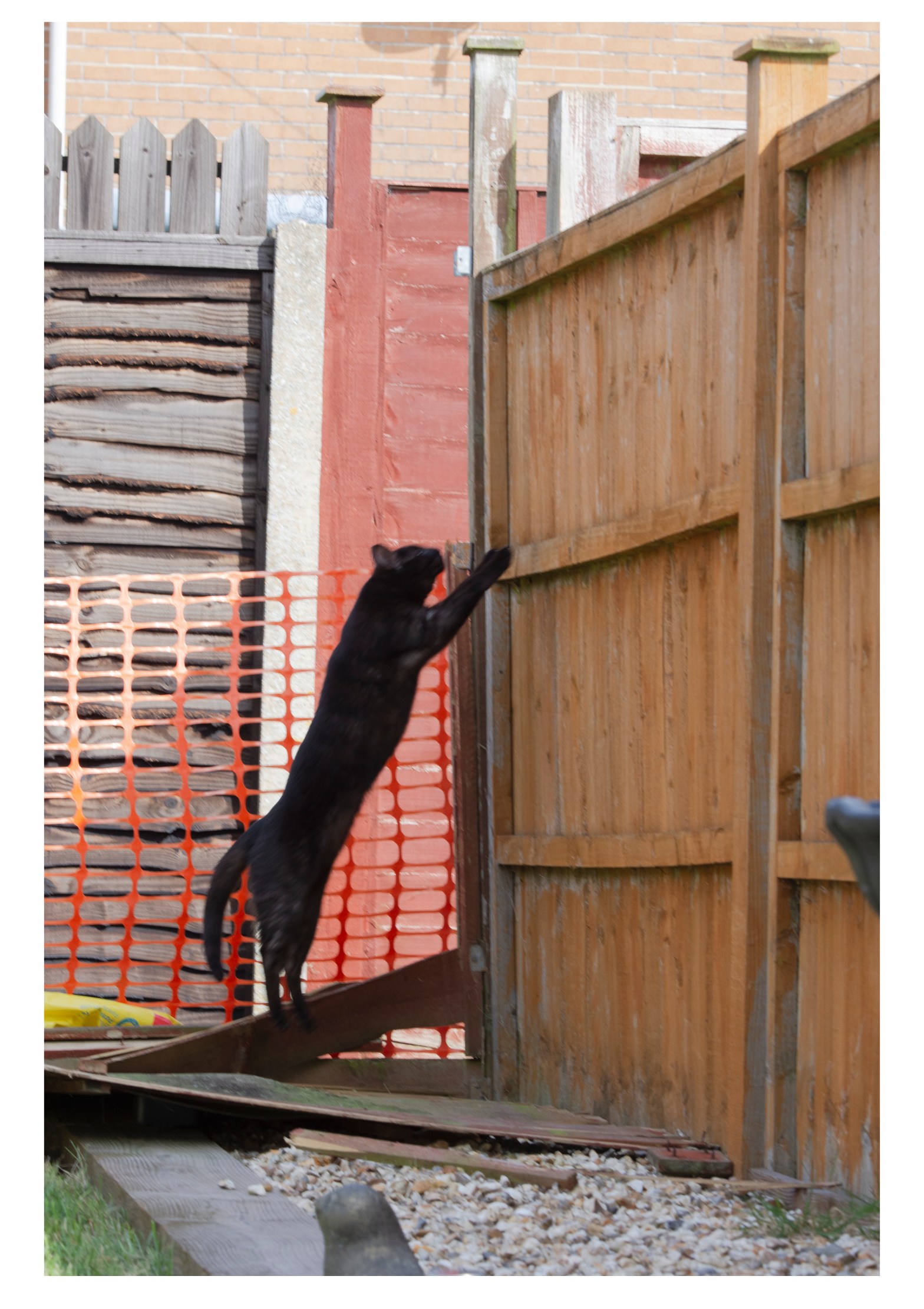
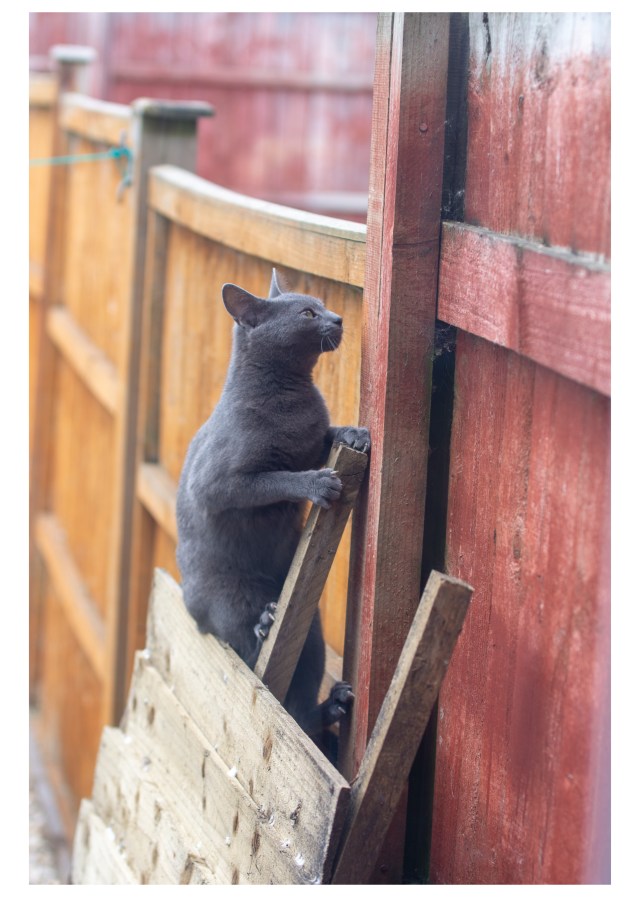
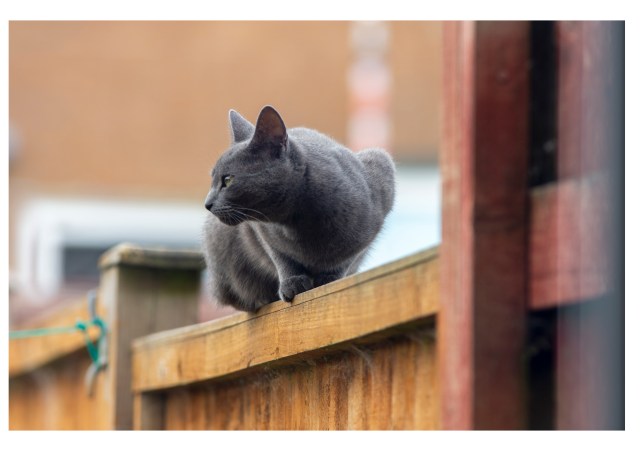
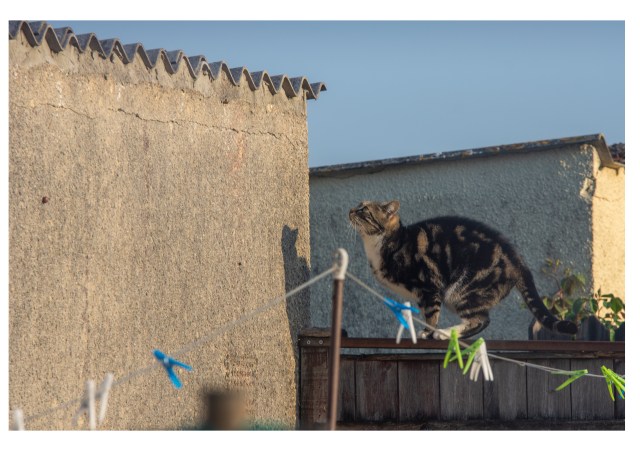
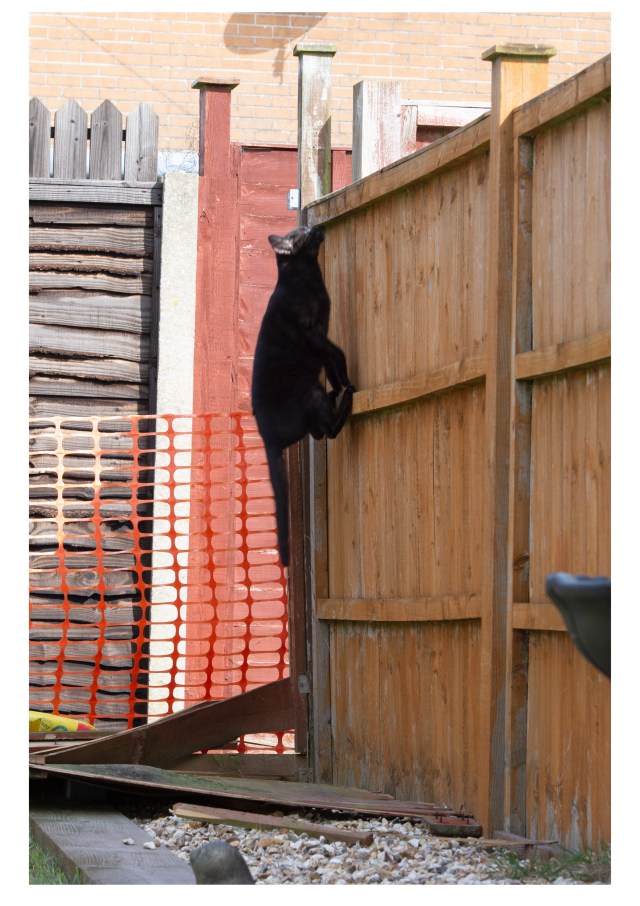
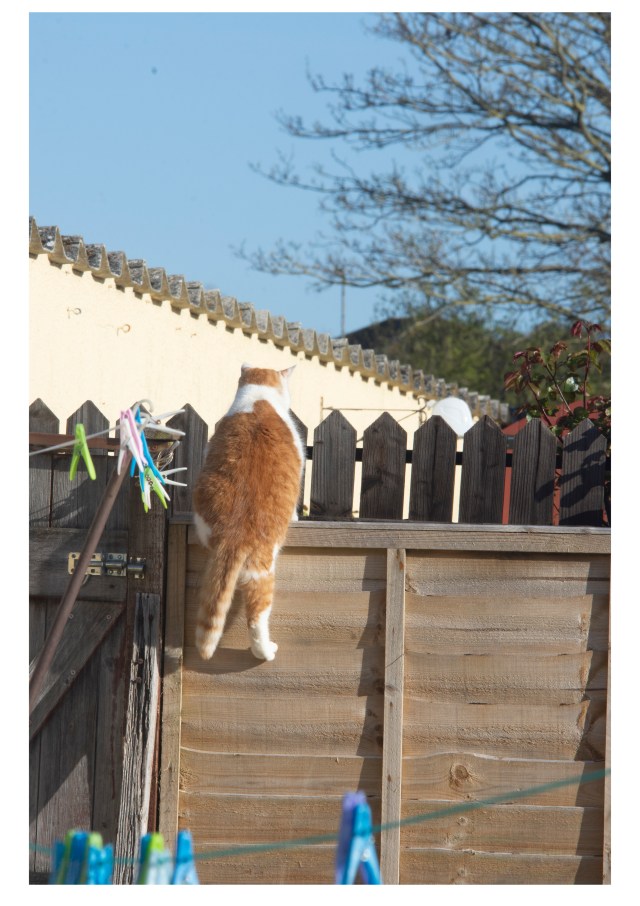
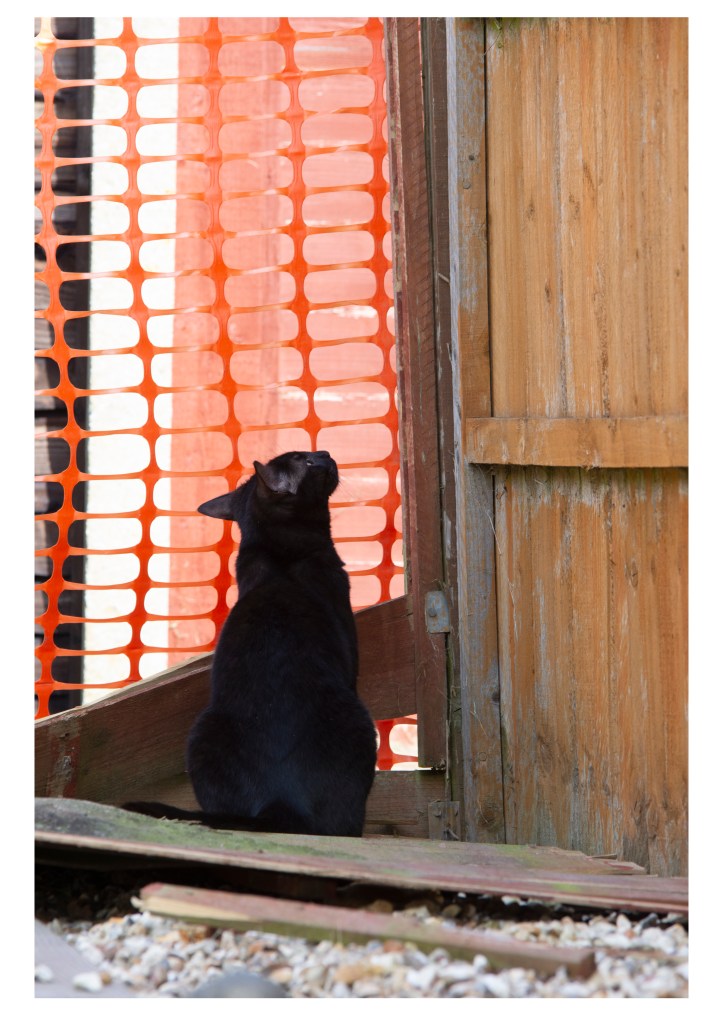
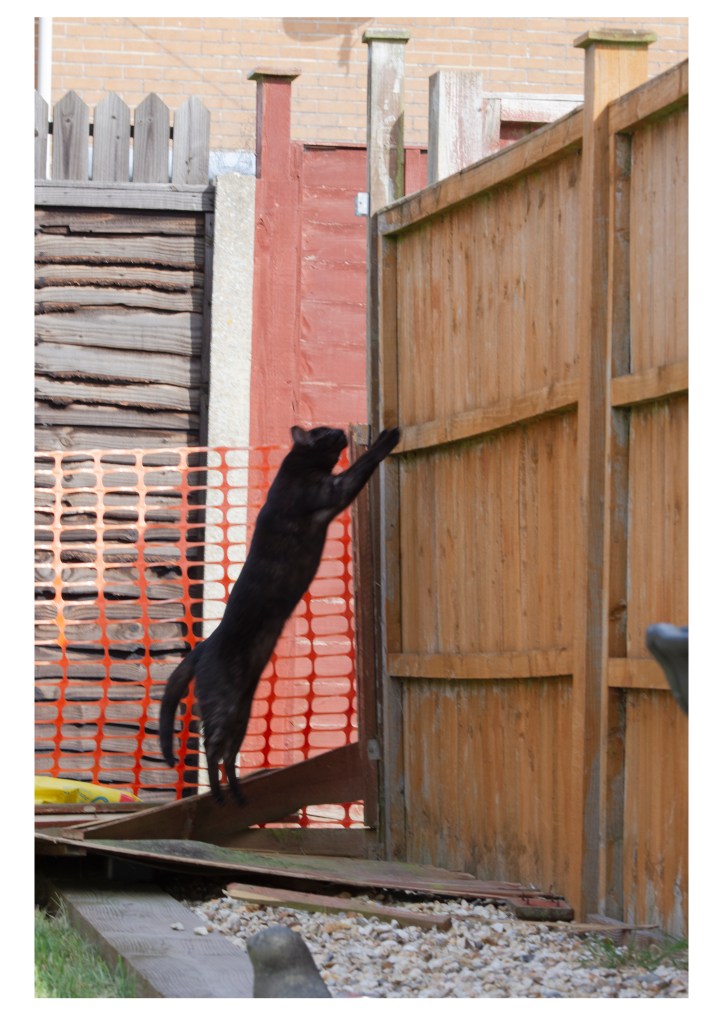
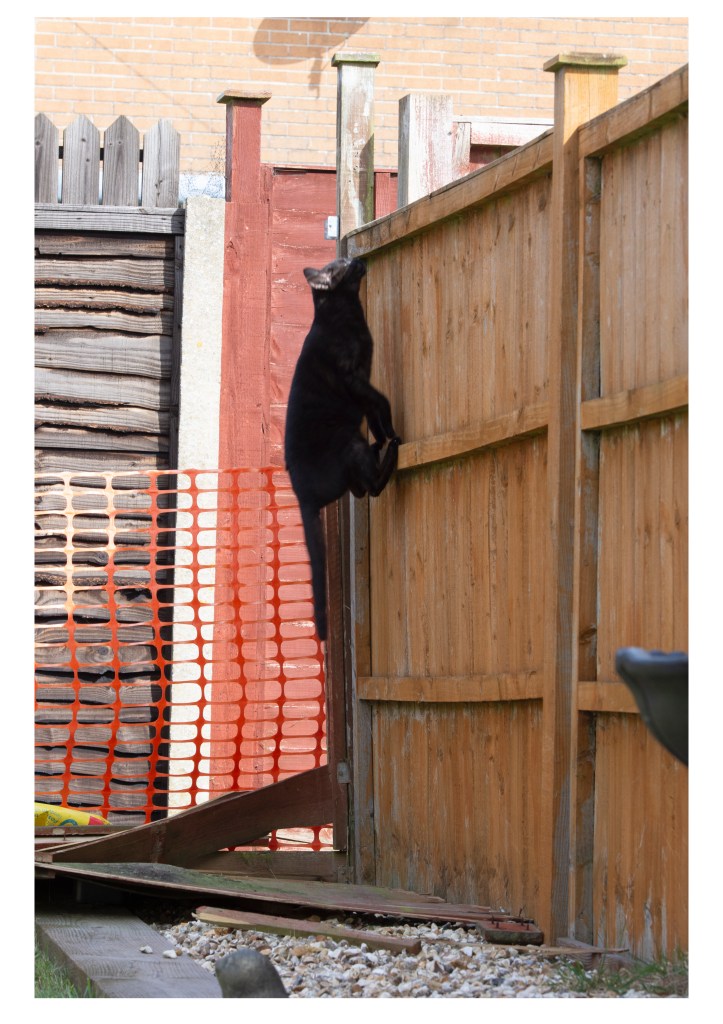
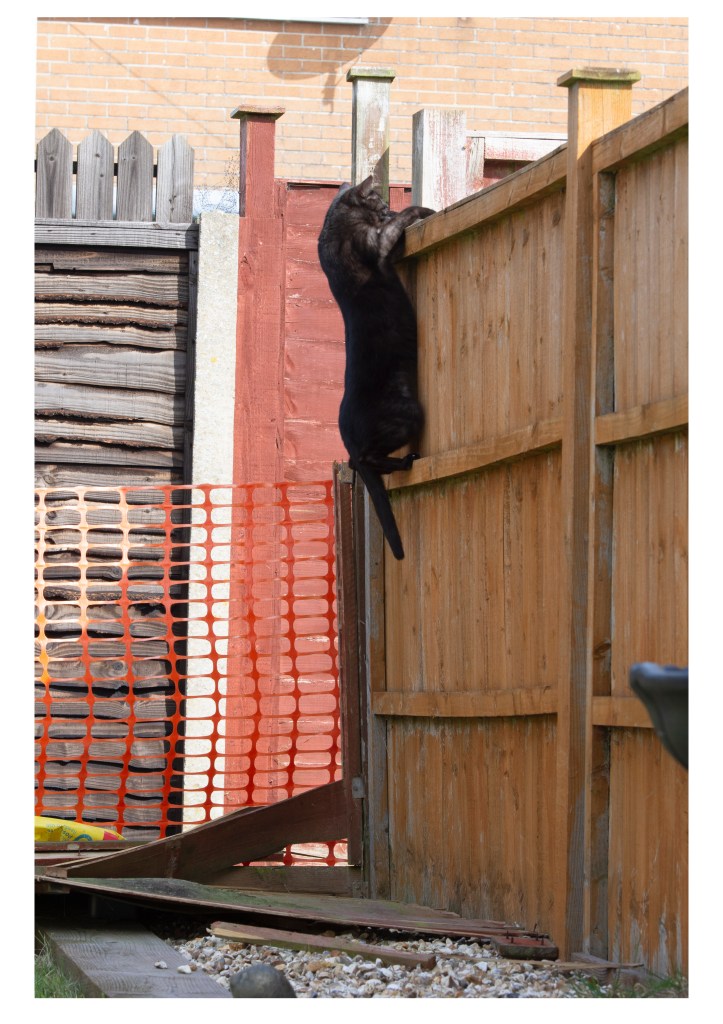
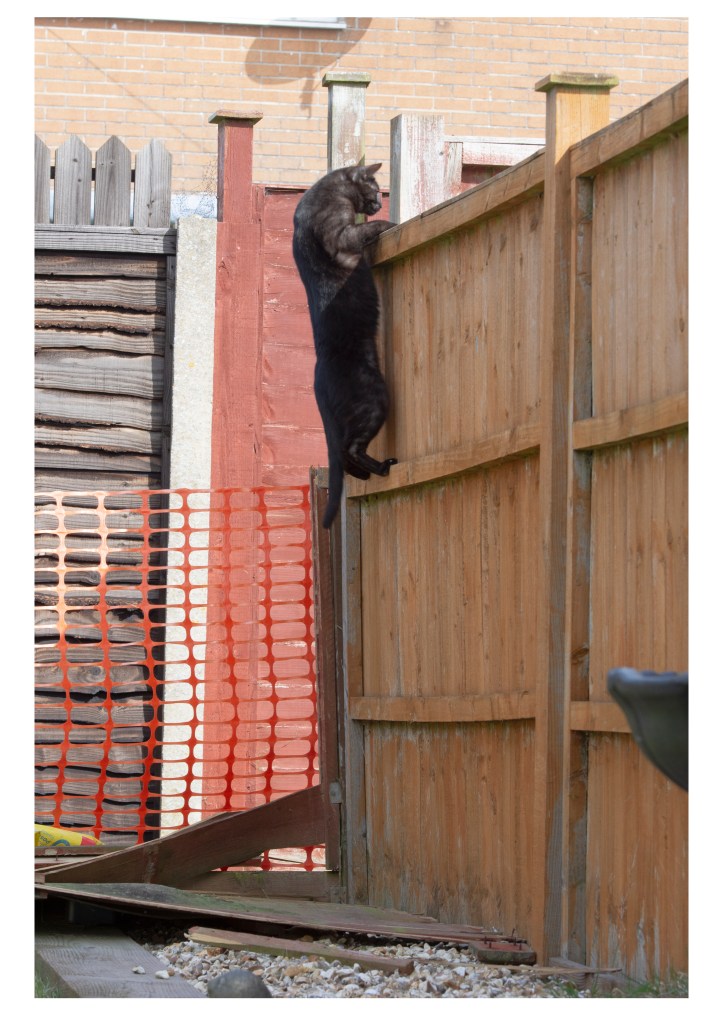
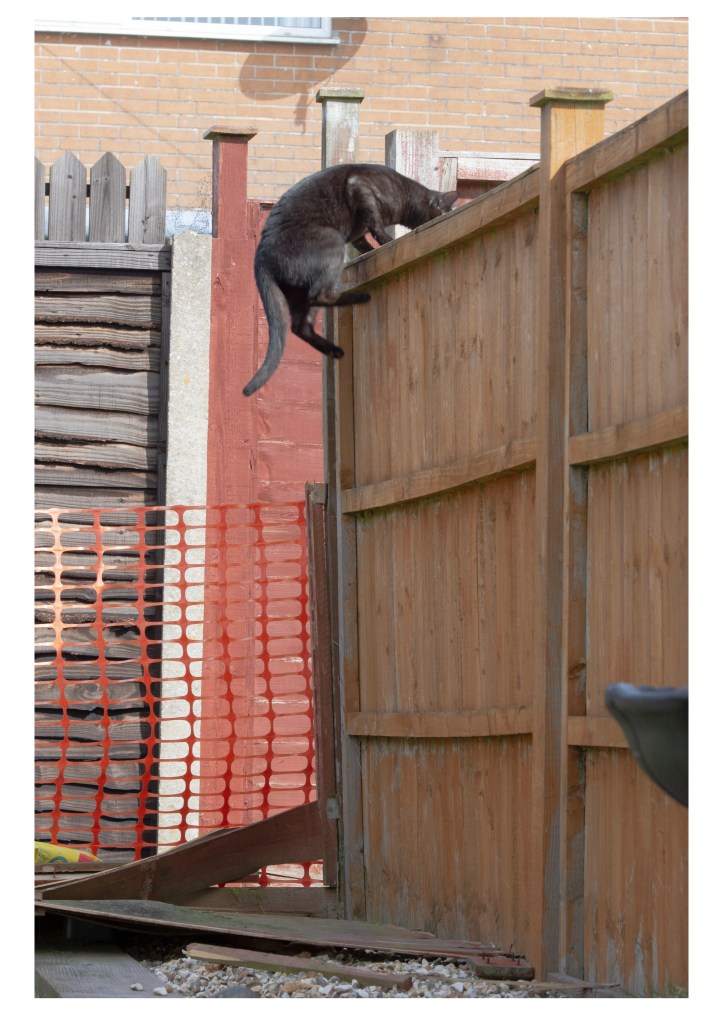
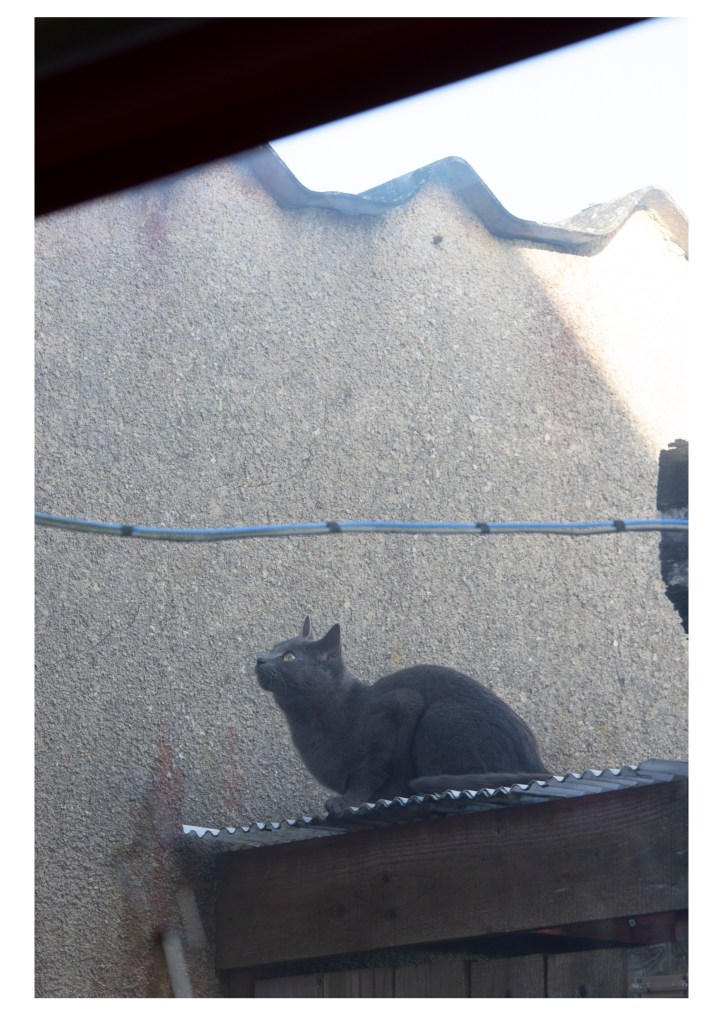
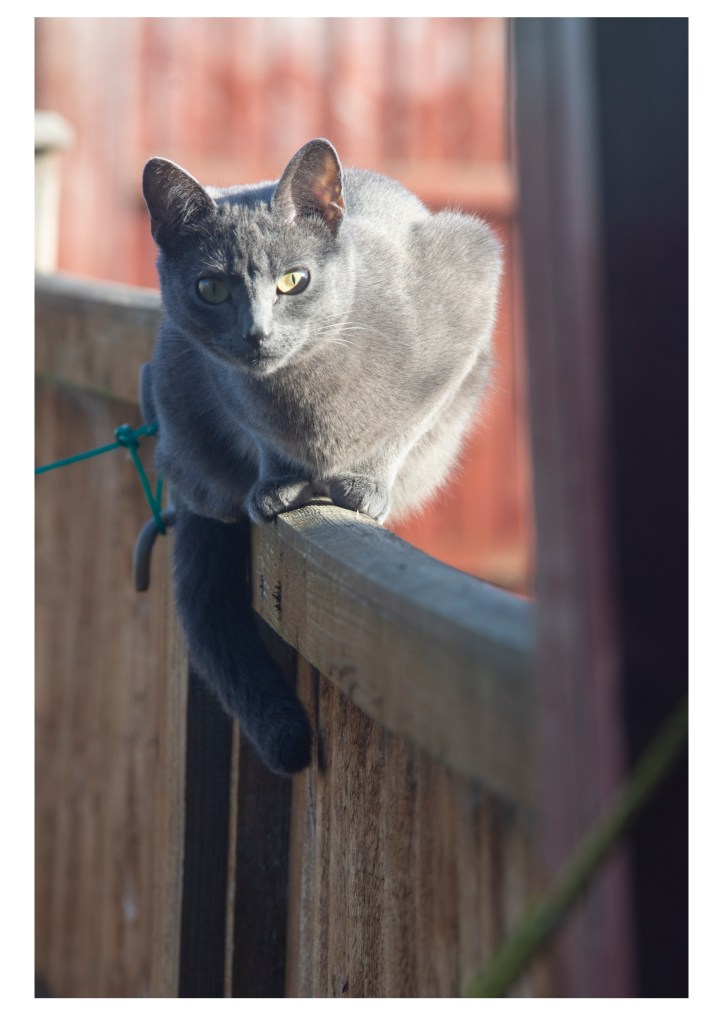
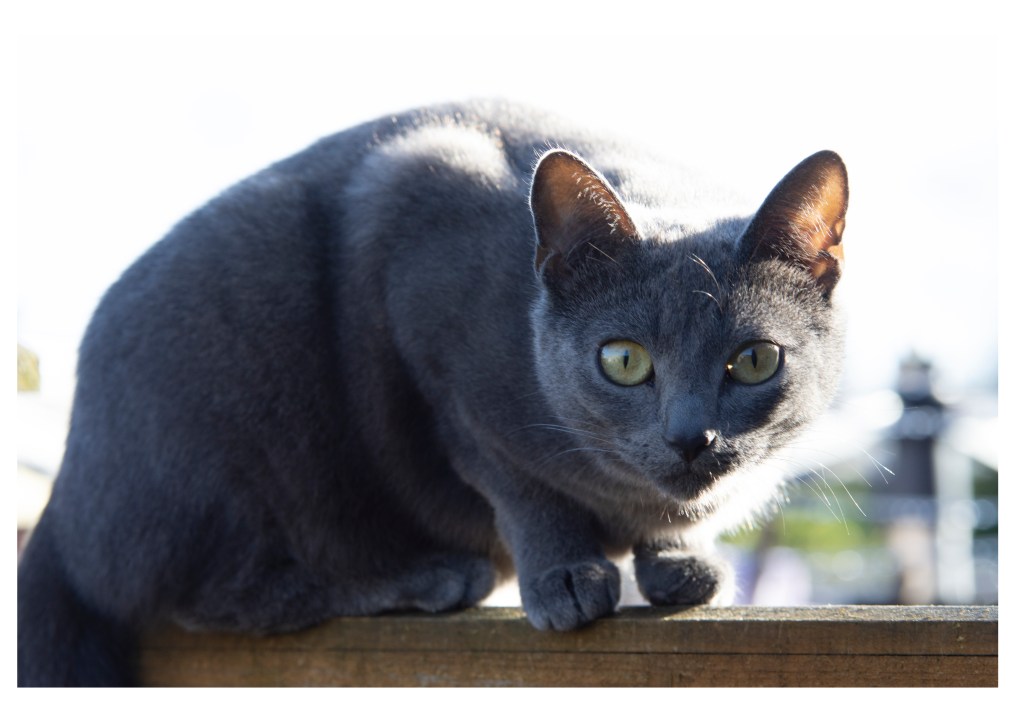
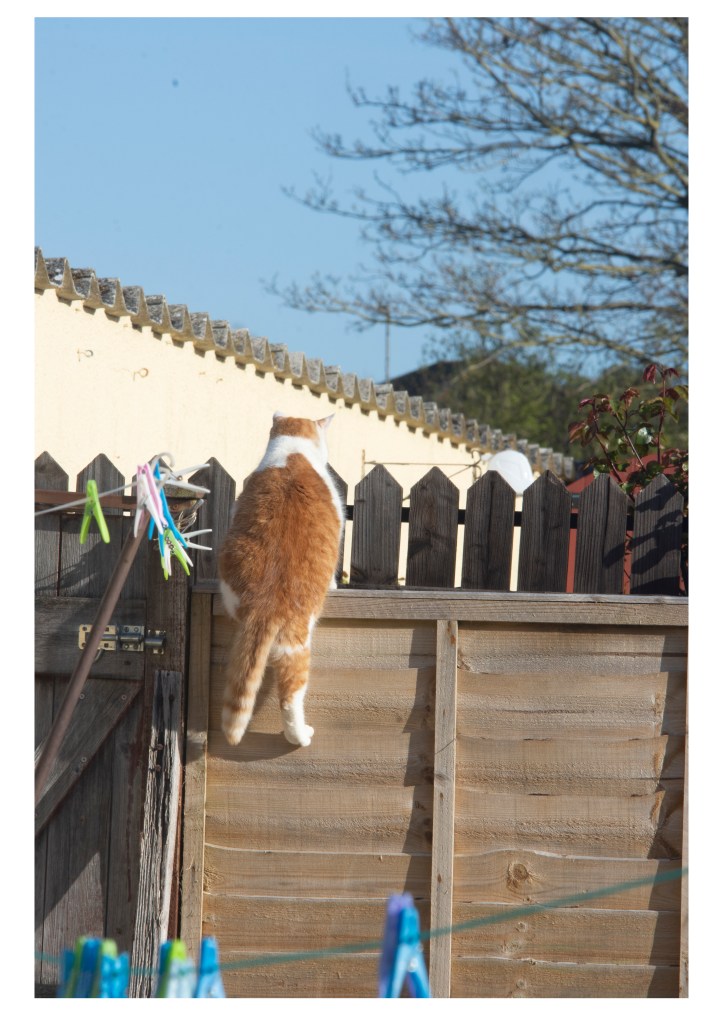
Due to the constraints placed upon you the choice of subject matter was good but was dependent upon the perambulations of the local felines. Because you were anchored to a specific spot I feel that the very nature of the subject matter was working against you because your point of view did not enable you to be able to get close to the subject. This lack of intimacy often leads to the recording of an event rather than any effort to interpret it. The genre of animal photography can of course produce many decisive moments and these are usually represented by the struggle of the individual within the context of the activity. Of the images presented the “claws out” one does capture the indecisive moment. The image works because of the precarious perching of the cat on the timber and the wonderful expression on it’s face. Here the viewer is brought straight into the picture and shares the moment. The “get ready” image again captures a moment of anticipation as we wait for the jump. The remaining images are less succesful as they lack tension or anticipation and the “heading for home” is hampered by the main subject being obscured by deep shadow. The “up and over” image has the subject with it’s back to us moving out of the image. This generally does not engage however at another level this image has a kind of surreal feel to it due to the juxaposition of the fence, gate, pegs and the other elements. Perhaps a tighter crop could reveal this aspect.
It might be worth considering that the captured moment encapsulates not only the subject but also the meaning inherent in the image. As such the viewer is invited to contemplate the social, cultural and environmental symbols within the image.
Overall this has been a brave attempt to engage with a difficult project under the present situation.
Coursework
You have followed the prescribed exercises and recommended reading and commented upon the content.
Research
You have followed the prescribed research for the assignment but it would be good to start developing your own lines of enquiry relevant to your specific ideas for projects. Also consider following up ideas that you reflect upon such as when you state, the juxtaposition of war and peace in these images, however, doesn’t have the impact of that in Wessing’s photograph, perhaps because we are more familiar with them, or maybe because we witness events happening in war zones not through the still image but through the moving one today. Do photographs have less impact? What piece of moving image do we recall that has lasting impact? Another thing to have considered was the photograph as propaganda such as in the images of the Russian soldiers. There are opportunities to explore other areas that you refer to namely the use of mobile phone technology as a means of recording moments. Perhaps it might be interesting to consider that new technology has freed us from the potential tyranny of the decisive moment and that it allows us the reflective ability to work on and develop our images. We would not consider it strange that a painter would make many sketches of a subject before attempting to finalize it in a painting and if necessary return to it many times. Bresson himself may have found this need for reflection when he abandoned photography in 1968 and returned to painting.
Learning Log
Your lockdown reflections are very apt and will echo the thoughts of many today. Your writing about Rhys was direct, full of feeling and will resonate in many hearts.
Pointers for the next assignment / assessment
Consider the assignment brief in relation to a chosen theme. Give weight to your opinions with evidence of critical reading. Reflect and evaluate your work through critical analysis.
Good development in engagement with prescribed research. Good attempt at project under challenging circumstances. Willing to reflect and act upon areas that need improvement.
Research in greater depth specific areas relevant to own work. Engage in developing technical skills as an ongoing process. Develop rigour in critique of own work
The work submitted for this assignment and the exercises carried out indicate a good level of development in your approach to photography. There are still some areas of technical skill in using the camera that need attention as there is a tendency for some of the images to be soft in focusing. In your learning log and written work you have started to engage with research and I was pleased to see that you have visited a number of recent exhibitions. This has opened up to you a new set of experiences and influences across a range of creative practice. Your comments on the work that you have viewed are descriptive in nature and need to become more analytical in relation to the content that could provide further opportunities for research.
You have also evidenced that you can produce a body of work based around a theme
Your learning log is clearly laid out and fairly easy to follow. You have researched the work of other photographer’s and this will have an impact on your own approach to image making however I would like to see more in depth analysis of the work of other practitioners.
The recommended exercises that you have undertaken demonstrate your growing awareness of techniques that you can use in your work. You have reflected upon some of these processes of image making. Overall a good submission
Assessment potential
I understand your aim is to go for the Photography Degree and that you plan to submit your work for assessment at the end of this course. From the work you have shown in this assignment, providing you commit yourself to the course, I believe you have the potential to succeed at assessment. In order to meet all the assessment criteria, there are certain areas you will need to focus on, which I will outline in my feedback.
.Feedback on assignment
The concept of this piece of work is interesting however as a set the overall similarity of the images make a repetitive sequence that does not fully engage the viewer with the work. At one level this is set is simply a series of images of statutes. As I stated in my previous feedback for assignment 1 how do you try to connect the images to the ideas that you engaged with – is this through technique, composition or conceptual ideas. How do you communicate to the viewer? Should the use of text be considered?
There are a number of reasons why the images have a similar feel and this can be put down to the weather on the day, the prevailing lighting conditions, the format selected, the location and perhaps not responding flexibly to the situation as it evolved. In relation to the latter within your learning log you show an image of the homeless tents next to a monument and in many ways this image speaks volumes. The idea of contrasting different situations with the idealism and historical contexts represented by the monuments immediately allows us to find greater meaning within the images. The homeless image, the child playing around the monument unites past and present. This could have been an area to develop.
What is clear is that you are attempting to create work that has a social/political context and you are willing to risk exploring your image making in uncharted areas in an effort to communicate your ideas. Keep this up but do reflect deeply upon your approach through an analysis of the results.
On a technical level the set overall appears to be almost tinted with a bronze appearance that does not correspond to other images I have seen of these subjects. You saw the flare on the Pankhurst image, before submission. Why submit this image? Develop a critical eye and reject.
Coursework
You have followed the prescribed exercises and recommended reading and commented upon the content. The reflections you have made upon this work indicate that you are willing to assimilate new technical approaches into your image making.
Research
You have followed the prescribed research for the assignment and have visited exhibitions. The comments that you have made about the latter indicate possible areas for future research. It is important to question the work that you are looking at as well as the context of production and viewing. So looking at Sander’s work we see an incomplete project but having an influence to this day. This could lead to considering the impact photography has had in the social, cultural and political spheres as well as critically asking the question are we superimposing meaning on work that may have been produced for a different purpose. Again looking at Martin Parr’s work particularly the image of the man eating we might well consider the impact that this image might have on the subject. Has the photographer depersonalized or dehumanized the subject without establishing a context for the image or indeed simply just to exploit the image. There are a number of instances when Parr has been taken to task over at this kind of image making and it would be worthwhile researching to consider alternative viewpoints. Another thing that you mention it is the use of titles and this is another area where it would be profitable to engage in further research about the relationship of image to text. When you ask a question about a piece of work try to follow it up with research and critical reading.
Learning Log
The learning log continues to develop in a coherent manner and it is well illustrated with the work of other practitioners. Do include your own work in the log especially alternative images and contact sheets. Use the log to reflect and critique your own work as an on-going part of your practice. Do use it to explore and examine other media and other issues. I was taken with the image of the young woman by Mancini that you included in the log. You wrote about his use of the grid in creating the painting and it would be useful to know what conclusion you drew from this practice. This particular technique has been used by artists for a long time along with many other tools and devices to assist in the creation of work. This might create some debate in relation to the use of technology in Art both historical and contemporary.
Continue to use the learning log as a means of developing your creative thinking underpinning the making of work. Do link it in to an engagement with critical reading. This will allow you to look in depth at your practice and to consider a wider range of possibilities in your making of images.
Overall you have made a good attempt to create work with a strong thematic concept and have demonstrated a willingness to be challenged, to question and to reflect upon the medium.
Pointers for the next assignment / assessment
Consider the assignment brief in relation to a chosen theme. Give weight to your opinions with evidence of critical reading. Reflect and evaluate your work through critical analysis.
Good engagement with exercises and prescribed research. Visits to exhibitions and reflection upon work seen. Willingness to attempt work that deals with thematic issues,
Research and reflect in greater depth on own work. Engage with independent critical reading relevant to work. Technical quality of images needs to be critically analyzed prior to submission.
This is the first assignment that you have undertaken to cover the requirements of the course. In doing so you have demonstrated a development of technical skill. You have started to work your way through the recommended exercises and this will help develop your visual awareness and an understanding of the course requirements.
In this first assignment you have managed to produce an interesting piece of work demonstrating a willingness to explore beyond the surface. There is clear evidence of an emerging narrative within the set of images. However a question that arises is where is the narrative originating? Is it from the viewer’s perception or is it the intent of the photographer? The results you have produced are a starting point in developing your ideas but you might wish to think of ways of expanding and generating ideas that can move beyond the immediate. The images need to be considered in greater depth in relation to the concepts that you wish to communicate.
This assignment has laid down a foundation of possibilities for new ideas and approaches and if you are willing to take on board these ideas there is no reason why your work cannot grow in technique, content and personal expression.
I was pleased to see through your contact sheets that you had a variety of alternative images under consideration for your presentation. I would like in future to see in your learning log some analysis of your thinking as you go through the process of final selection.
You have started to consider and reflect upon the work that you have produced. You obviously felt comfortable working within the framework of your own environment and experience but alongside this there is a need to engage with deeper analysis and reflection upon where the work lies in relation to critical theory. At present the learning log is descriptive in nature and indicates an uncertainty as to what exactly are your intentions for the themes that you are exploring.
Overall you have made a good start to your course and have demonstrated a willingness to be challenged, to question and to reflect upon the medium.
Assessment potential
Assignment 1
You may want to get credit for your hard work and achievements with the OCA by formally submitting your work for assessment at the end of the module. More and more people are taking the idea of lifelong learning seriously by submitting their work for assessment but it is entirely up to you. We are just as keen to support you whether you study for pleasure or to gain qualifications. Please consider whether you want to put your work forward for assessment and let me know your decision when you submit Assignment 2. I can then give you feedback on how well your work meets the assessment requirements.
Feedback on assignment
You have taken an approach in this assignment that poses a challenge in making the everyday if not somewhat overlooked subject matter of the culverts and water drainage features on the River Yeo interesting to the viewer. This has resulted in images of varying degrees of success in fulfilling the brief. There is an inherent narrative within the work but it is not always clear that you are certain about what is your theme. You state “In this assignments case the culverts and drainage pipes don’t register, or are never seen by residents because they never get close enough to the stream to notice them.” Your work now draws attention to these objects but what does it say about them? Is it a metaphor for the environment, for politics, for anxiety of the unknown lurking beneath our feet or simply a record of what exists?
You are exploring exploring the familiar that we often become blind too and there are times when you capture a sense of menace in the images that these places often emit. Yet the final set of images do not quite work together in a coherent manner. There are some good images. I particularly like the reflection image as well as the split pipes one. There is in the work a sense that these might be miniature landscapes or even architectural studies but there is a need to consider a clear concept for the work and further editing prior to a definitive selection. You might reflect upon the whole sequence work. How do you try to connect the images to the ideas that you engaged with – is this through technique, composition or conceptual ideas. How do you communicate to the viewer? Do you want to guide them to a definitive meaning or to allow them to arrive at their own interpretation? Should the use of text be considered?
Overall a good attempt at producing a piece of work on an out of the ordinary subject.
Coursework
You have engaged with all of the prescribed exercises and reading. You have commented upon the work of other photographers and ideas that open up wide areas of debate. Do consider this work in depth through the application of a critical analysis rather than describing the content.
Research
You have read a book of essays on photography. In doing this you have discovered that information overload is not the best way to carry out research. As you have found it is better to read what is pertinent to the work in hand however this should not exclude books that do need to be read in their entirety. At this stage it is better to focus on research that is relevant to your work and that informs its development and understanding of the medium.
Learning Log
I was delighted to see that you had started to keep a sketchbook. This is a great way of developing work and ideas for projects. From this there is a natural progression to using the learning log as a means of expanding these ideas into concrete projects. The learning log should indicate any influences or ideas that may have originated from research. Ask questions about your work and draw links to that of others.
I was impressed with your enthusiasm about the exhibition that you visited and this clearly will have an impact upon your future work and thinking. Again to evolve this I would like to have seen you take the opportunity to engage in more in depth analysis of individual images that you mentioned and a critique of this work and perhaps also the overall show. The same analysis, critique and reflection should also be applied to your own work.
As a start to analyzing work I would like you to start researching and engage in depth critique into the work of others. I would like to see an engagement with critical reading and also perhaps carry out some research into semiotics as a means of interpretation of images.
Wells, L. (ed.) (2009) Photography: A Critical Introduction (4th edition). Abingdon: Routledge
Summary
Strengths
Areas for development
Willing to tackle challenging subject matter. Engagement and commentary on prescribed exercises. Potential ideas for new projects.
Research and reflect in greater depth on own work. Analysis of images needs to be carried out with reference to critical theory. Take care in assessing technical quality of images
Mandy Barker’s “motivation for the past 10 years has been to raise awareness of plastic pollution in the world’s oceans.”1
We are all familiar with discarded refuse on our beaches and shorelines. When we pay a visit to the seaside it can be hard to miss such sights. In recent years the problem of pollution caused by plastic, and other items, in our rivers, seas and oceans has gained increasing recognition.
In Blue Planet II David Attenborough explored the issue one of the episodes. He discusses the issue in Sir David Attenborough’s plastic message (2018).
Microplastics2 are being found in our sea life, and in the wildlife that depends on it, and as a result will to some level be found in humans.
Images of animals ensnared in plastic can rings, nets and ropes are easy to find online.
Social media brings us videos of divers and other marine users with title such as “These divers noticed something was wrong with this whale3, they were shocked when they looked closer.”
It is not just items like these that are polluting our seas and oceans. It is not just microplastics that are finding their ways into the stomachs of the creatures that inhabit the waters of our planet or use it as a source of nourishment.
Mandy Barker has produced a book that highlights the issues that our planet, our wildlife, and ultimately, we as a species face. The core of the book is a series of works that Barker has produced over the last decade. Each series makes use of plastic items that have been found in different places around the world.
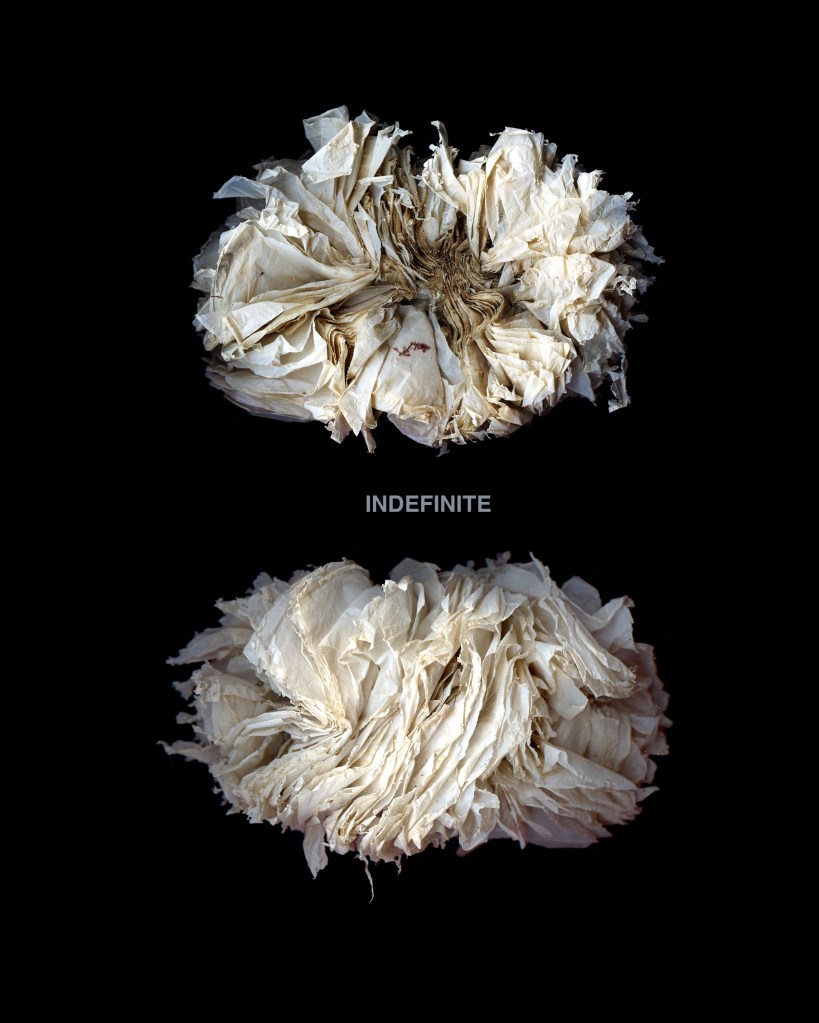
Indefinite
This series shows items found on the sea short. Alongside each item is an estimate of how long it would take to degrade in sea water. From a few years to hundreds of years. Some plastics will take longer to degrade than the time since the Industrial Revolution started.
The worst of the items displayed is polystyrene, which will never degrade if left in the environment.
Indefinite – Mandy Barker
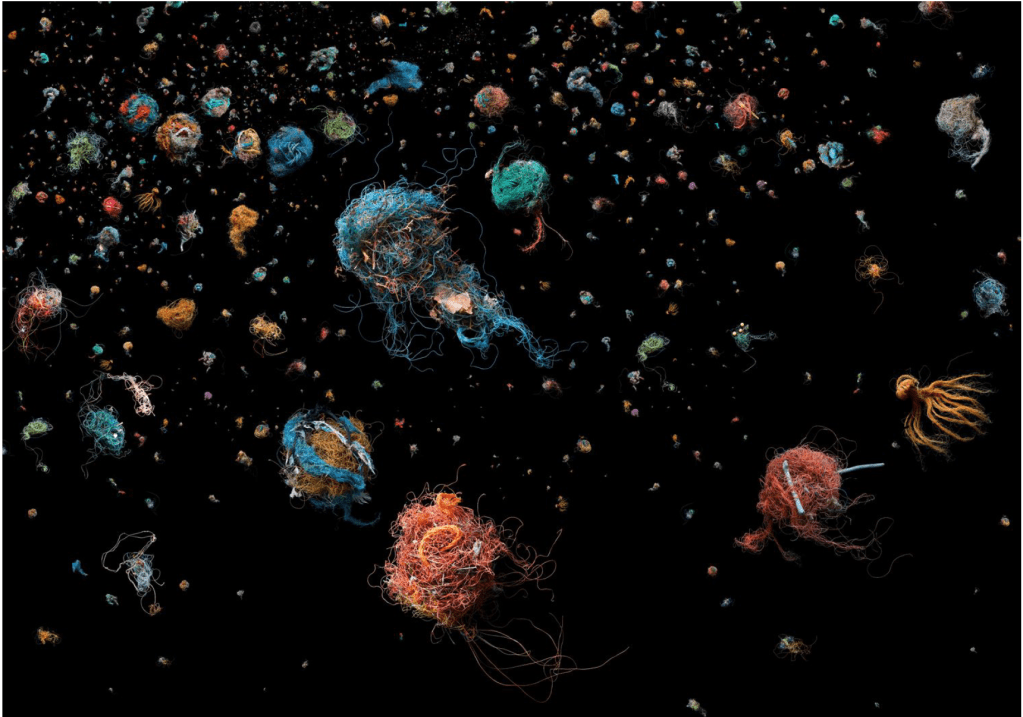
Soup
This series is based on the term used to describe plastic suspended in the ocean.
Nature is perfectly capable of bringing large masses of plant life together in the seas and oceans without human intervention. The Sargasso Sea is a perfect example of this.
Mankind, however, has helped by means of dumping plastics and other items into our seas to cause a similar area, the ‘Garbage Patch’ to develop in the Northern Pacific.
Soup is based on items found on shorelines around the world. When looking at the series I always find myself drawn into the images.
Although a variety of objects can be seen in each image, there are some where it is possible to see smaller and larger versions of the same object. As a result, I find myself looking harder at these works to see if I can work out how many unique items there are.
Mandy Barker has achieved the aim of drawing the viewer in when looking at these images.
Looking at the works in the Soup series is also reminiscent of looking at life through a microscope.
Soup – Mandy Barker
Shoal
This series makes use of items washed into the Pacific Ocean after the Thoku earthquake and the Japanese tsunami in 2011. Similar sets of items have been used to mimic groups of fish swimming in the sea.
Shoal – Mandy Barker
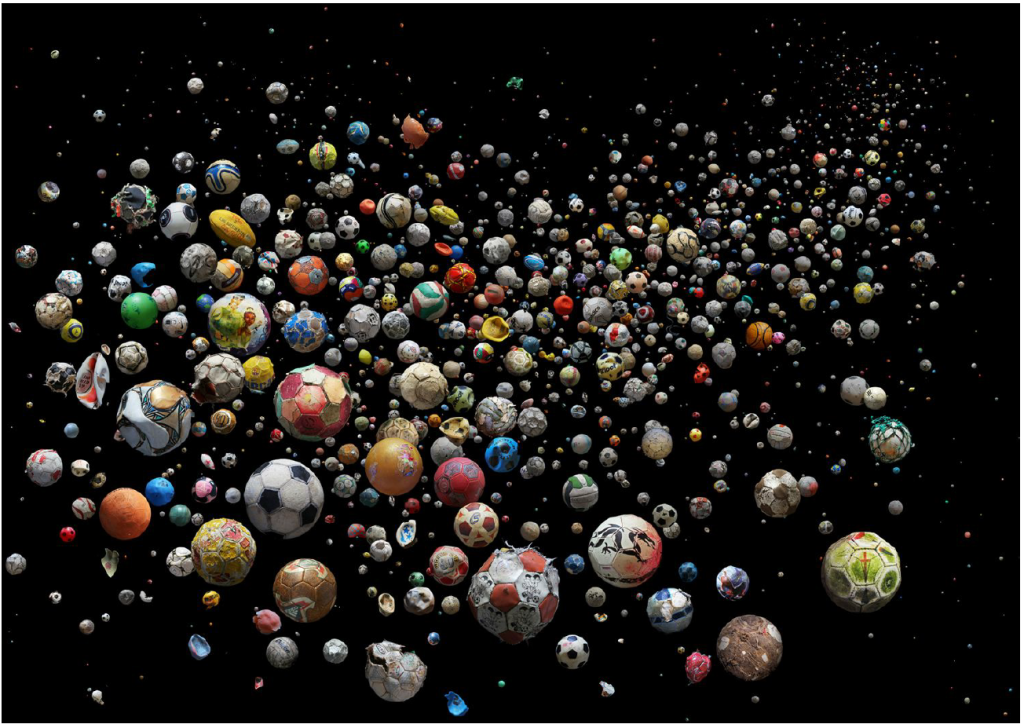
Penalty
For this series Mandy Barker put out a global request for people to send her footballs found in the sea or on the shoreline. In total she received 992 balls. The series consists of 32 individual images showing a single football, and 4 other images showing a mass of footballs gathered from specific areas of the world and by a single person.
Penalty – The World – Mandy Barker
Hong Kong Soup
Like the series Soup this series utilise plastic found on beaches in Hong Kong.
The series provides an insight into the traditions and culture of the Hong Kong people with its linking of some images, via their captions, to traditional Hong Kong food.
Although the series is based on a particular location in the world, the items found, or remarkably similar ones, could be discovered anywhere in the world.
Hong Kong Soup – Mandy Barker Of all the images in the book, this is my favourite
What makes this book fascinating is not just the subject matter, something that has become more widely discussed in recent years, but the facts and figures given, the additional details that Barker provides.
Altered Ocean provides a clear indication that what started out as an item intended to help the environment has been twisted through overuse, into something that has the potential to destroy it, and which we are going to be dealing with to some degree for centuries to come.
Sten Gustaf Thulin, inventor of the plastic bag, developed it to save the planet by providing an alternative to paper bags which required the destruction of forests.
In an interview for the Independent, Plastic bags were created to save the planet, according to son of engineer who first created them (2019), Raoul Thulin says that his father would find the idea that people throw them away as being bizarre.
Synthetic plastic has been with us for over a century. Since its earliest form, to the many different types that have today, plastic is everywhere we look. It is an important substance that we could not easily do without. However, its use is something that we need to consider, and particularly with regards to its impact on the environment and our ability to re-use and recycle it.
Following an essay by Liz Wells about plastic pollution, Mandy Barker finishes the book by including extracts from her sketchbooks. As someone who still struggles with the concept of sketchbooks for photography, I found this a useful addition. Being able to see examples of how somebody develops projects such as these and getting an idea of the thought processes behind it is a huge benefit to my own work.
References
Barker, M. (2019) Altered Ocean. (1st Ed) Germany: Overlapse.
2: Microplastics are very small pieces of plastic that pollute the environment. Microplastics are not a specific kind of plastic, but rather any type of plastic fragment that is less than 5 mm in length according to the U.S. National Oceanic and Atmospheric Administration. (Source Microplastics (2020) In: Wikipedia. At: https://en.wikipedia.org/w/index.php?title=Microplastics&oldid=955272046 (Accessed 09/05/2020).)
3: Substitute whatever large marine mammal springs to mind that may approach humans for help.
Create a set of between six and ten finished images on the theme of the decisive moment. You may choose to create imagery that supports the tradition of the ‘decisive moment’ or you may choose to question or invert the concept by presenting a series of ‘indecisive’ moments. Your aim isn’t to tell a story, but in order to work naturally as a series there should be a linking theme, whether it’s a location, event or particular period of time.
Include a written introduction to your work of between 500 and 1000 words outlining your initial ideas and subsequent development. You’ll need to contextualise your response with photographers that you’ve looked at, and don’t forget to reference the reading that you’ve done.
Reflection
Initial Ideas
When I started to think about this assignment, my initial idea was to photograph people as they finished my local Parkrun on a Saturday morning.
My reasoning for linking this to the idea of the decisive, or indecisive, moment was that it would show people’s differing reactions to completing a Saturday morning run. For some people this would be a regular thing, for others a first-time event, for some 5K would be easy, for others a huge challenge. I hope to reflect this across the series of photos.
My second idea reflected my state of mind at the time. A series of images based around the idea of suicide. The first image I conceived was an empty bottle of Scotch lying on its side with a pile of anti-depressants scattered next to it. An initial search for any photographers that had undertaken a similar project proved fruitless.
My reasoning behind this idea was that images like this would symbolise what is a very decisive moment in a person’s life. The moment that they decided to end it and act upon it.
The Government instigating a lockdown as a result of the Coronavirus took away the opportunity to go with my first idea. Developing the second idea would be more challenging.
As I was considering how to develop a body of work for the assignment an EVY Meetup on assignment 3 was organised by Robert Bloomfield.
The presentation breaks the Decisive Moment down into 3 constituent parts, two of which I want to cover here because they link with how my ideas developed.
Juxtaposition
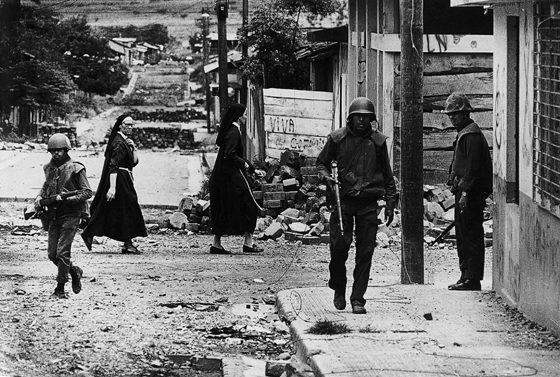
This is where elements of a photograph contrast with each other. For instance, Koen Wessing’s photograph from Nicaragua in 1979, highlights such a case as it captures soldiers and nuns within the same image. Soldiers, who are normally associated with war and fighting. Nuns who are associated with peace and helping others.
Koen Wessing, Nicaragua, 1979
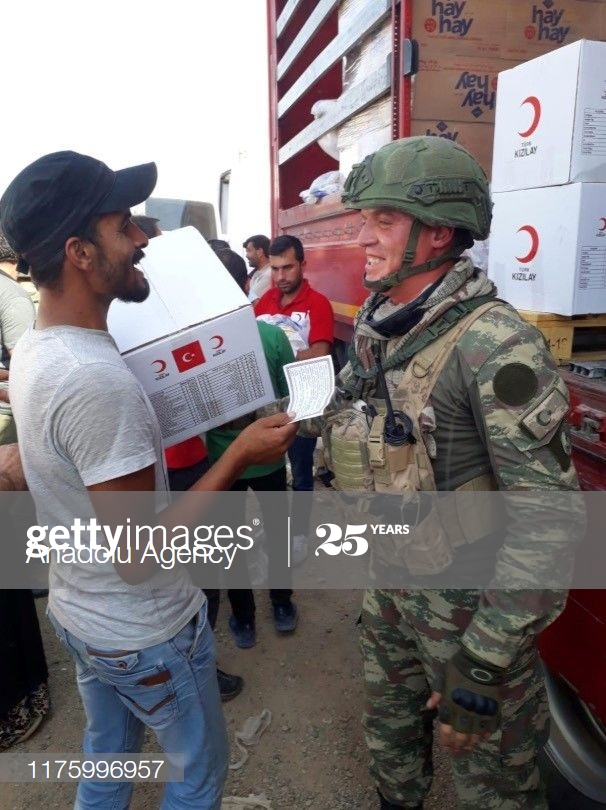
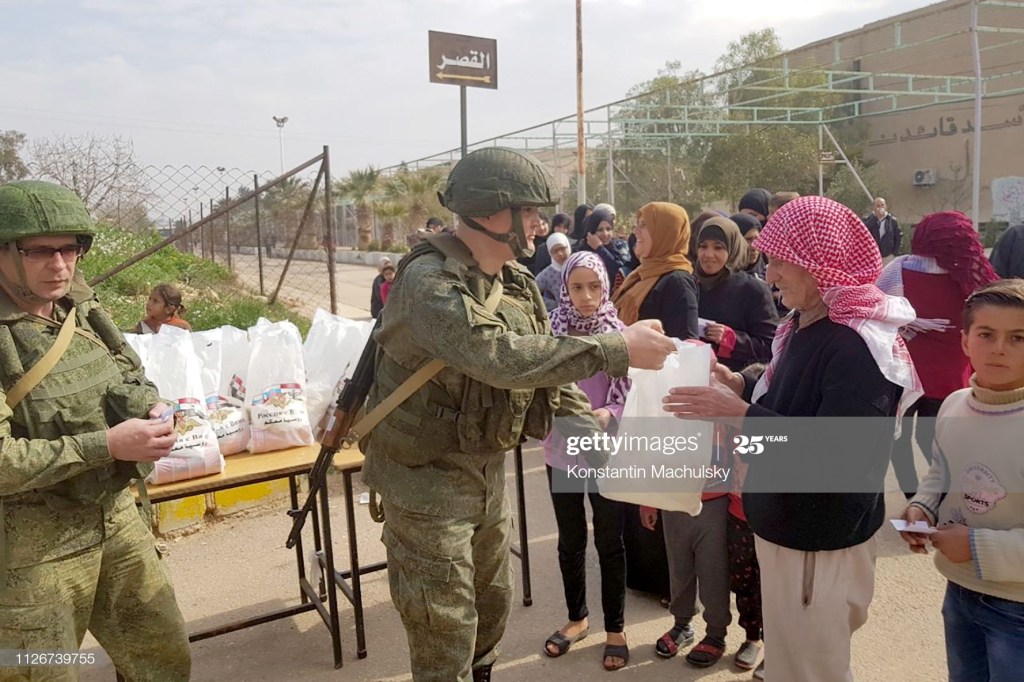
Fighting is not the only part of a soldiers role, providing humanitarian relief is another important task and we have become used to seeing images similar to those below of refugees being supplied with food and other necessities by members of the military forces.
The juxtaposition of war and peace in these images, however, doesn’t have the impact of that in Wessing’s photograph, perhaps because we are more familiar with them, or maybe because we witness events happening in war zones not through the still image but through the moving one today.
Paul Graham used juxtaposition in his work The Present, PAUL GRAHAM: ‘The Present’ – The New York Times (2012), by presenting two or three images side by side where the viewer had to flick between each to see the differences. I was able to explore Graham’s work as part of the Research Point for this part of the course.
Moment
Henri Cartier-Besson’s said:
“There is a creative fraction of a second when you are taking a picture. Your eye must see a composition or an expression that life offers you, and you must know with intuition when to click the camera. That is the moment the photographer is creative.”
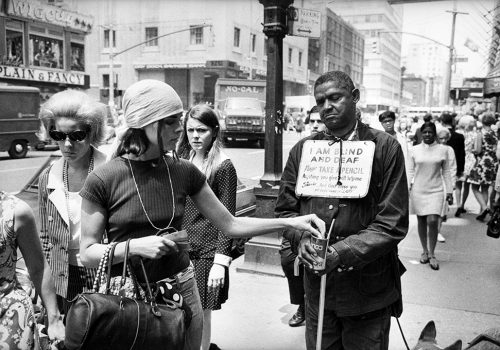
When looking at a lot of images it is possible to see that this is the case. Look at examples of street photography and the photographer has composed their image and then released the shutter at the right moment to capture the image that is in their mind.
Gary Winogrand
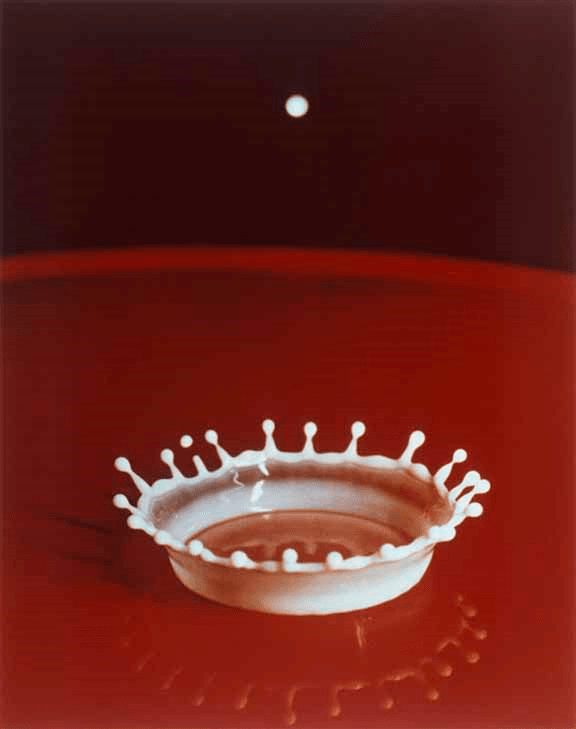
There are examples that go counter to this. Harold Edgerton produced many images where the camera shutter needed to be triggered at the right moment. His Milk drop coronet is an example of this. However, this is not a case of intuitively knowing when to take the picture but calculating the moment that the shutter needs to be released in order to capture an image. A fraction of a second either way and you have a different image.
This does not mean that the photographer is not being creative at that point, it’s just that to reach this point requires careful planning rather than intuition.
Development of ideas
Having looked at the slides from the EYV meetup I looked around my home and garden to try and find ways that I could make use of my location to find ways to demonstrate the Decisive Moment, or alternatively Indecisive moments. Several ideas developed as I did so, and these can be found in my Learning Log under the piece called Decisions.
The idea I was going to go with came about when I noticed one of the cats in the garden. Grabbing my camera, I was able to watch as it wandered along the fence before pausing and then leaping up onto and then over it. During that leap there were moments that were key to the cat climbing the fence. The initial leap, catching the fence with its paws, a second leap upwards and then reaching the top. Looking at the series of images I felt that I had captured the essence of the Decisive Moment.
Zouhair Ghazzal when talking about the Decisive Moment, decisive moments (2004), as I discuss in my Research Point for Project 3 ‘What matters is to see’, raises the issue of capturing a series of images which, may show a series of decisive moments but when put together lose those moments. Looking at the series of images I planned to use I could see that could possibly happen, and so I made the decision to continue using the cat theme but to use a selection of photographs of neighbours cats in my garden, caught when they didn’t always know I was watching.
My final selection of images is linked by two themes. The first is the subject matter, cats. The second is location, my garden.
Image submission
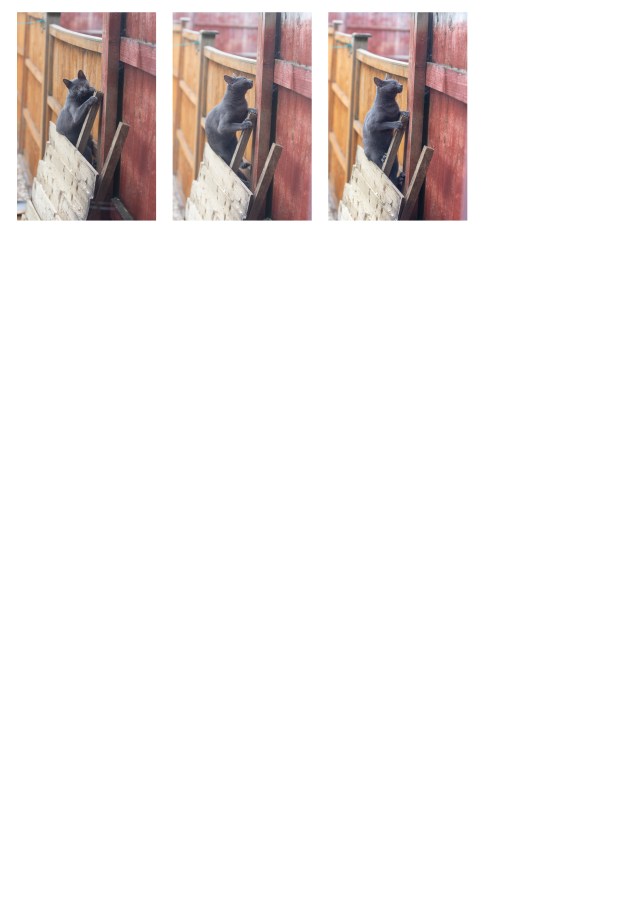
Claws out f/3.2, 1/200sec, ISO-100 70mm Millie had decided that she was going to climb up inside the broken panel leading against the wall. This is the point where she was readying herself to leap for the top of the fence.
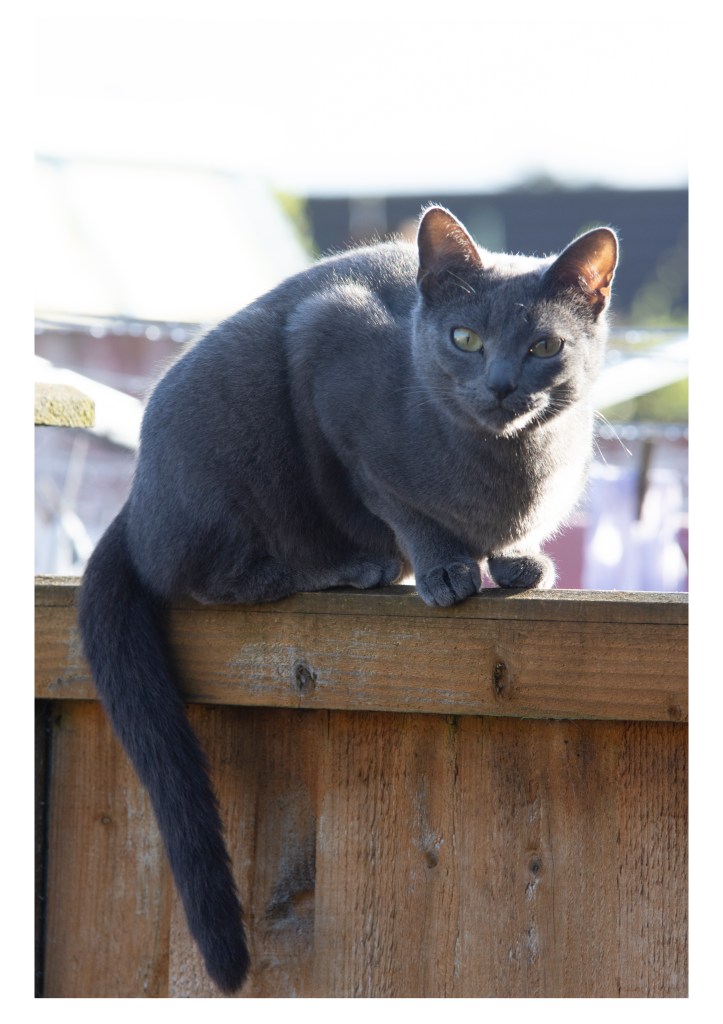
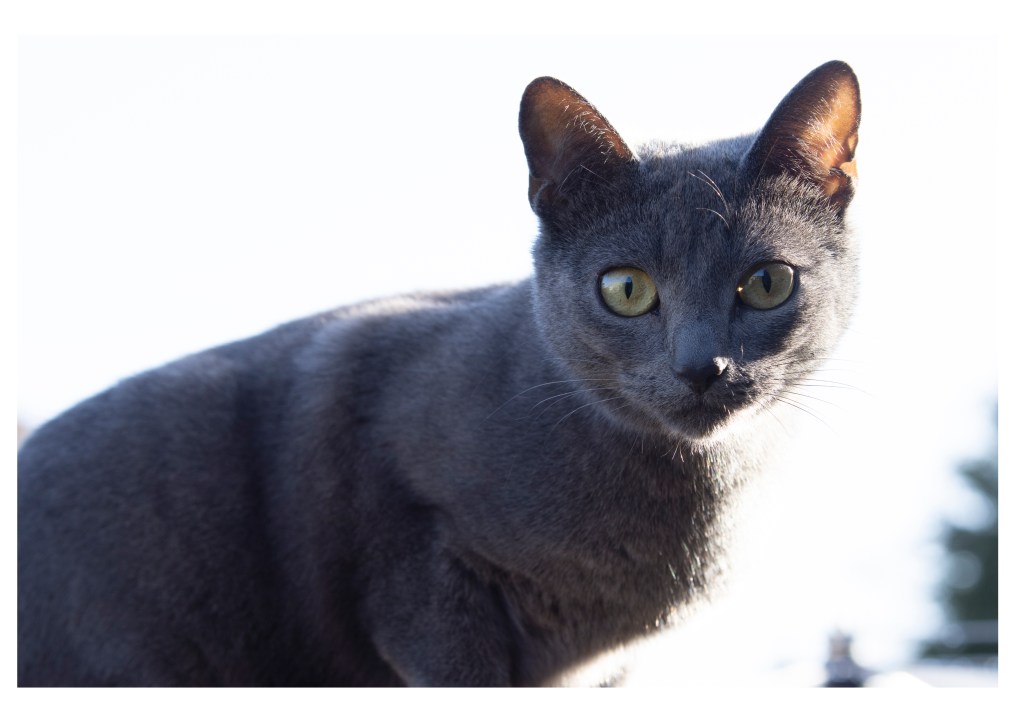
What are you looking at? f/3.5 1/200sec, ISO-100, 200mm When I look out the window I frequently find Millie sitting here on the fence. Sometimes she’s looking around, other times she’s staring in the window at me.
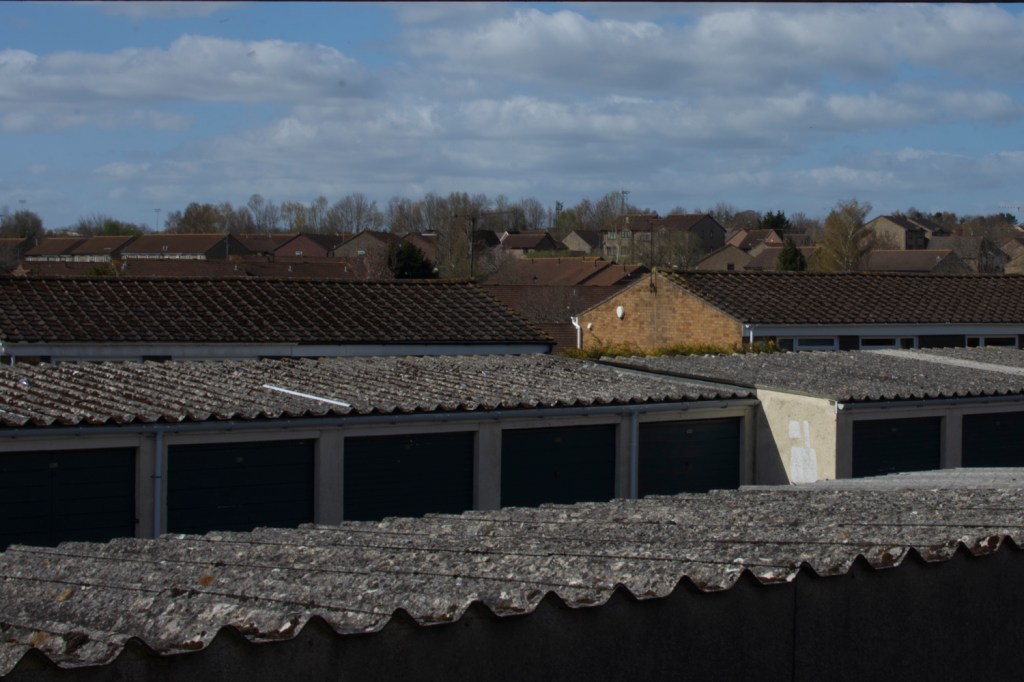
Get ready f/5.6, 1/200sec, ISO-100, 200mm The cats love the corrugated roof of the garages that border my garden. Charlie decided he was going to go for a wander one morning.
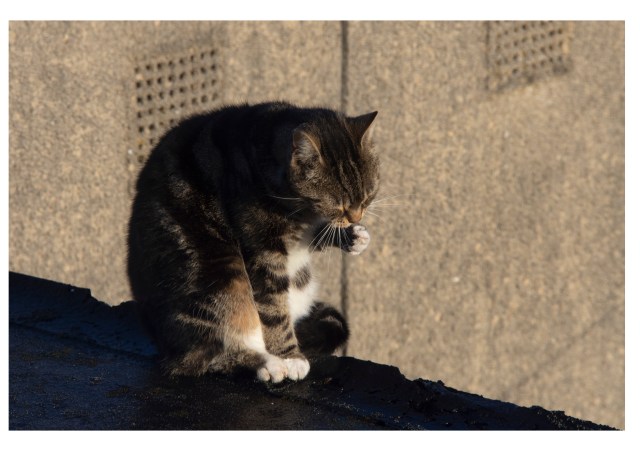
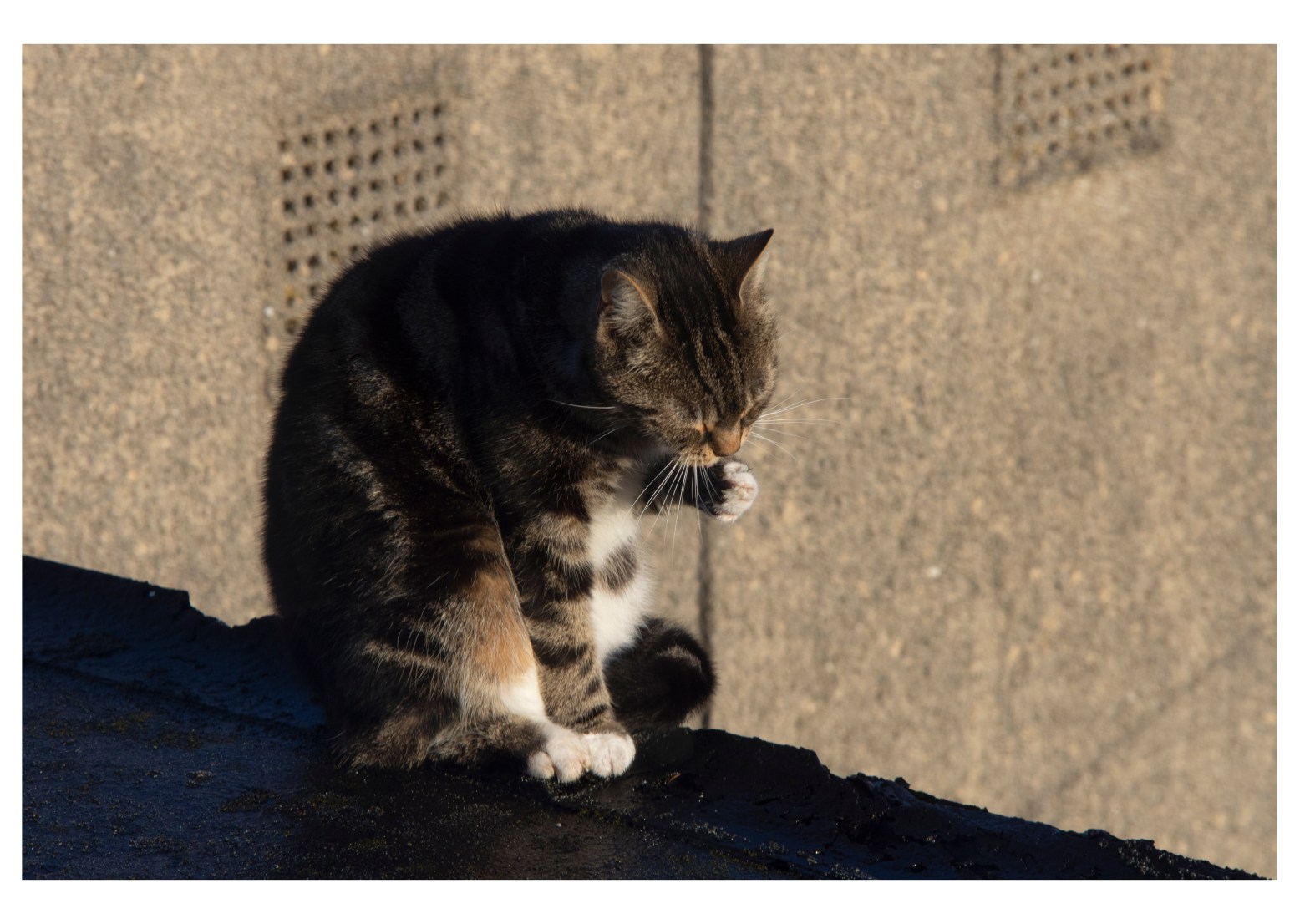
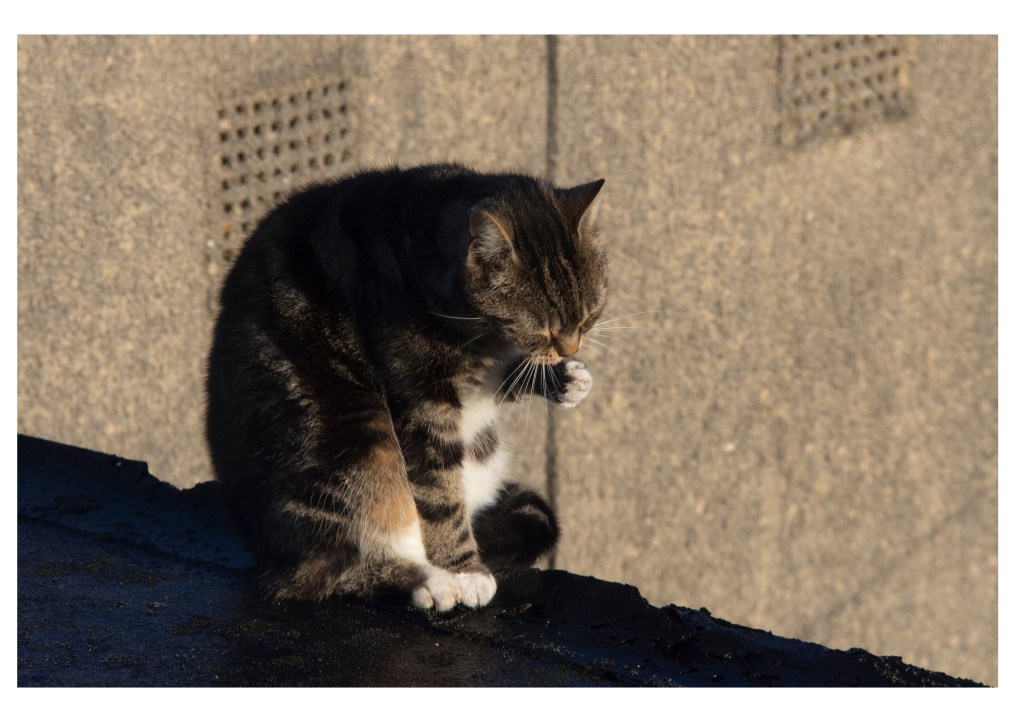
Getting clean f/10, 1/200sec, ISO-400, 190mm One damp morning I found Charlie sat on top of our garden shed. Here he is while cleaning himself.
Heading for home f/9, 1/250sec, ISO-400, 95mm Jack got bored of wandering around my garden so decided to go home.
Up and Over f/16, 1/200sec, ISO-400, 200mm A rare visit from Billy.
Assessment against criteria
LO1 demonstrate an understanding of photographic techniques and image making
Throughout this part of the course I have experimented with different techniques.
For the assignment images were captured using lenses with a variety of focal lengths. To photograph flowers and animals such as snails a macro lens was used to allow me to get closer to my subject. For some images a flash was used but I found that this overwhelmed the subject and so I fell back on using natural light. Using flash in this way is something I need to practice so that I can improve upon my image making skills.
Other images were captured from a distance and it soon became apparent that with longer lenses a faster shutter speed was required in order to compensate for vibration when the camera was held in the hand.
Exploring the images produced by Harold Edgerton led to exploring water drop photography in more detail, and especially the techniques that are used to captured such images. Depending on your level of interest in this area of photography you can use items that are found around the home or look at purchasing, more expensive, specialist equipment.
Slit Scan photography, as explored in Exercise 3.2 – Trace, provided the opportunity to move away from my DSLR and to explore a new way of using the camera on my phone. Downloading a Slit Scan photography application allowed me the freedom to capture images whenever I wanted to and gave me new ways to capture dance and movement.
LO2 present a selected body of photographic work
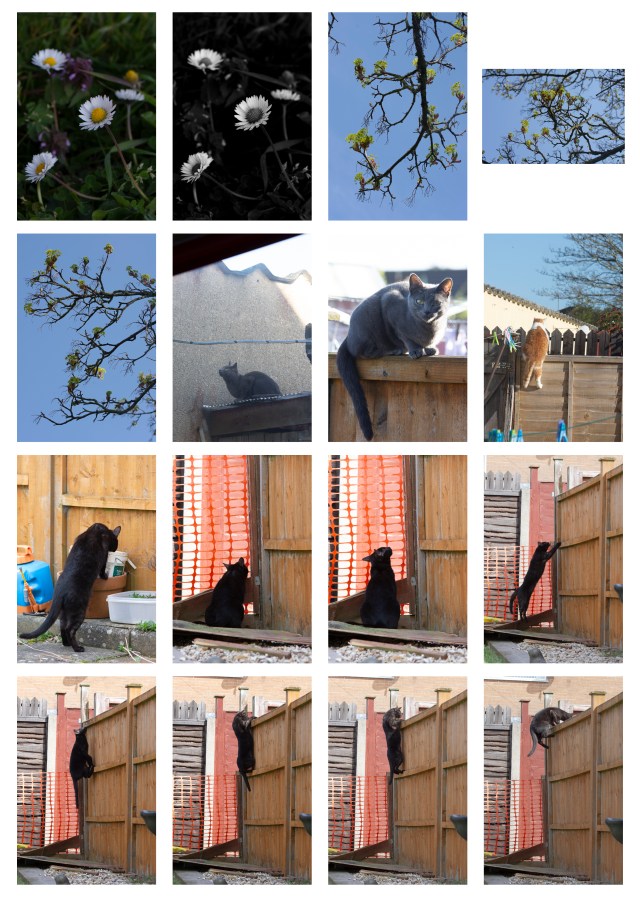
Through the different ideas that I have worked on for this assignment, and which can be seen in the images submitted, the contact sheets below, and the other reflective items in my Learning Log (Decisions, Lockdown Reflections) I think I have demonstrated the process that I have gone through in order to present the above selection of photographic work.
LO3 develop and communicate your ideas as a photographer
I believe that I am getting better in this area. One of the ideas that I rejected for the final submission I made use of text with each image. The text reflecting my thoughts while reviewing the sequence of images I had opted to use.
LO4 demonstrate a critical and contextual understanding of photography and reflect on your own learning
This is still an area that I feel I’ve not quite achieved enough improvement with. I have explored areas as a result of the coursework and assignment for this part of the course. When exploring the Decisive Moment there was a lot of material written by photographers. Delving into more of these writings, pulling out key points and ideas is something I need to become better at doing.
The Present – Paul Graham reviewed by Colin Pantall
In Colin Pantall’s review of Graham’s book The Present, Pantall, C. (2012), he highlights how the images presented are the opposite of the decisive moment, so much so that we are left in the position of not knowing what we are looking at.
Pantall suggests that Graham’s images are open to the interpretation of the viewer, that each image allows the viewer to seek out what draws their attention rather than what the artist wanted to draw their attention to.
The presentation of the images as diptychs and triptychs aids this by providing the opportunity to flick between similar images looking for differences.
It’s a bit like playing a game of Spot the Difference but where you haven’t been told how many differences there are.
To fully understand what Pantall is talking about, you need to look at the images themselves. An online image search for “Paul Graham the Present” brings up a number of images from the book as well as photos taken of exhibition installations.
Each of the images that Paul Graham has used are fairly unremarkable, everyday scenes that could have been taken by a tourist. Ordinary people, doing ordinary things.
Each image is different to the others within it’s particular group. In nearly every image nothing remarkable is happening. You could see a similar scene on any street, in any city in the world. Although maybe not at the moment during the COVID-19 pandemic.
There are, however, exceptions. In one pair of images a group of people are seen walking along. In the second of the pair, one of the people, a woman, has fallen over and some of the others are gathered around her.
The actual moment that she fell has been missed. The Decisive Moment is not shown, whether it was missed accidentally or deliberately, or it was captured but not used does not matter. Instead we are left to witness the aftermath and speculate on the cause. We are left to interpret the image in our own way.
In actuality, using an image of the moment that the lady fell would have undermined the whole approach that Graham was aiming for and which Pantall brings to our attention in his review.
Zouhair Ghazzal
The article the indecisiveness of the decisive moment, decisive moments (2004), was a very difficult read. Not because it is complicated but because the layout of the text makes it very difficult to follow, leading to re-reading parts of the text, or even missing sections because of how the eye follows the text as it moves down the page. Copying it to something like Microsoft Word makes it easier to read and digest.
Ghazzal suggests that overuse of something can result in it being turned into a cliché, no matter who uses it, even Cartier-Bresson.
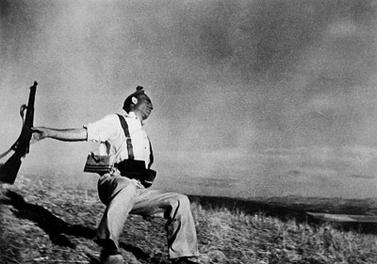
Capturing decisive moments has become harder to achieve in more recent times as photographers spend more time photographing the same subjects over and over. The prevalence of selfies, Snapchat and Instagram where the subject tends to be the photographer rather than the environment around them or what is happening in it, supports this idea. The indecisive moment is more important today than the decisive one. Even in photojournalism we are presented with the aftereffects of events and not the moment that they occur. Cartier-Besson’s image that defines the Decisive Moment or Robert Capa’s image of the Spanish infantryman are rarely seen now. Instead we are bombarded with similar images, telling us the same story over and over.
For decisive moments it is the moving image whether from professional film crews or the person in the street with a smart phone that we can witness Decisive Moments. The moment that JFK was assassinated, the impact of the second aeroplane into the Twin Towers, the collapse of both the buildings. These are images that we are all familiar with, but the still images are single frames from a series of moving ones. In the case of the Twin Tower, the majority of images were not captured by professionals but by amateurs who happened to be on the ground at the right moment. Perhaps that is where the future of the Decisive moment lies, not with photographers such as Henri Cartier-Bresson but with the person on the street, caught up in events who has the presence of mind to take out their phone, hit the camera icon and begin filming.
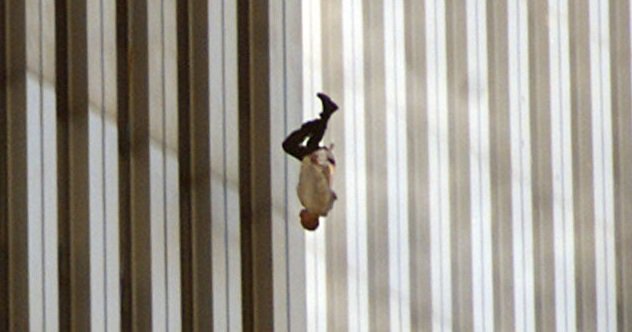
Ghazzal, raises the issue of taking a series of images, each which on its own might have something decisive about it but when added to a series loses that meaning. How then do we ensure that we continue to show something decisive when we move beyond the single image and into a multiple of images that have a linked or overall meaning? How do we ensure that what is decisive about each image continues to stand out? Is it a simple matter of choosing the images that we use and only picking those where it is possible to discern a moment of importance? The Falling Man image from 9-11 is iconic, it shows someone who has decided that they would rather jump from a building than burn to death.
The Falling Man By Associated Press photographer Richard Drew
The image is important and shows just how overpowering the need to survive can be but the Decisive Moment, certainly for me, would have been the second that he jumped. At that point he had made a horrific decision and acted upon it. The moment he left the building, there was no way to go back, no way that it would be possible to recapture it. The same is true of the moment he hits the ground. Until that point he must have been hoping that he would survive the fall, even if the odds were so severely stacked against it. The moment of impact, well, we will never know what his thoughts were, and it is impossible to imagine but that is the moment that a life ended.
H. Cartier-Bresson: l’amour tout court
Watching and listening to such a well known photographer is special. The documentary isn’t just about Cartier-Bresson and his photography but also about several other photographers and the work they do. The documentary title translates as ‘Just Plain Love’ and it is that love of image making that comes across from all involved.
The documentary gave me the impression that Henri Cartier-Bresson was a very vocal and opinionated person. Someone who was very aware of the world around them. A person who was critical of their own work, to the point that he criticises some of the images that a curator of his work as chosen at one point during the film.
I also think that he was also very modest and self-deprecating.
Watching the documentary I found myself drawn to some of the things that he said when discussing photography.
“We live in a privileged world, we don’t have to go to far to see”. The current situation has forced us as students to look at the world around us, we don’t have the freedom to go wherever we want and so have to pay particular attention to things that we might normally have ignored.
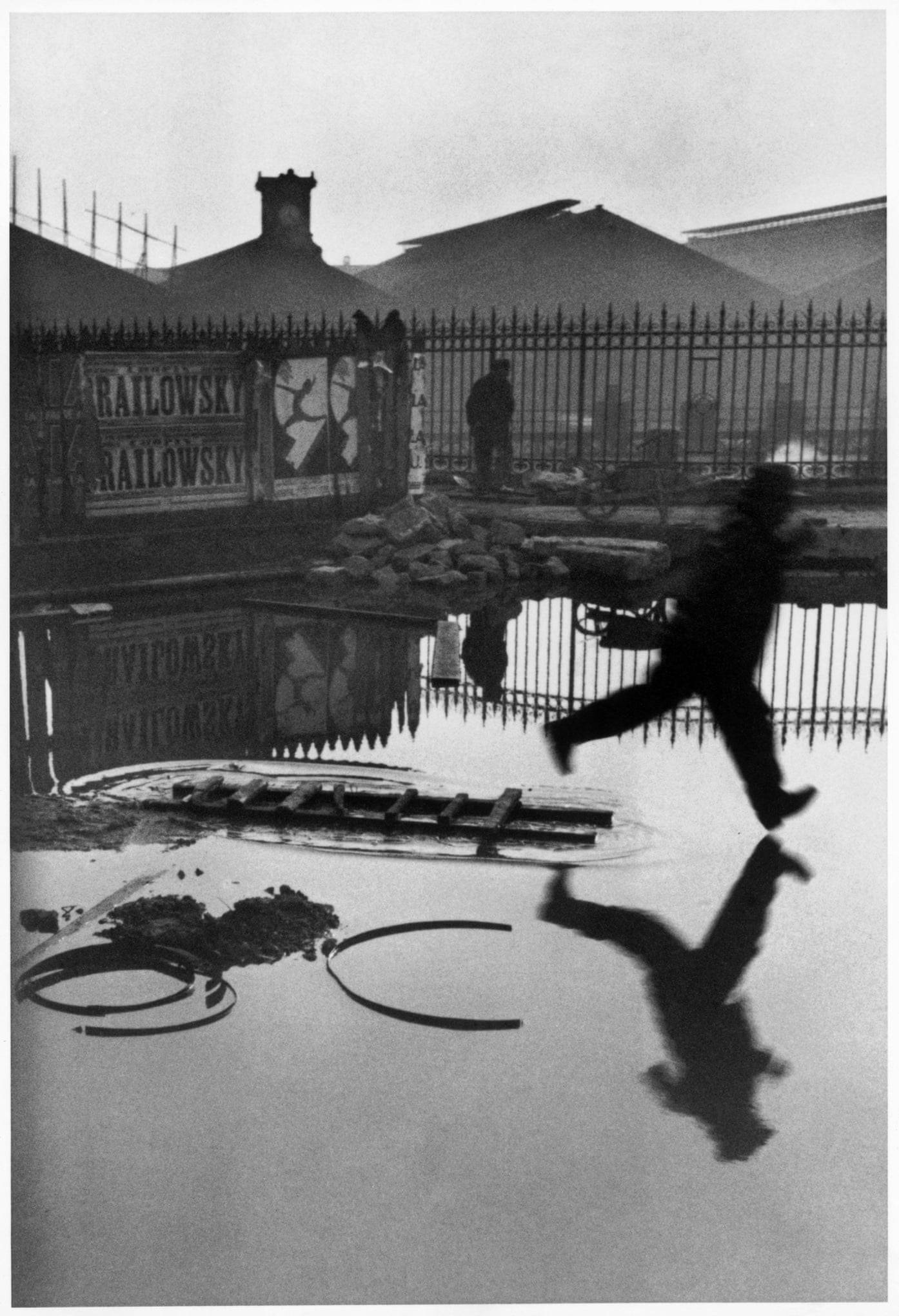
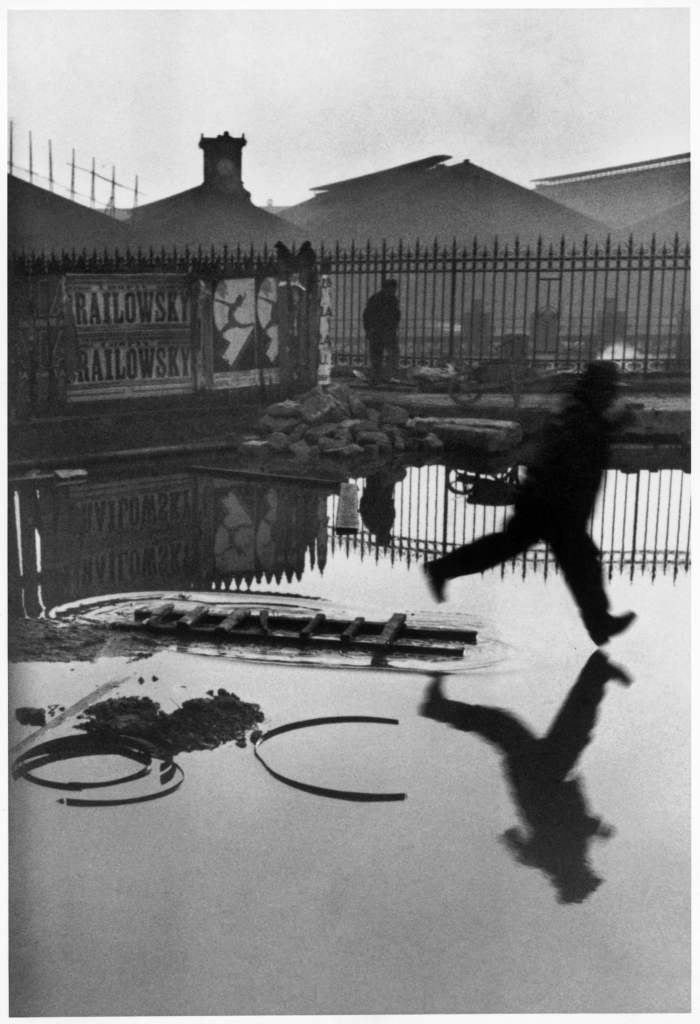
“Its always luck”, “Luck is all that counts”, “If you’re open it will come.” When talking about his photograph Cartier-Bresson says that he didn’t have a clear view of what was happening, he managed to get his lens through the bars but couldn’t frame the image intentionally to get the figure running. Such an important image, an important concept in photography, comes down to luck and pressing the shutter release at the exact right moment.
France. Paris. Place de l’Europe. Gare Saint Lazare. 1932. Photograph: Henri Cartier-Bresson/Magnum Photos
In his article, O’Hagan, S. (2014), about Sean O’Hagan says “The decisive moment has come to mean the perfect second to press the shutter.” In 1932, when Henri Cartier-Bresson took this image, and when other photographers like Capa, Taro, Franks, Winogrand and their peers were capturing their images, there was no digital cameras, just film. Capturing the image was, indeed, a matter of pressing the button at the right moment. Today with digital cameras and the ability to set the to capture high speed bursts of images, it isn’t so much a case of pressing the button at the perfect second but being aware that something is about to happen so you can release the shutter and capture a period of time, including the moment what you are waiting for happens.
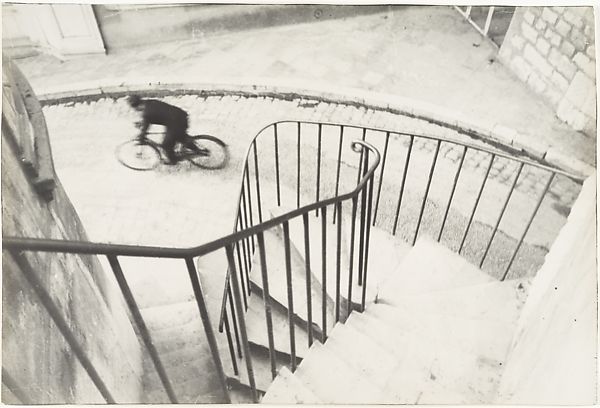
For Cartier-Bresson “Form comes first. Light is like perfume for me” and that is well illustrated by his photograph taken in Hyères, France. Composing the image, getting the shapes right and then waiting for the right light makes this a great image. Having the cyclist come through just at the right moment is luck, although it is possible to have an inkling that they are coming through, catching them at the exact moment they were opposite the bottom of the staircase is challenging, and requires a large dose of luck.
There are so much that we can learn from Henri Cartier-Bresson but the one, really important, thing that we can learn by watching this documentary is when he says:
“You need to learn to love to look. You can’t look at something you don’t love.”
We do need to learn to do this as photographers and artists. If we can’t look at something because we don’t love it, then how can we expect to capture those Decisive Moments when they happen.
Reflection
By the time I sat down to right up this research I’d already taken the majority of the images I was going to use for Assignment 3. I had an idea of which series of images I was going to use, but finalising this learning log entry has made me reassess that. In particular Zouhair Ghazzal’s article has made me think about what I was going to submit.
After reflecting on the three sets of images I’d put together I was going to go forward with a series of a cat jumping up on a fence. Ghazzal’s comments about using a series of images made me realise that what I would be showing was a series of decisive moments as the cat jumped but these moments would be lost in the overall idea that it was just a cat jumping. To demonstrate a grasp of the Decisive Moment would mean stepping away from a series of images that tell a story and using a set that show moments that have gone and cannot be captured again. Hopefully my new selection of images will show that.
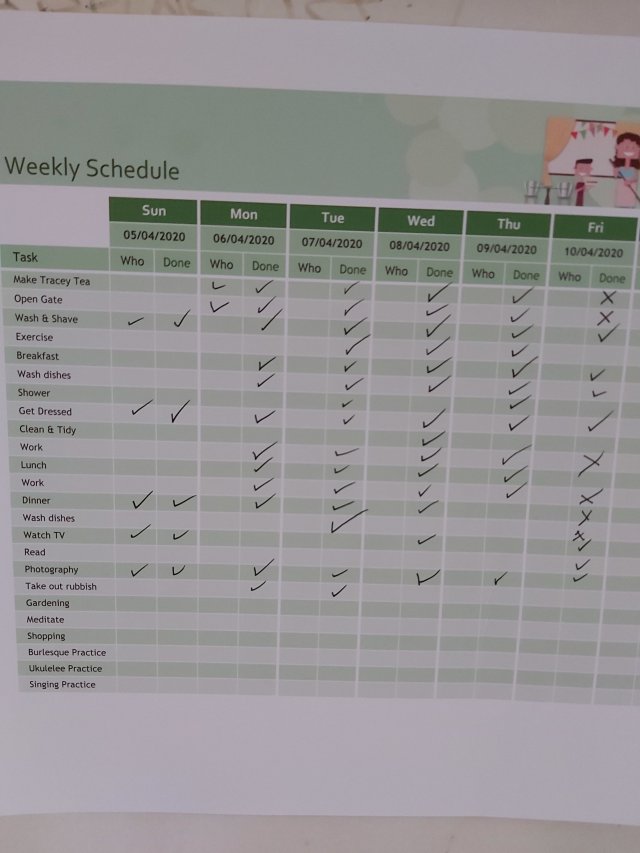
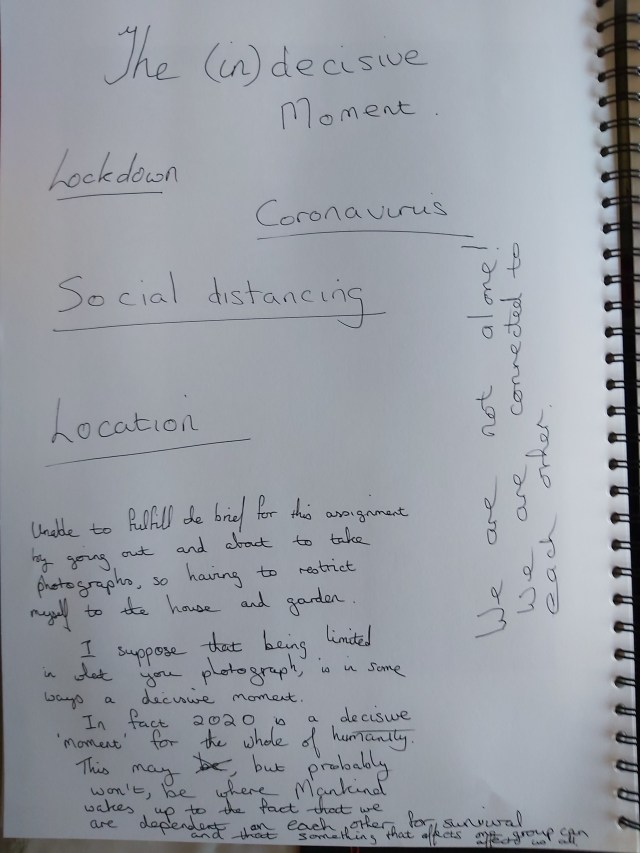
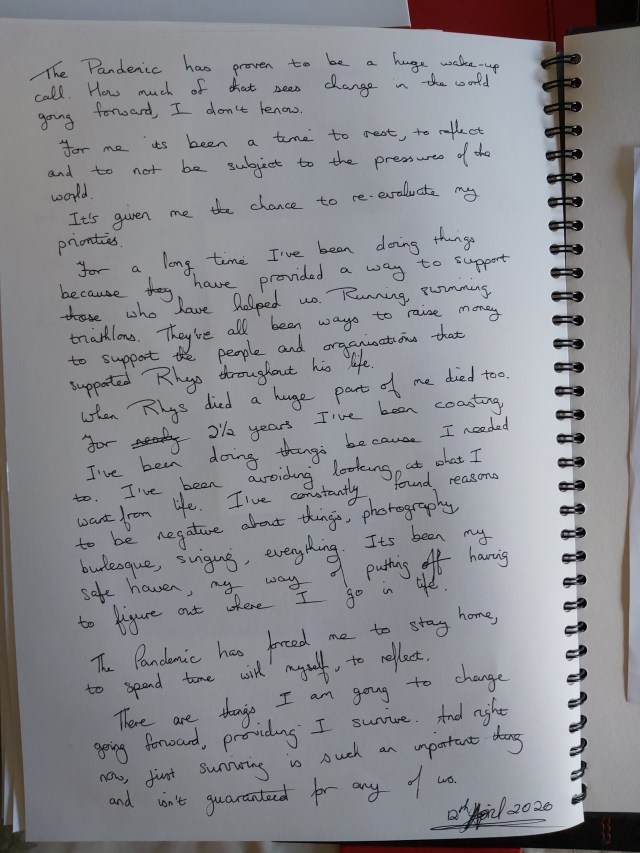
This is the fourth week that I’ve been at home since the Lockdown started. Monday to Friday I’m normally on my home until my partner gets back from work, which is usually around lunchtime. Most days I’ve been working from home, I’m lucky enough to be able to do that. Still being at home gives you time to think and as I’ve been adding material to my sketchbook I’ve found myself going back through the pages and annotating it with my thoughts.
After the first two weeks I decided that I needed to get myself into a routine and so I set up a schedule for myself. Nothing to fancy but it provided a bit of structure to the day.
This week I’ve not set myself up with a schedule, I don’t really need it because I’ve taken a few days annual leave, and the company I work for have reminded all staff that even though we are working from home for now, we should still use up our leave because having breaks are important to our mental, emotional and physical wellbeing.
On some social media platforms people have been sharing posts and tweets about how the Earth has finally decided to heal itself, and the Pandemic is it’s way of doing this, by forcing Mankind to hit the pause button, to stop travelling, to stop doing damage to the environment.
It’s nonsense but it has been nice seeing images of animals like goats and deer wandering around town streets. Seeing skies that have a marked absence of contrails has been nice, as has being able to simple pause and listen to the outside world and not hear the constant hum of traffic or people.
I do think that we are at a point in history where, we have the chance to look at our world; our civilization; the way we live and to decide whether that is the way we continue, or whether we take the opportunity to change.
It has been clear from the groups that have been set up in towns to support those that are unable to look after themselves fully, because they are vulnerable, or are busy putting their own lives at risk, that people are, at heart decent individuals. Events have shown that we are connected to, and depend on, each other in so many ways.
What harms one group, can no longer be taken as something that does not affect us all. Only a century ago Spanish Flu killed between 50 to 100 millions people around the world. It is likely that Coronavirus will not lead to a similar number of deaths but once again we as a world are facing deaths on unimaginable scales. Very few people around the planet will be left untouched by this disease.
Is this the point where Mankind changes and finally starts working towards ensuring the safety of all people, not just those who live in countries where they are relatively safe and not faced with famine, war or disease? Or will, if we survive as a species that long, find ourselves in 2120 facing another Pandemic that threatens to wipe out large numbers of the human race.
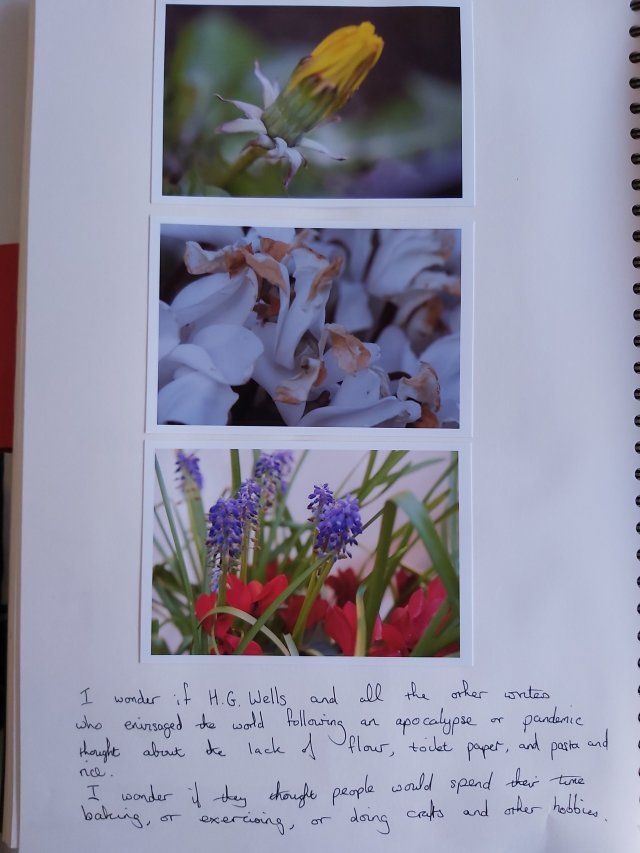
Over the years I’ve read novels and watched TV programmes and films where mankind is facing an apocalypse, whether through disease, war or alien invasion. Never did the writers of those stories every mention shortages of flour, toilet roll, pasta, rice, pasta sauce and hand sanitiser. Neither did they mention people spending their time baking bread and cakes or exercising whether outdoors or in front of TV and computer screens.
I wonder what HG Wells would have thought about how our world and its people are dealing with this crisis.
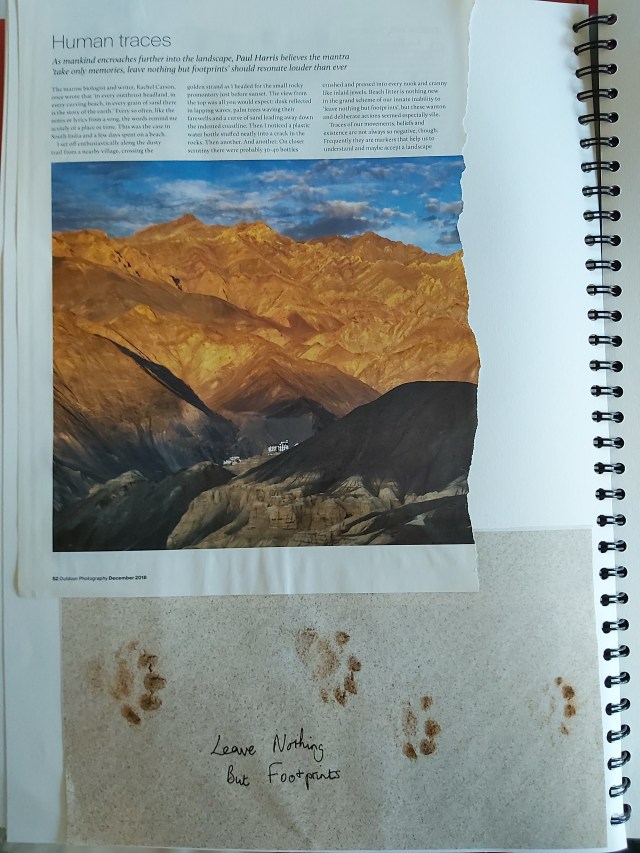
Flicking through some photography magazines I found the article above and separately the image of pawprints. I had to include the two together in my sketchbook “leave nothing but footprints” is how we should be treating nature.
Being under lockdown has given me time to think about things, about my plans, my goals and provided the chance to figure out what is really important to me going forward.
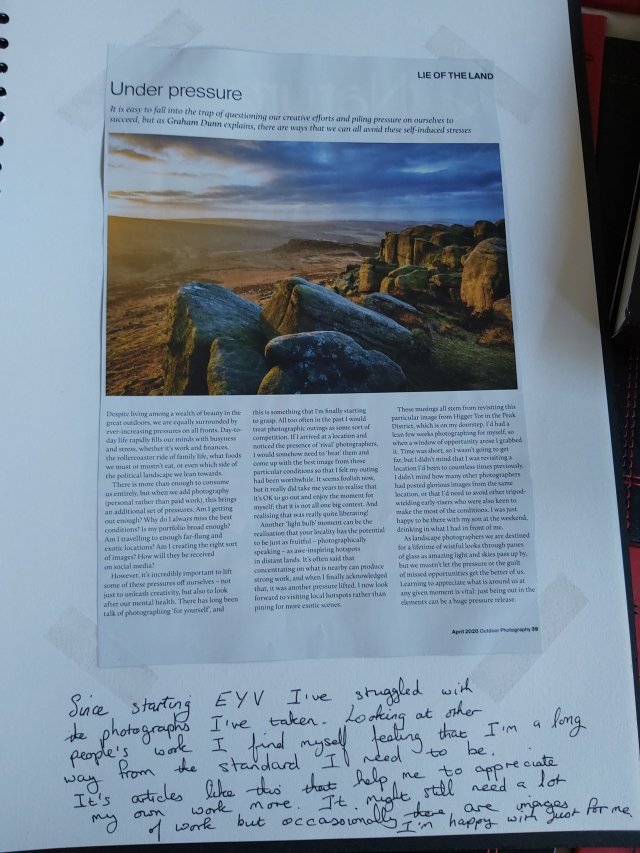
Again, while leaving through a magazine I found an article that resonated with me.
Since I started studying photography on the Foundation in Photography and now the degree course I’ve learned a lot about the subject. Its history, the different techniques that have been developed over the decades, different photographers and their work, and I’ve enjoyed every minute of it.
I do, however, find myself doubting the quality of my work.
Reading the article helped me to gain a bit of perspective and to appreciate that I’m not the only person that feels like that.
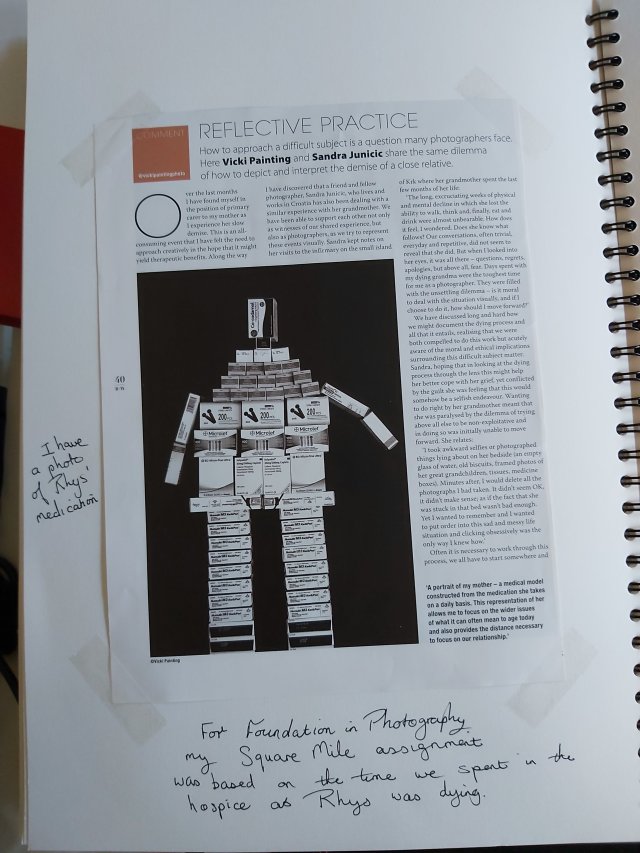
When my son passed away in September 2017 we had been lucky enough to have known he was ill and that there was a chance that he might not make it through the surgery and radiotherapy that he would need. When in the May we found out that his condition had grown worse and was now terminal we still had five months during which to make memories.
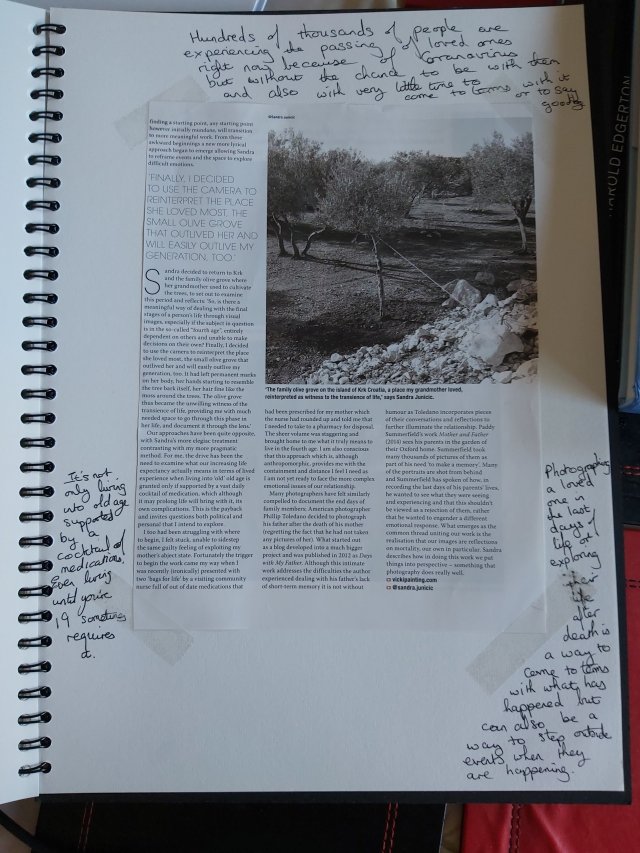
Like the photographers mentioned in the article, and several others who have explored what it is like when a close family member dies, we were lucky. So many people around the world aren’t having that chance, aren’t able to make final memories, aren’t able to be with their loved ones when they pass.
When Rhys died I wasn’t at the hospice with him. I’d taken the opportunity to go out for a break. By the time I returned he had gone. Dealing with losing him, dealing with not being at his bedside at the end, has taken a lot of working through, and its still not complete. It never will be. We had time though, we made memories that will last forever, we were able to be there with him, his Gran, Grandad and my wife were there with him at the end. He wasn’t alone or with just a nurse to hold his hand.
What we are experiencing today is going to have effects for many, many years to come, as people around the world deal with the aftermath. For once, we can’t just tell ourselves that something has happened in another part of the world, and be thankful that it doesn’t directly affect us. Now, we can all appreciate just how small our planet is, and how easy it is for us all to be impacted by events.
When it was announced that the United Kingdom was going into lockdown and we would all face restrictions as to where we could go and for how long, I was beginning to think about what I would be able to do to capture the Decisive, or indecisive, Moment.
I was aware that doing an assignment on the Decisive Moment, would be difficult, but doing it when you would not be able to go very far or for long, and certainly without being able to just sit and wait for something to happen that you could capture, that’s another level of difficulty.
Although I missed the EYV online meeting where this assignment was discussed I did read through the presentation slides and one word leaped out at me. Location.
I am lucky that I have a front and back garden. The plants in both are not spectacular but they were something to explore. Over a day or two I noticed that there were several insects, both the crawling and flying kinds in the garden, even bees seemed to be making an appearance. Possibilities.
I also have a communal open space at the front of my property that is shared with the neighbours. There is a large tree in that space which was just starting to bud. Another possible subject.
And then there are my neighbour’s cats. Our garden, and sometimes house, is a place that they feel safe to wander and explore.
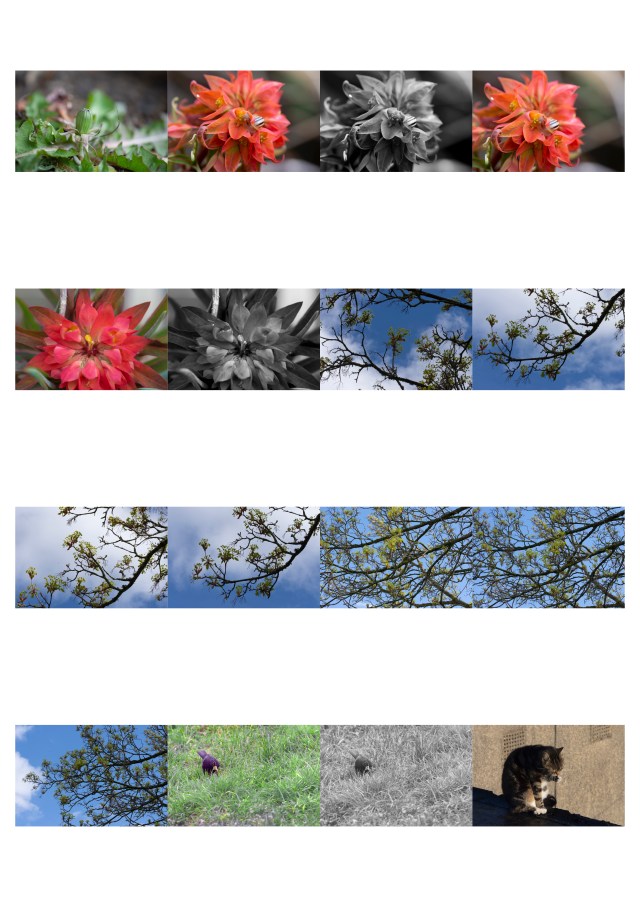
In the end it turns out that the difficult bit with the assignment, was not finding things to photograph, but deciding what to use. In total I took over 240 photographs while working on this assignment. Now I must figure out which series of images to use.
Calculating speed and trajectory
Up, Up and Away
Ok, might need a little boost
Made it
Time for a pull up
And up and over
Jumpin Jack
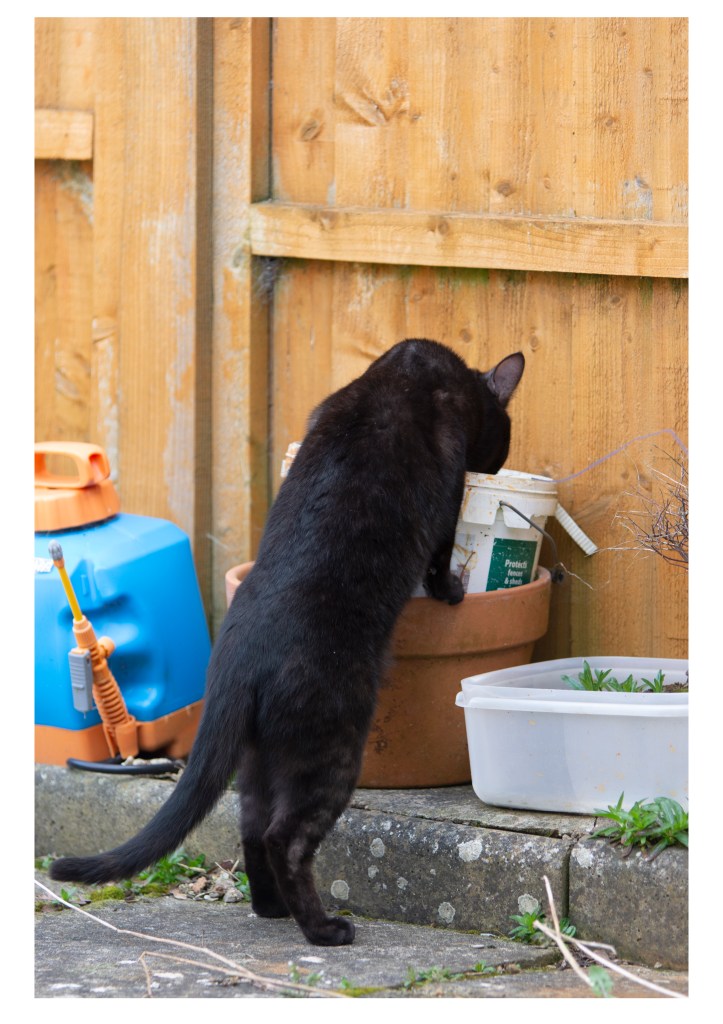
So, the first set of images is Jumpin Jack above. Jack is one of my neighbour’s cats and often can be seen wandering around my garden. On this day I was working in the kitchen when I noticed him. I picked up my camera, stepped out the backdoor. Jack noticed me but did not seem worried. Instead, he paused to drink some water out of a dirty container and then sauntered up the garden. As he did, I was hoping that he would decide to climb the fence.
Keeping my camera focussed on him I was able to trigger a burst of shots as he leaped up the fence and then over it.
When I looked at the images I had caught, the second in the sequence, left me slightly disappointed. Jack himself was slightly blurred. It was not until I realised that the blur is fine because it shows a sense of movement, and that is fine in a shot like this.
I think the second, third and final images in the sequence could stand on their own as examples of the Decisive Moment.
For this reason, I’m leaning towards using this sequence for my assignment submission.
One o’ clock, two o’clock, time passes by.
Some, find themselves closing up, shutting down.
While others, burst forth because their time has come.
Even in the darkest of time,
As death surrounds us and all withers.
There will always be new life waiting to burst forth.
To bring beauty to the world.
To find life, you just need to look for it,
Or wait for it to come to you
Life is all around you
The second sequence of images that I am considering was the first that I completed.
At the time I started taking photographs in my garden, the grass had not been cut since the end of last year. The grass was filled with daisies and dandelions. All of which were at various points of growth.
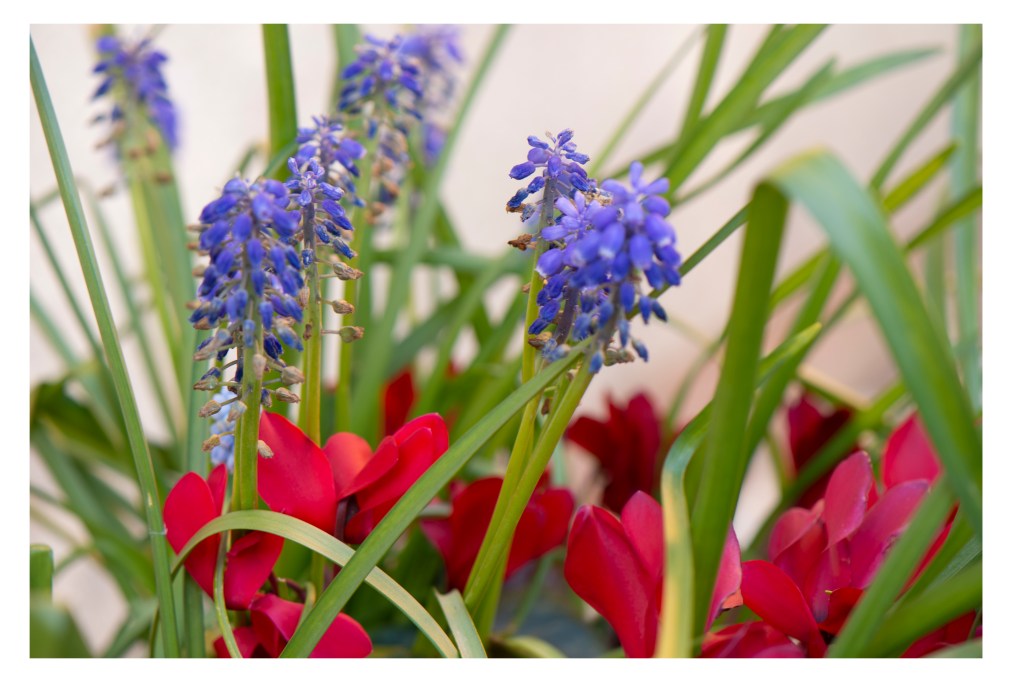
Some planters had early flowering plants as well as one of our wall baskets.
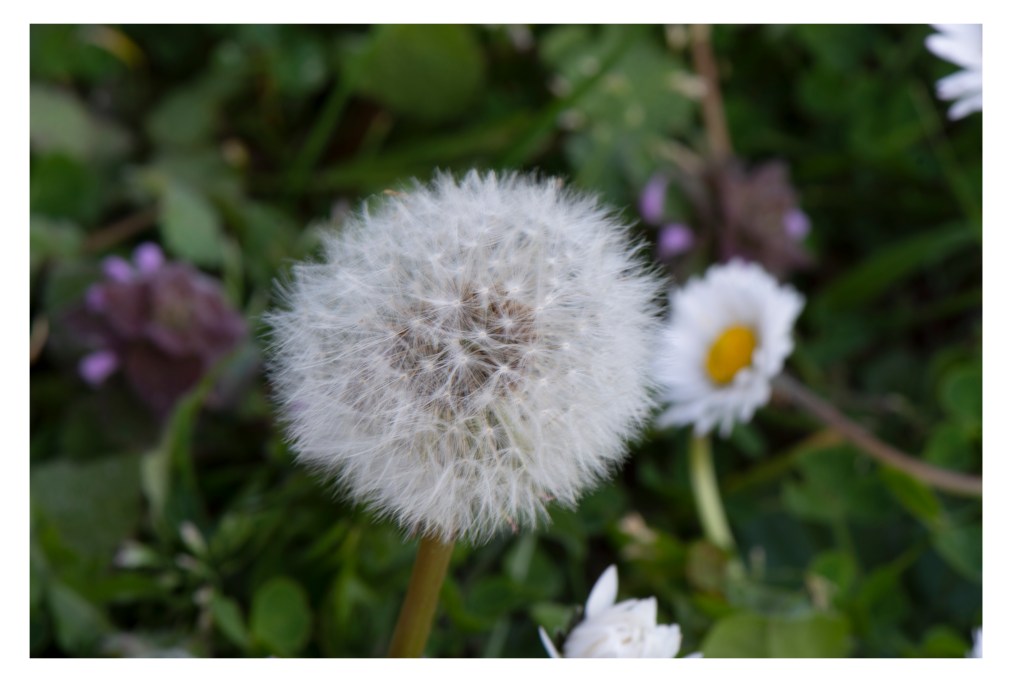
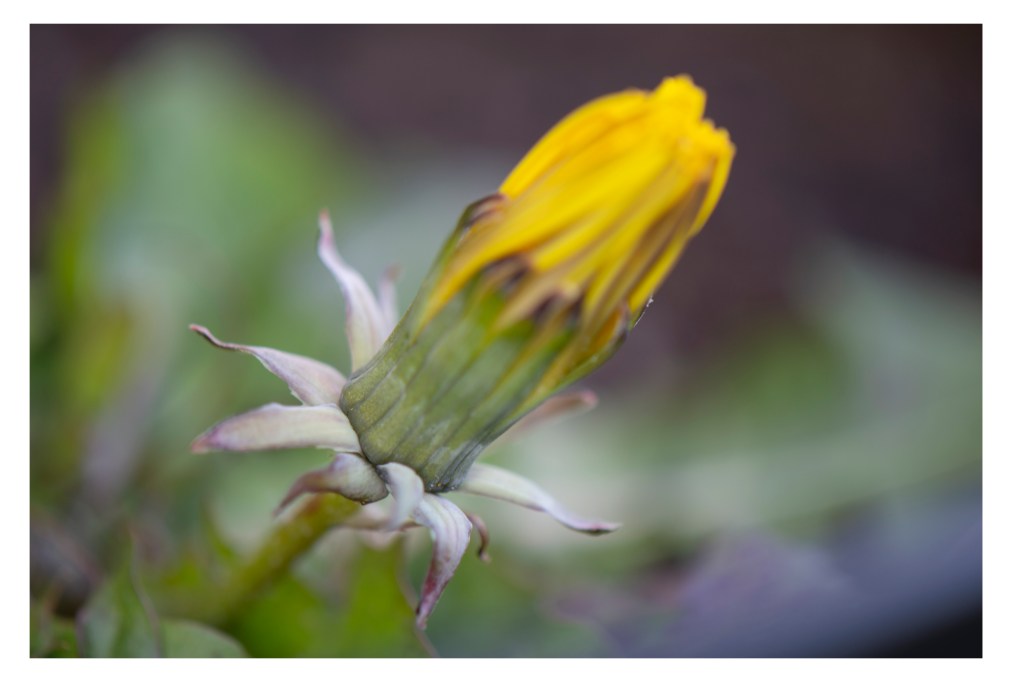
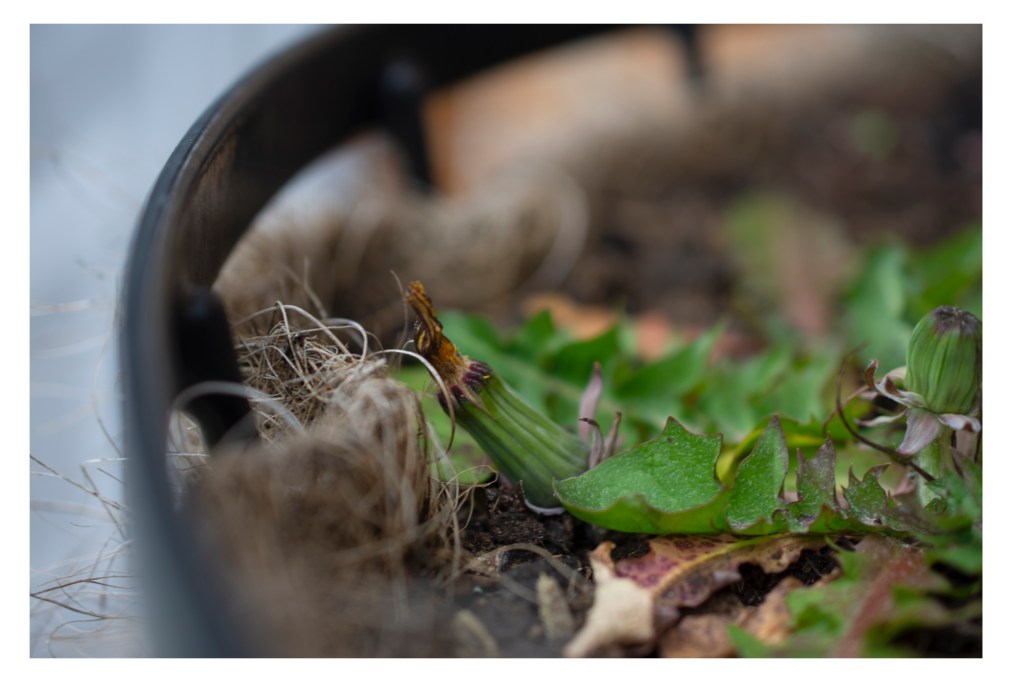
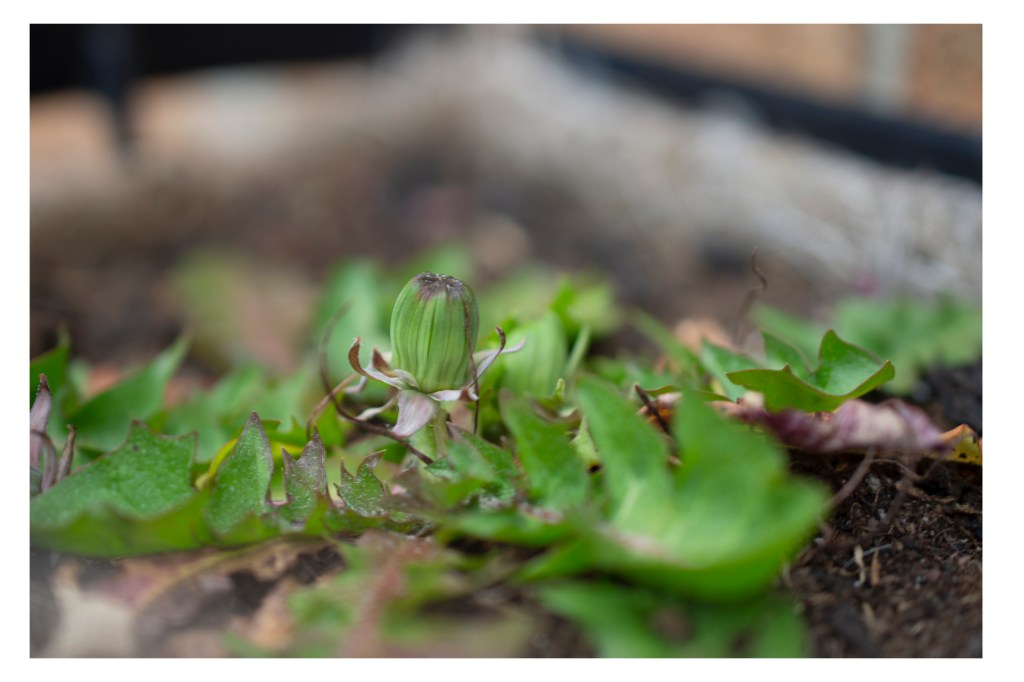
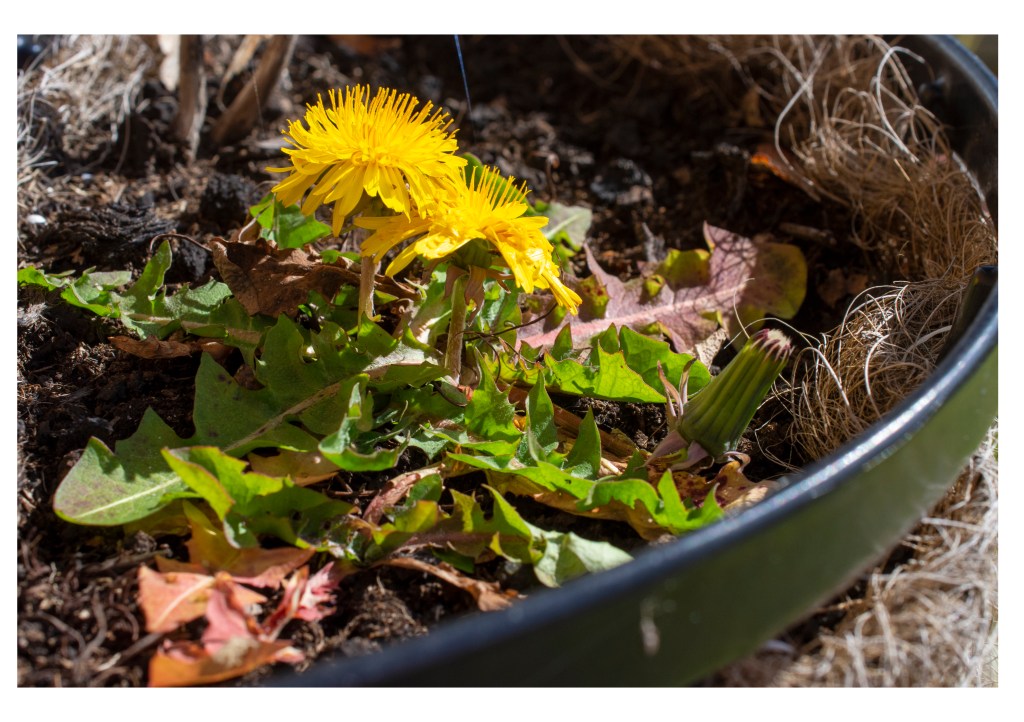
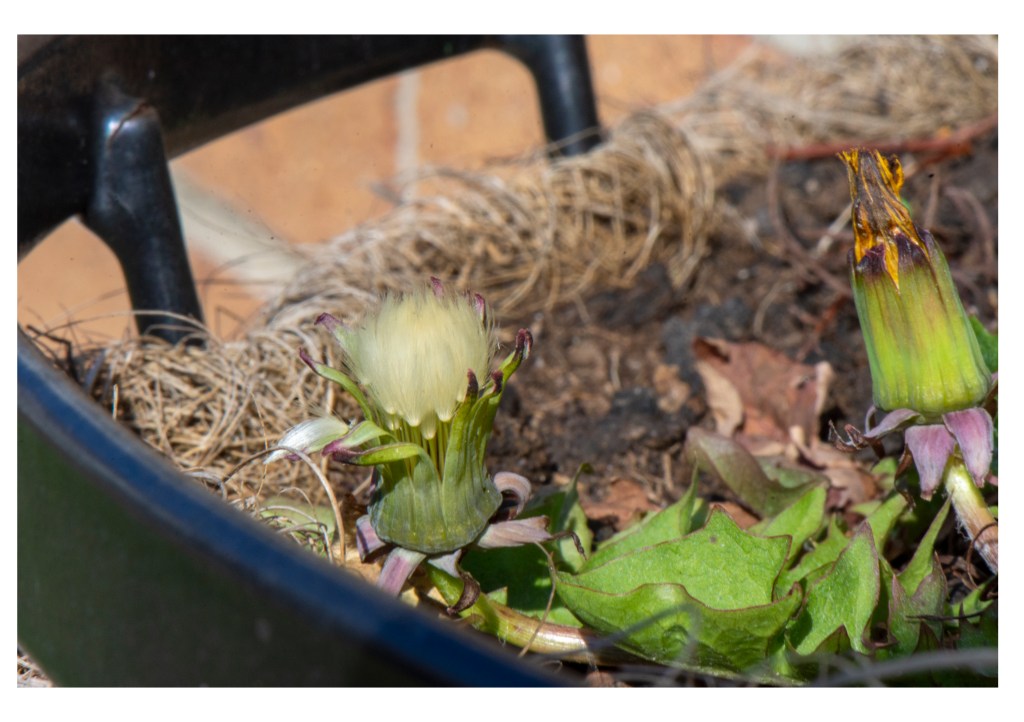
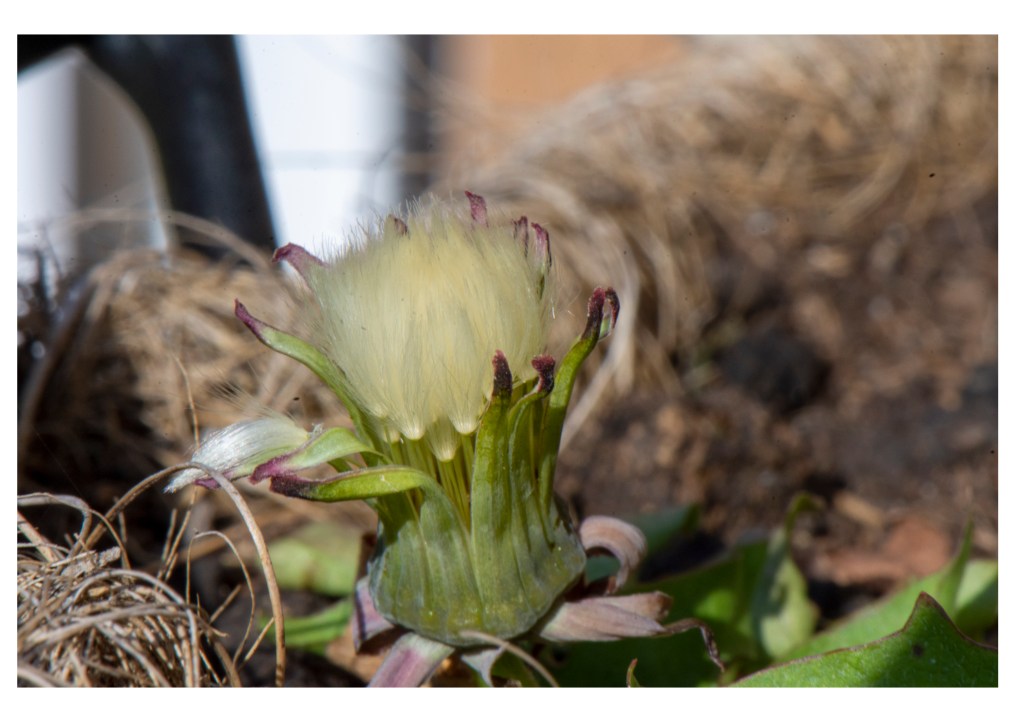
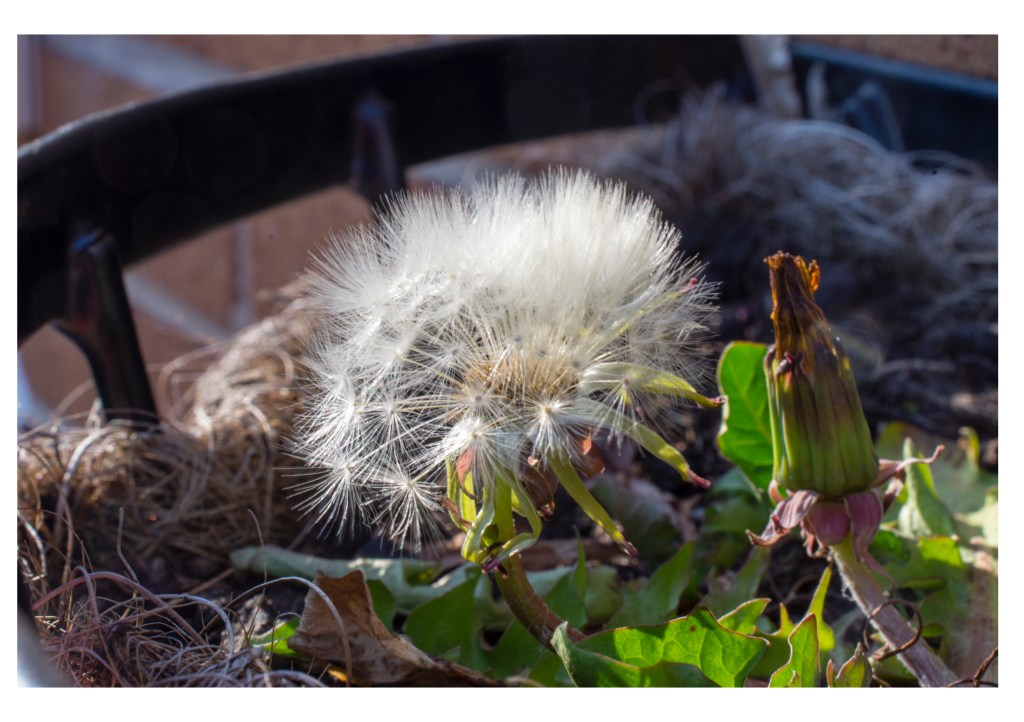
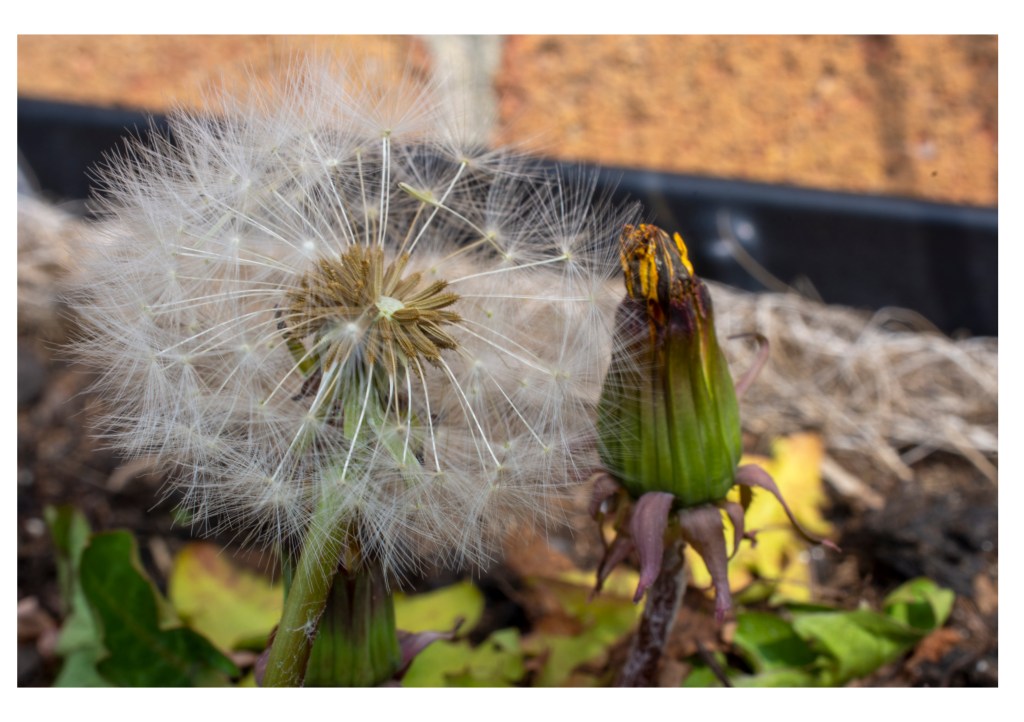
The other wall baskets were not quite barren but home to a small number of dandelions. As these grew and blossomed over the course of several days, I was given the chance to capture them.
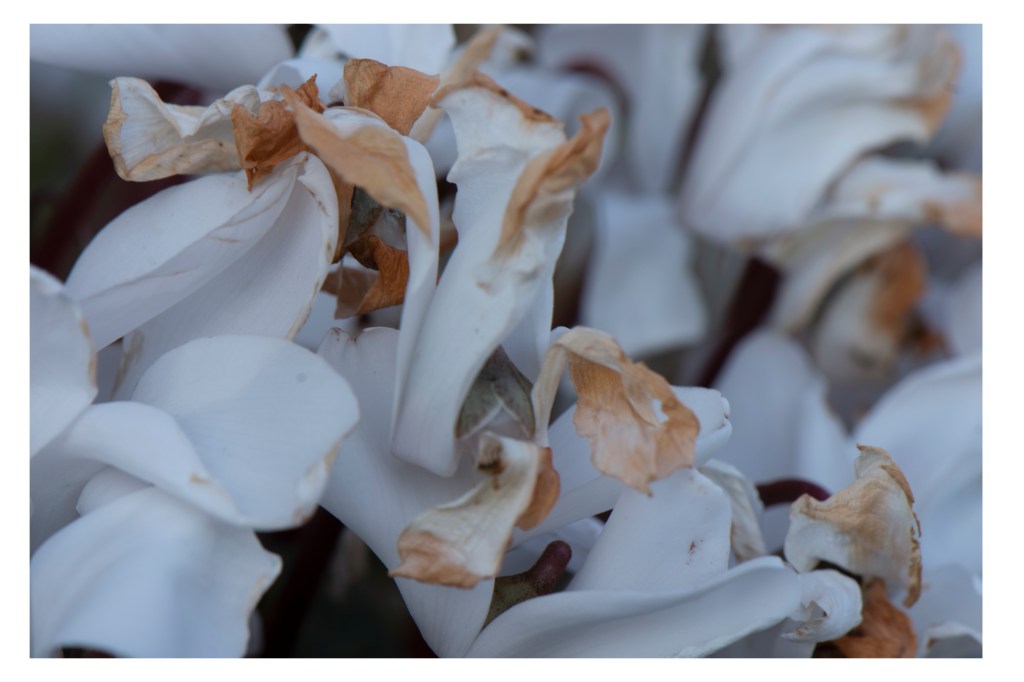
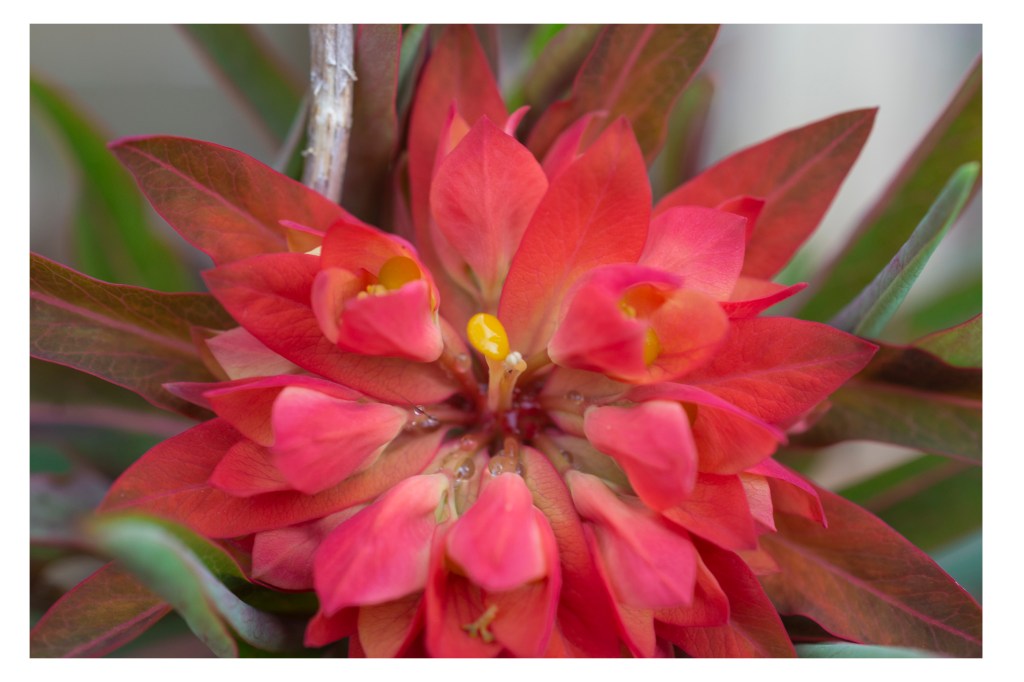
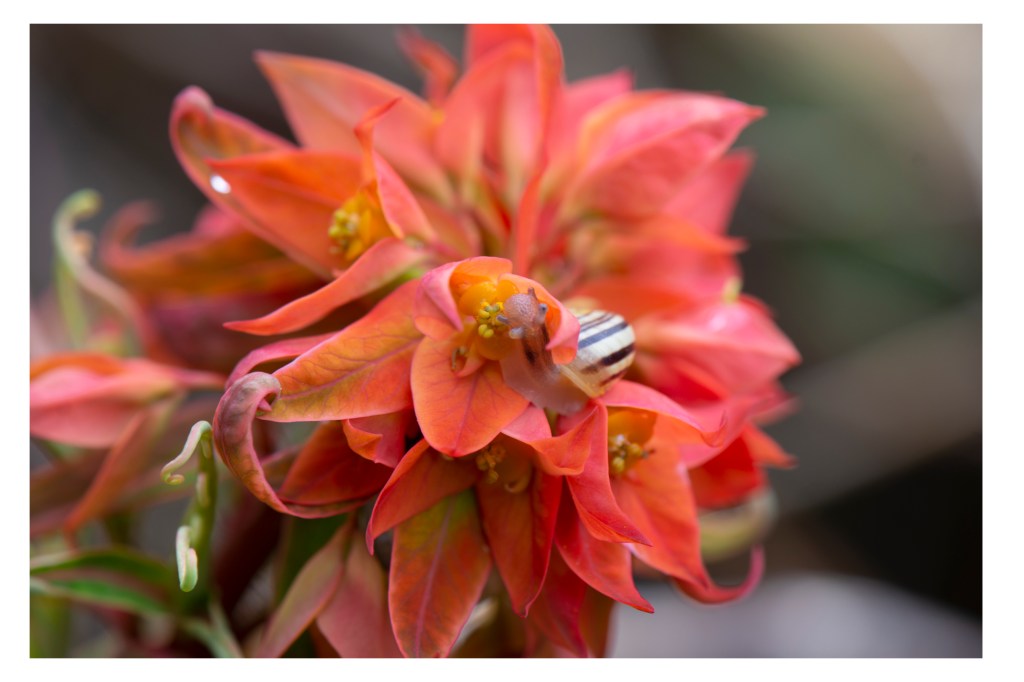
In my back garden there are a small number of plants flowering, the red one captured my attention one morning and I decided to photograph them. Within some of them, dew was still protected from the sun, on other snails were seeking sustenance.
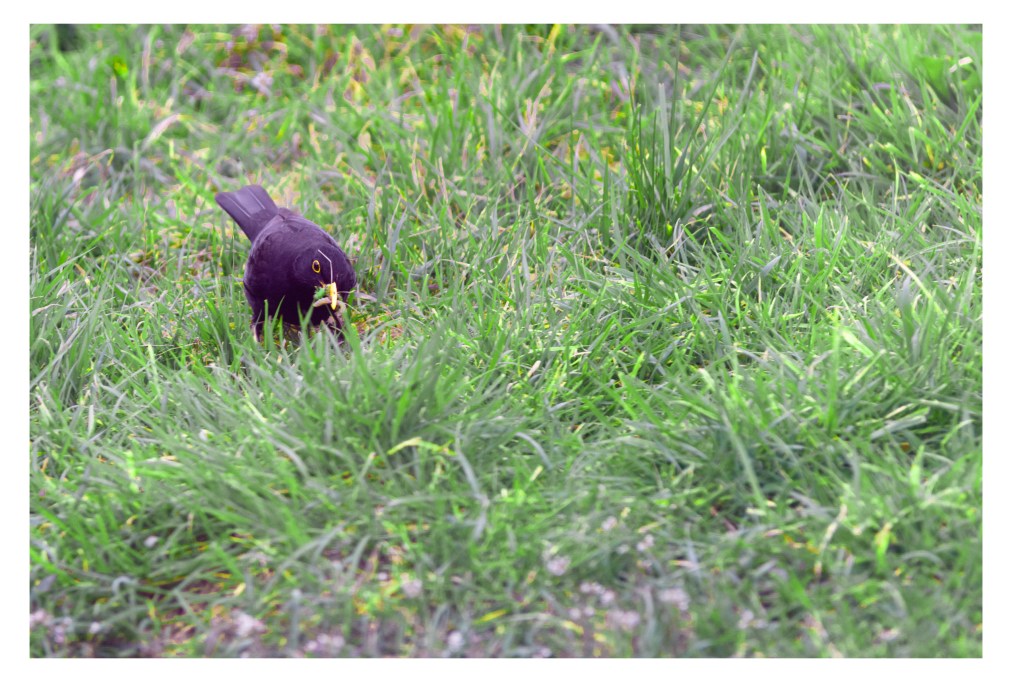
Finally, there was my friend, the bird. Over a few days I had noticed it hopping around the garden gathering worms and bits of dry grass. Keeping my camera in the kitchen I kept an eye out for my feathery visitor, and one morning spotted them. I managed to capture several images but the one above is my favourite because they are almost looking at me.
So how does these tie in with the (in)decisive moment. Initially I would have said they were indecisive moments. The flowers were there, the bird had visited on several occasions. They were not caught at a moment in time that would not happen again or which I would be lucky to capture again. At least that is how I saw them initially.
Reflecting on them I realised that they were an example of the decisive moment. The dew drops wouldn’t necessarily be in the exact same positions again, the snail would not be positioned where it appears as if it is looking at the camera, the bird wouldn’t be at that point nor looking at the camera again (grass would be cut depriving it of nesting material, another bird or animal could kill it), the flowers would bloom and die, the dandelion seeds would be dispersed by the wind. These are moments that once gone, may be gone for ever.
Like the film of John F Kennedy being shot. It exists and shows us a moment of historical importance, we can watch it over and over, we can recreate it in films and pictures, but we cannot capture those exact images, those exact moments ever again.
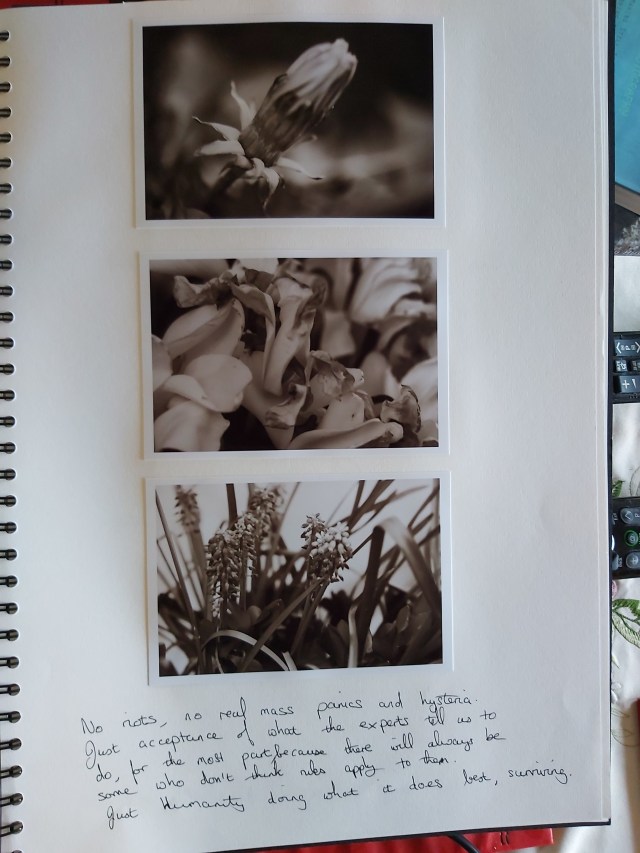
The captions attached to each image are based on something I wrote in my sketchpad while working on the assignment and trying to whittle the images down for the final submission.
Lockdown has provided an opportunity for reflection, on the past, on the future, on goals, on what is important. Some of those reflections have made their way into my sketchbook and I will include them in a different post in my learning log.
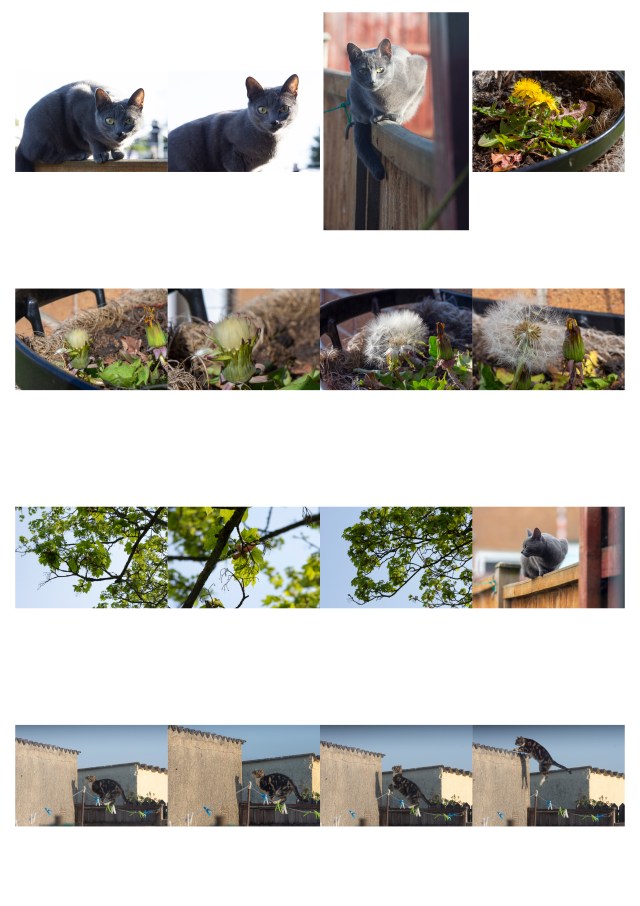
Circle of life
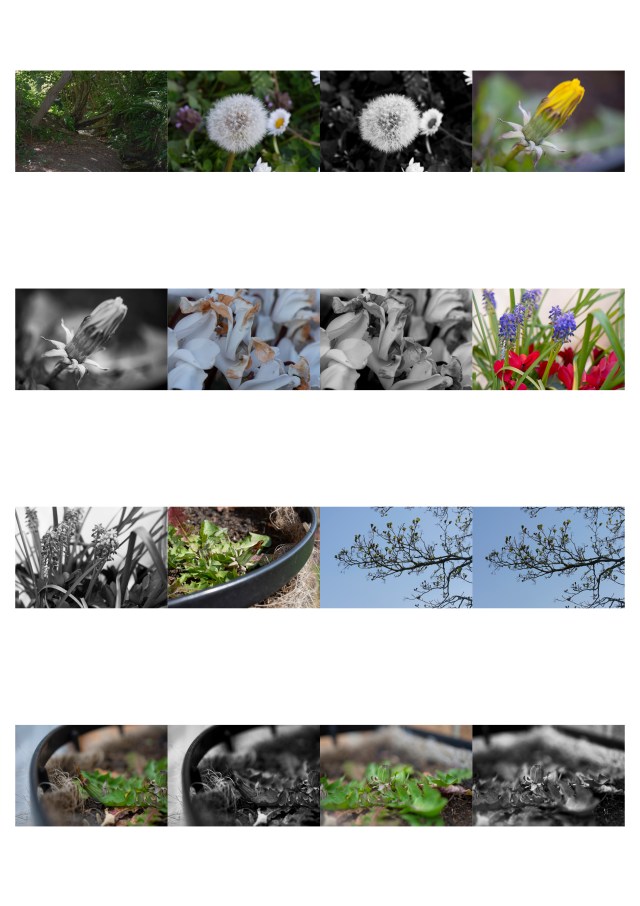
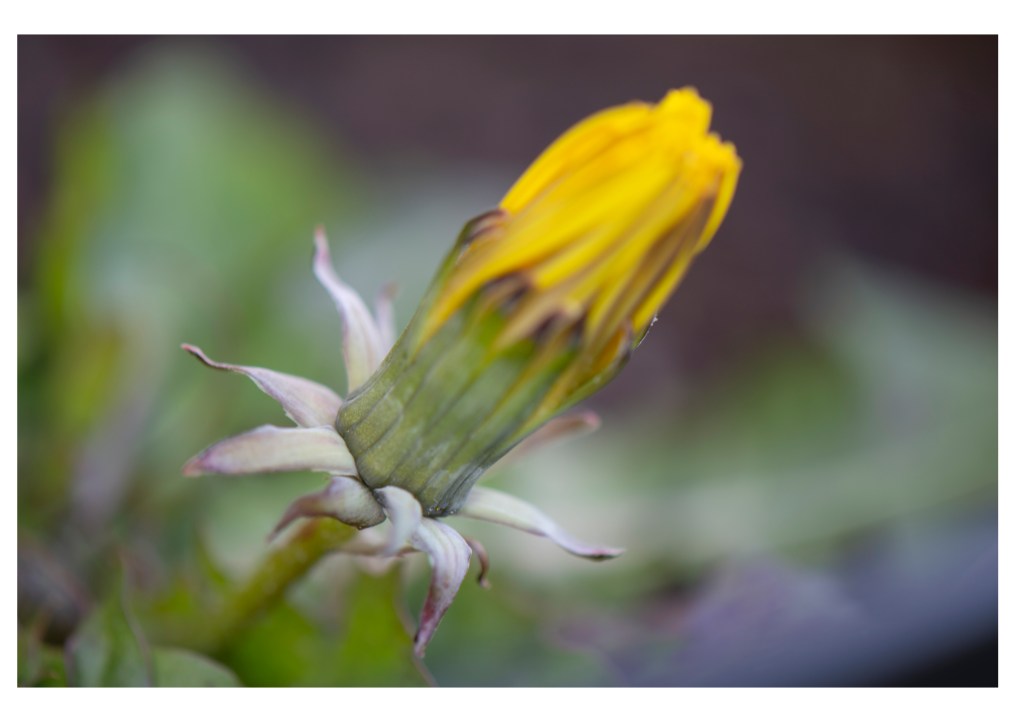
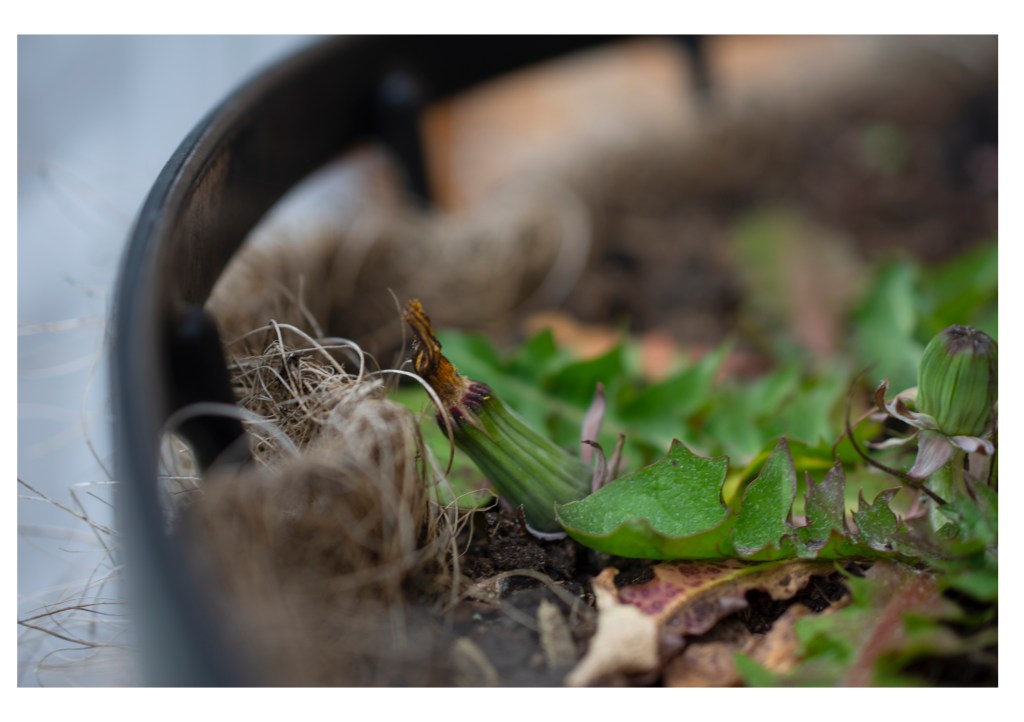
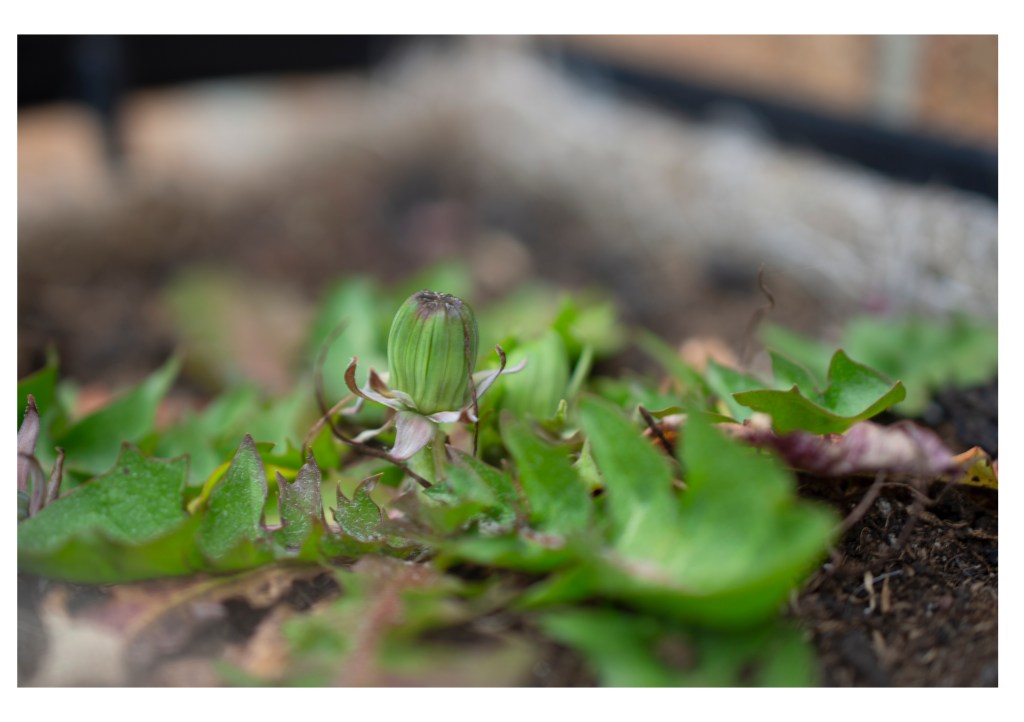
The sequence of images above was developed with the intent to follow the life cycle of the dandelions in the wall basket by my front door. Over the space of a week, I was able to capture of them growing, flowering, developing seeds and dying back.
As with the previous set of images, I think these illustrate the Decisive Moment for the same reasons.
Cats
Finally, cats. My neighbour has four cats. Millie is the one most curious when she spots you, she is always interested in what you are up to and is happy to let you photograph her.
In the first image above, I spotted her preparing to jump onto the roof of the garages that run alongside our property. Unfortunately, I missed the actual moment she leaped.
The next four images are just Millie being curious about what I was doing, she really is quite nosey.
The fifth image shows Charlie licking his paws. I had spotted him on our shed roof and captured several photos from the bedroom window as he cleaned himself one morning. One of the images, the one above shows him holding his paw in an almost human way, just before he licked it.
The sixth image is of Billy. I spotted him wandering in the garden and managed to capture him as he leaped up and over the fence. The image I would have liked to use shows just his hind paws and tail as he disappears down the other side. Unfortunately, I was too far away for the shot to be usable, his tail is just a little bit too blurry.
The final image is of Jack, drinking out of a bucket of dirty rainwater.
I think some of these images could be used for the assignment but now I do not have enough of them to produce the number required for the submission.
What I submit for assignment 3 is going to be one of the first three sequences, it’s just a case of deciding which.
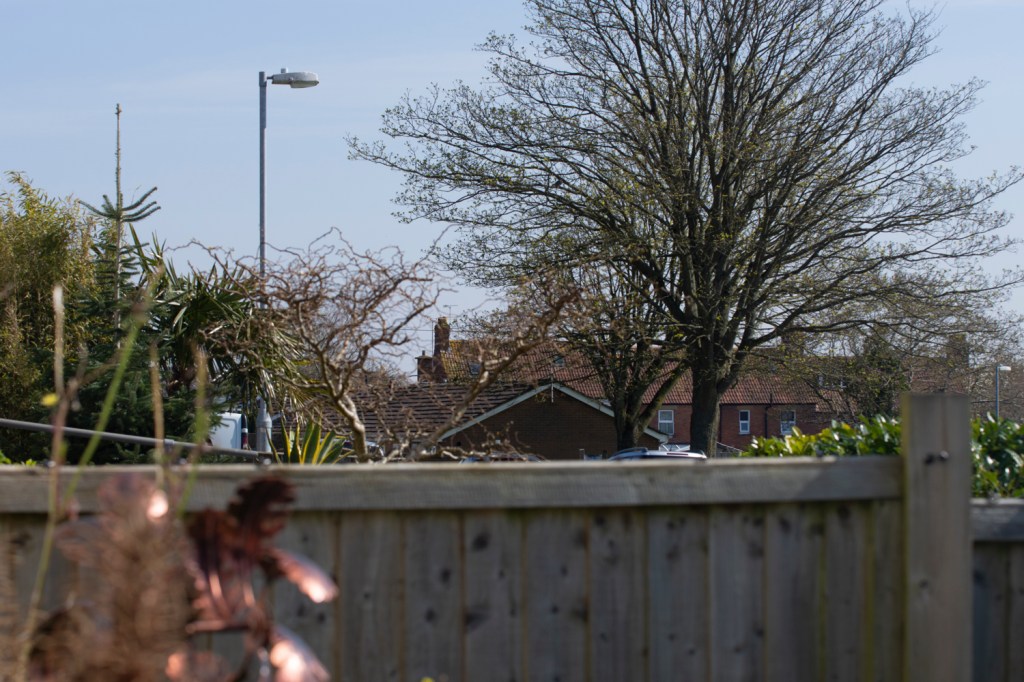
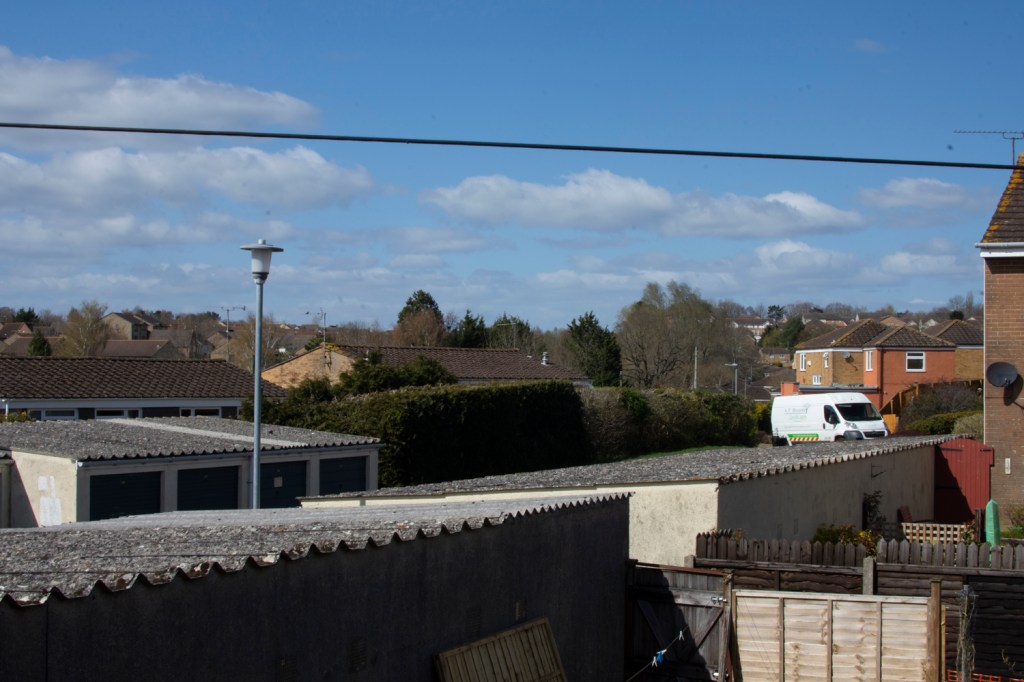
The brief for this exercise is to find a good viewpoint where you can see a wide view or panorama. Look at the things closes to you in the foreground. Then pay attention to the details in the middle distance and then the things towards the horizon. Try to see the whole visual field together, all in movement. When you have it, raise the camera and release the shutter.
Add a picture and a description of the process to your learning log.
Lockdown. Taking photographs when you are not allowed to go far from your home without good reason is a challenge, especially when you are trying to make the most of what you can see. Still, it is good practice and forces you to be creative.
The view from the front of my house is limited. The view from the back, while still limited, does provide for a bit more variety.
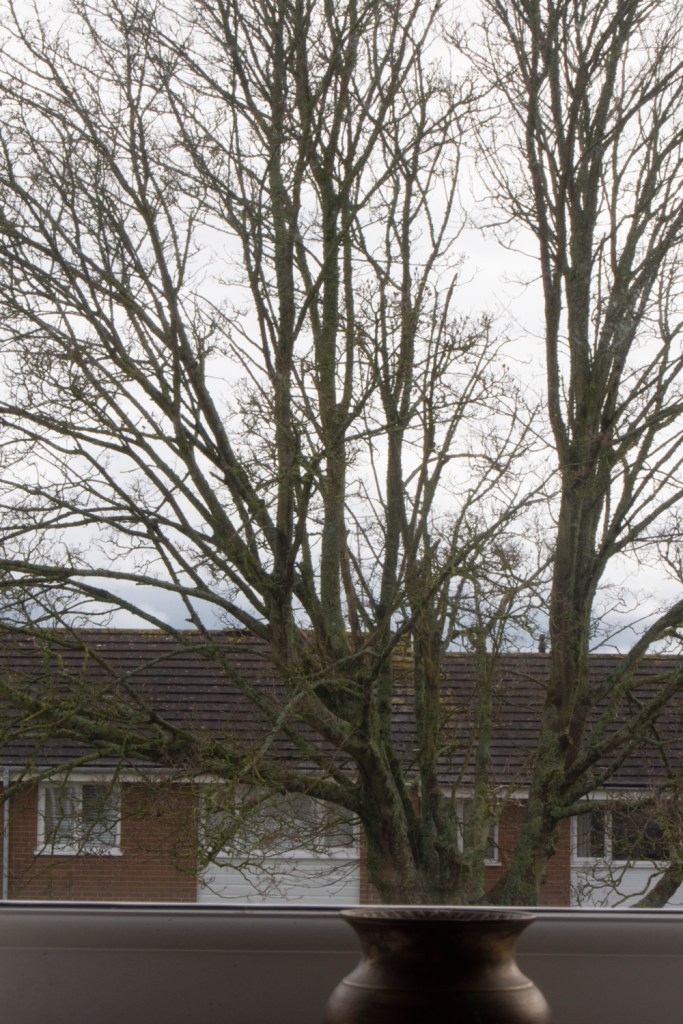
f/32, 1/40 sec, ISO-400, 55mm
The image above is I took while sitting on the bed and staring out the window. There is not much to see, mainly the sky and a tree. As I took pictures out the window, I decided to limit myself to what I could see while sitting down and without adjusting the position of the window blinds.
By putting these limits on myself, it was almost as if I were bedridden, or at least restricted to how far I could move. Most of the images were not very interesting. However, the one above I thought was better because of the positioning of the pot on the windowsill and the tree. Bonsai?
f/29, 1/13 sec, ISO-100, 40mm
f/9, 1/250 sec, ISO-100, 18mm
f/8, 1/400 sec, ISO-100, 18mm
f/7.1, 1/400 sec, ISO-100, 70mm
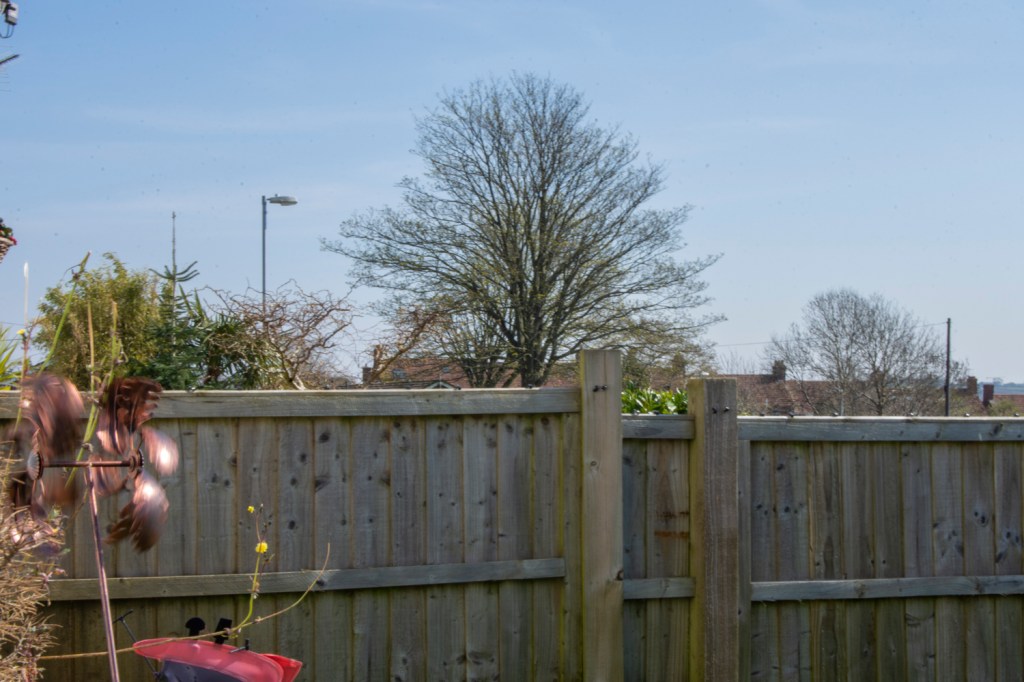
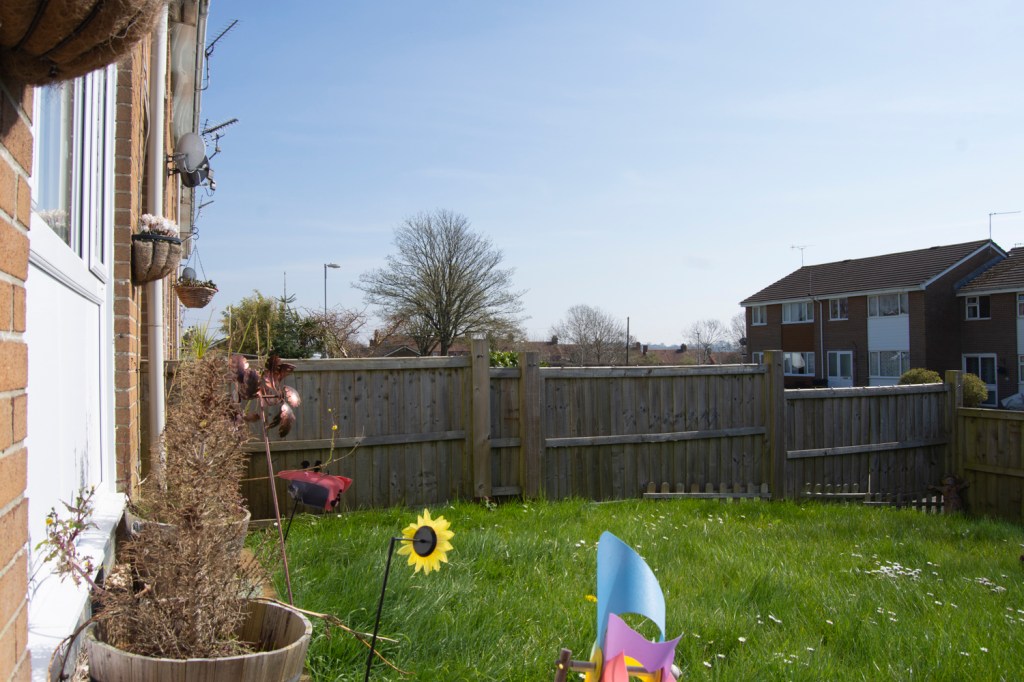
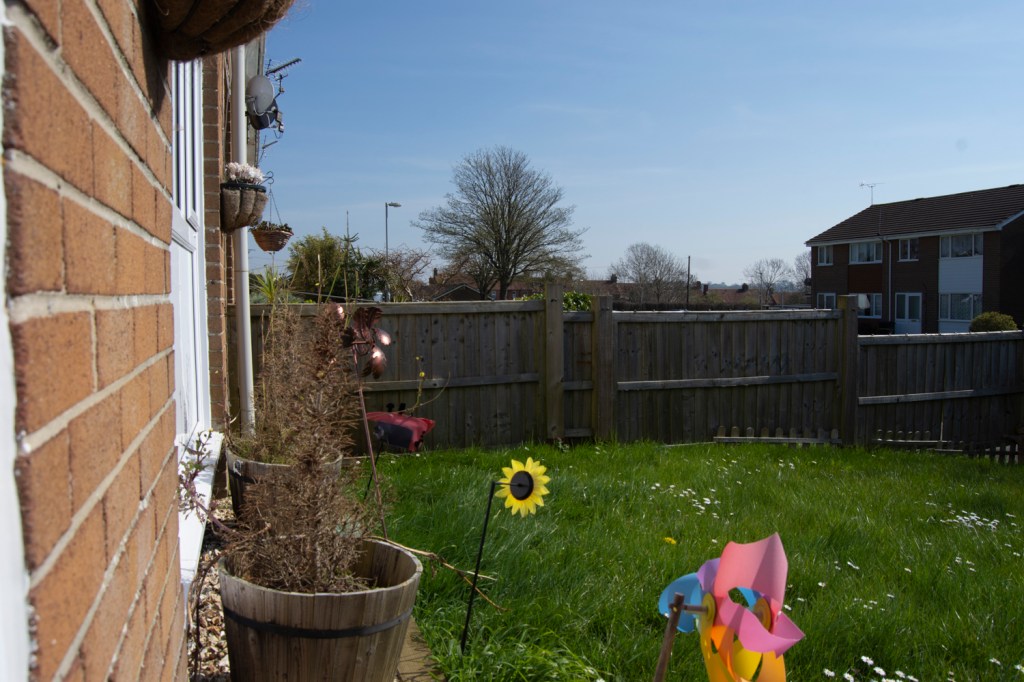
The sequence of images above was taken over several days. Rather than using a high viewpoint I opted for a lower one while taking a break from working at home and sitting on the doorstep, getting a bit of fresh air and sunlight.
The first of the four images I chose because of the movement of the movement. Previous exercises during the part of the course have explored movement and so I thought that this was, even if it was unintentional, appropriate.
The others were selected because of they show how what you see can change just by slight changes in where you are focussing your attention.
f/16, 1/40 sec, ISO-100, 35mm
f/14, 1/40 sec, ISO-100, 35mm
f/16, 1/40 sec, ISO-100, 35mm
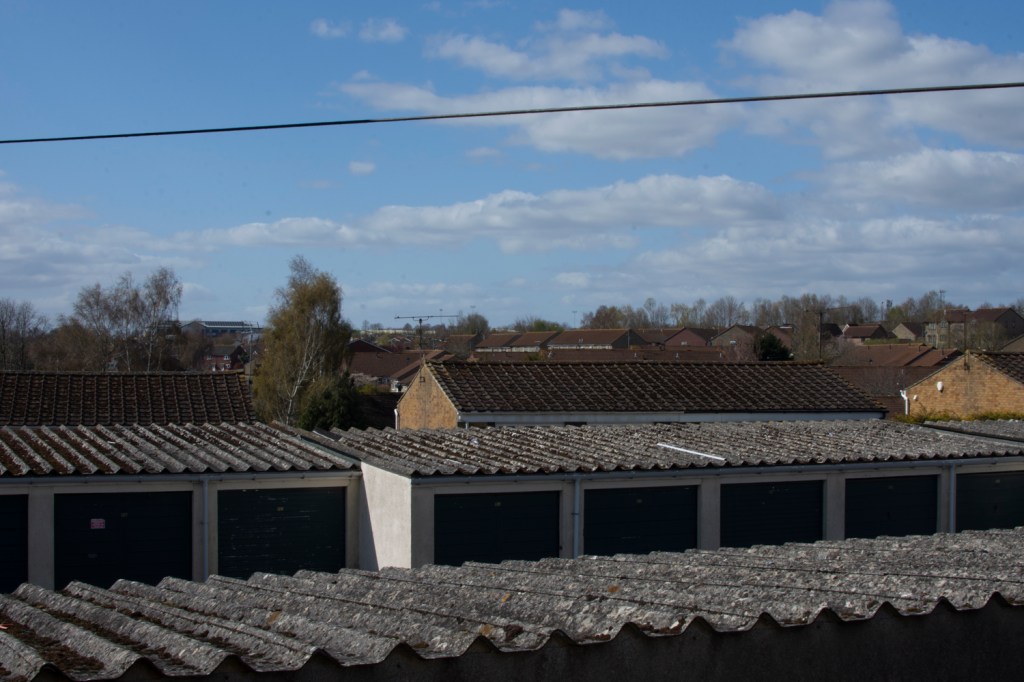
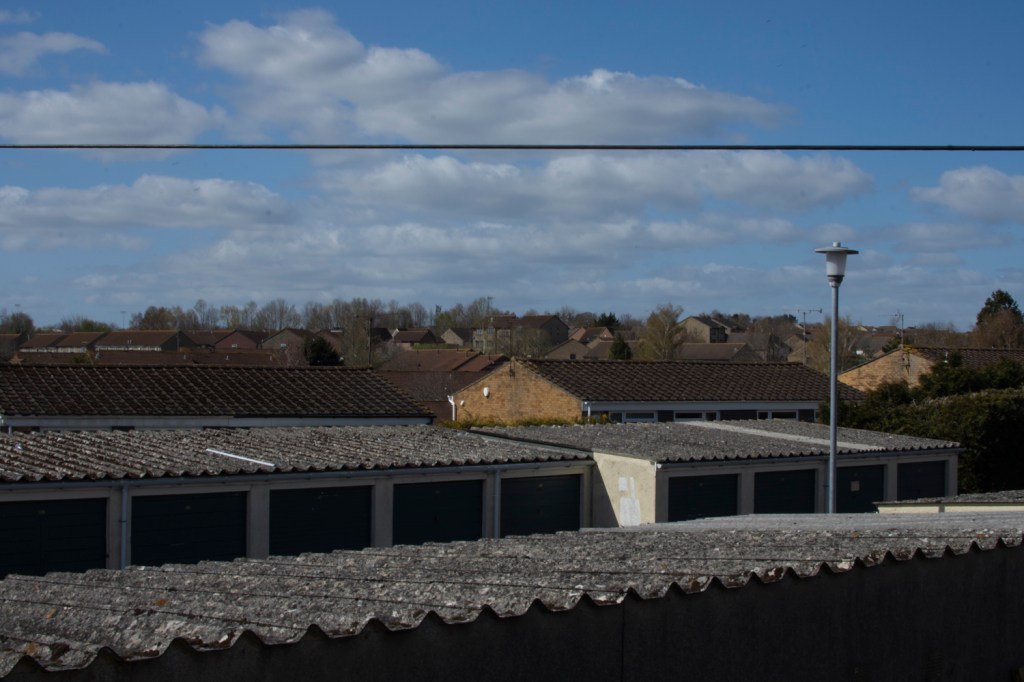
The three images above were taken while hanging out of an upstairs window at the rear of my home. The view at the rear of the property is a bit wider than the front and so there is more variety to explore.
I particularly chose the last image because of the way that the overhead wire and lamp post connect in horizontal and vertical directions, almost creating a frame within a frame. The image below is the result of cropping the image using the wire and lamp post.
Capa’s ‘D-Day and the Omaha Beach landings’, Magnum (2017) must be one of the most well-known images of the 20th century. Taken during the D-Day landings, Capa had joined American forces during the landings at Omaha Beach.
Having made his way to the beach from a landing craft, with soldiers trying to make it ashore while under gunfire, Capa turned back to face the way he had come and saw an American soldier lying in the water. Capa was quick to capture the image, a risky endeavour because it meant he was facing away from where gunfire was raining down on the invading troops.
The low quality of the photograph has its advantages. Although it allows those that were lucky enough to be far away from the beaches and the risk of death that lay there, it also symbolises those men who were willing to lay down their life in order to free a continent from oppression. Like the unknown soldier before him, the figure in the water symbolises a generation of men who were willing to give up the safety of their homes to travel thousands of miles and risk their lives for their fellow man.
Robert Frank
A young woman stands at the controls of an elevator. Her eyes are looking upwards so we can tell that she is thinking, maybe daydreaming, to pass the time. Her world a box that moves upwards and downwards only. People coming and going as she ferries them between floors.
Jack Kerouac described the figures around her as blurred demons. The blurriness of the figures gives some of them a sinister feel, particularly the figure of a man at the back of the elevator who is just a shadow.
That Frank’s was able to take four photographs of the young woman without her knowledge and without using a flash demonstrates why he is seen as one of the great photographers of the 20th century.
Hiroshi Sugimoto
In the short film Contacts (s.d) Hiroshi Sugimoto explains that his intentional use of out of focus photographs is a way to remove detail and information from the buildings that he is photographing. This runs counter to how we would normally look to capture images of architecture.
What Hiroshi Sugimoto is demonstrating by doing this is that it is possible to break the rules, but when you do, then it has to be for a reason but also, that when you do you have to know that you are breaking the rules. Taking photographs of buildings, or any other subject, in a way that runs counter to how it would normally be done, is not something that you can just do, and then say that it’s what you intended. You need to set out with that as your aim.
In the second half of the film Contacts: Hiroshi Sugimoto 2 (s.d.) Hiroshi Sugimoto discusses his series on movie theatres. As I looked at this I found myself thinking about the work of Bernd and Hilla Becher, particularly in the way that the images are displayed in a grid format but also in the way that a series of locations have been captured in similar ways. In the Becher’s case through trying to capture the winding and water towers in a similar orientation and lighting conditions. In Sugimoto’s case the orientation is always going to be the same, i.e. facing the screen, while the lighting conditions are going to be those required for the film goer to be able to watch the movie without being distracted by the people and things around them.
Michael Wesely
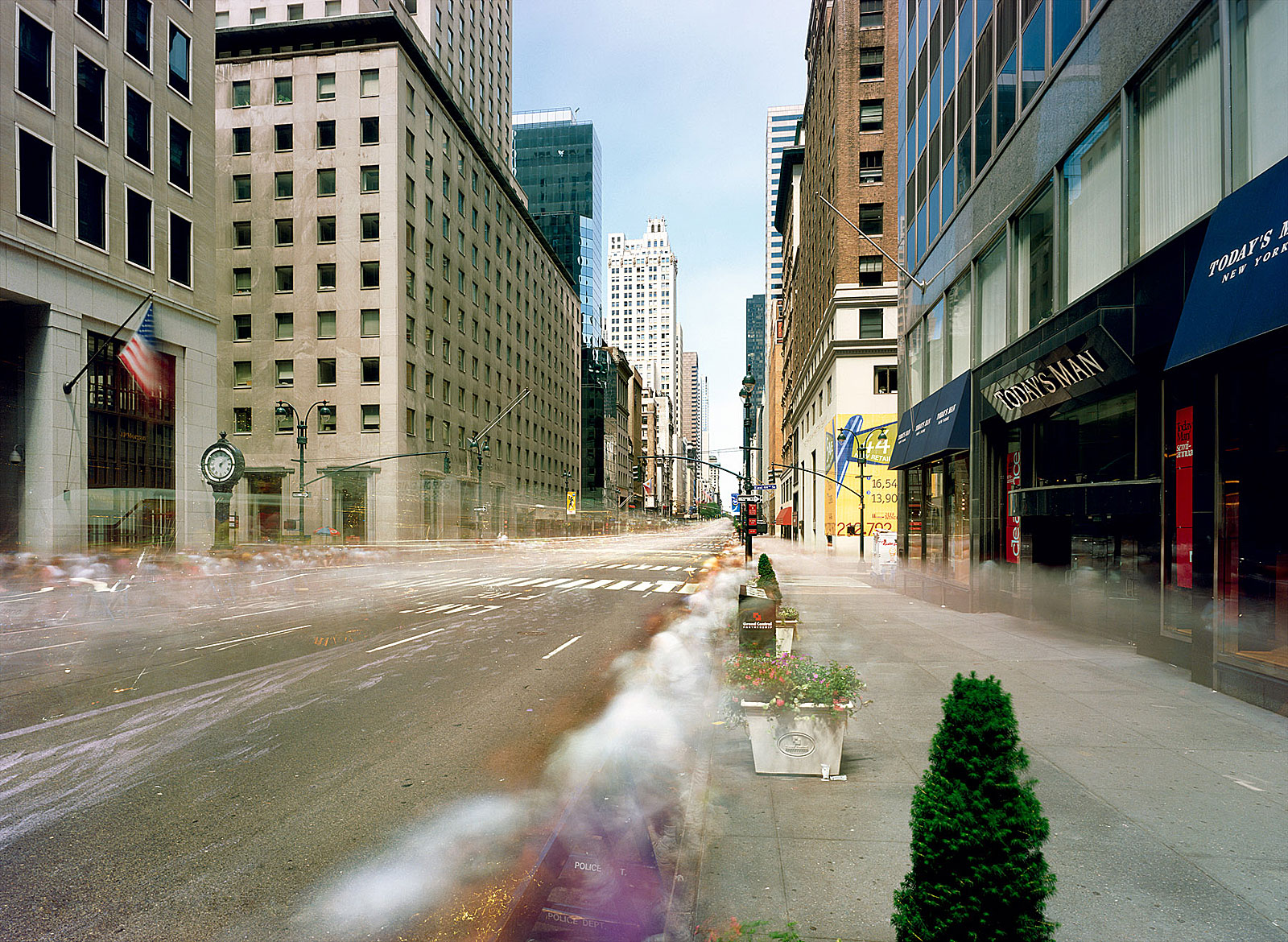
Michael Wesely’s work has an otherworldly feel to it. As if we are looking at the ghosts of people who have died, or of people who have yet to be born.
There is a sense that places and buildings are permanent but that people are transitory, here briefly before disappearing again. Which is true when you look at our existences compared to that of the world that we live in.
The planet we live on has been around for billions of years but humanity only for a short, blink and you missed it time.
Wesely’s New York 1998 series shows this clearly. Photographs of the Gay Pride Parade, city streets, bars and other venues. People can be faintly seen, like wisps of smoke, but the buildings are there, solid structures. The world around us is shown as more solid than we are.
As the world faces the Coronavirus pandemic and towns and cities around the world are placed into lockdown, with people not able to leave their homes or move about freely, Wesely’s images have a prescience to them and a precursor to the images that we see on our television screens on a daily basis.
Maarten Vanvolsem
Maarten Vanvolsem has sought to find ways to take photography beyond freezing a moment in time and to capture time as an element of the photograph. Making what is a 2-D representation of a 3-D subject into a 4-D representation.
Vanvolsem has achieved this through the medium of strip photography.
Strip photography is a technique by which an image is captured as a sequence of one-dimensional images, that are made over a period.
Images captured in this way will seem distorted. Movement of people and objects within the image space will be shortened or extended depending on their speed and direction of motion.
Images capture in this way add a touch of dynamism to what the viewer sees.
In his article Motion! On how to deal with the paradox in dance photography, Vanvolsem (2008), explores how we can make something appear to move in a still image.
Most photographers when taking photographs of performers on stage will freeze the movement producing a still image. These images, however, do not give a true sensation of the performer’s efforts on stage. A performance is not a series of individual movements but also the flow between these movements. Slow movements, fast movements, each add to the story unfolding before the audience. With dance there is an energy that is hard to portray in a single image with no sense of time.
In his image Contraction of Movement 3, Vanvolsem has brought the focus on the dancer and their movements. It is impossible to not see this as an image that is not a single instant in time. Even the fastest dancer would not be able to move fast enough for the camera to record the movement while also removing the focus from their surroundings.
By adding the element of time to images, especially those of performers, we give viewers a glimpse into what the audience sees on stage before them.
Wong Kar-Wai’s Chungking Express
Mike D’Angelo’s article ‘How Wong Kar-Wai turned 22 seconds into an eternity’, D’Angelo, M. (2013), is an interesting analysis of a scene within the film Chungking Express.
Within the scene, which can be viewed on YouTube, WONG KAR-WAI IN SLOW MOTION(2018), and is one of a series of clips highlighting Wong Kar-Wai’s use of slow motion in his movies, a male police officer and a woman shop assistant are the focus of the viewers attention while around them blurry people move back and forth.
D’Angelo’s analysis of the scene is interesting in that it shows an evolving appreciation of the scene. At first, he sees the scene as being focussed on the young woman who is attracted to the police officer who has been visiting the shop to buy food for a while. This, however, ignores what happens in the run up to this scene.
While writing the article D’Angelo realised that there was another interpretation for the scene when you look at what happens just prior to this sequence. The police officer has just been given a letter by his ex-girlfriend and decides not to open it until he has finished his coffee.
By slowing the actions of the two characters, while allowing the rest of the world go by as a blur, Wong Kar-Wai produces a sense that the characters are prolonging a moment in time. The police officer delaying opening the letter, the young woman delaying the moment he leaves to return to duty.
What the scene highlights for me is the importance of context. Without any context this could seen as a young shop assistant watching a police officer taking a break. The use of slow motion suggesting the humdrumness of their lives.
To capture the same with just a photograph would be a lot more challenging. Although it is possible to have two figures standing motionless, while other people move by, as a long exposure photograph is taken would give a similar image, there would be no context. To provide context would require other images or text, would require telling a story through a sequence of images.
Francesca Woodman
Woodman was an American photographer who studied at the Rhode Island School of Design between 1975 and 1977. In 1981 Woodman committed suicide. Her work since her death has been seen favourably.
The images ‘Space², Providence, Rhode Island’ McAteer, S. (2013a and 2013b) show the artist in an empty room. Both images show parts of Woodman clearly, her feet in one and her whole body except for her head in the other.
In both images, Woodman has hidden her face using movement during a long exposure that results in blurring. It is as if she is hiding her identity despite using herself as the model.
There is something reminiscent of Cindy Sherman in the way that Francesca Woodman uses herself as the model in her images, but where Sherman hides her identity using make-up and costume, Woodman hides her identity is a much simpler way.
Both Space images are multi-layered. The walls and floor provide a boundary, a sense that the person is restricted in some way. The window providing a means of escaping those boundaries.
The clear, motionless parts of her body could be seen to represent being held in place, unable to break free of the things that hold you in place. The blurred movement representing the desire to move beyond what is holding you back.
Both images are symbolic of the difficulties that it can be for female artists to move beyond being a student. They are also symbolic of the struggles faced by women in a lot of fields, including photography where the most well known of photographers are male.
In ‘Self Deceit’, Badger, G. (s.d.), a naked figure moves in front of a mottled wall. A mirror positioned to the side of the figure reflects the feet and lower legs of another figure, who is presumably the photographer. Although the moving figure is identifiable as a woman, via the dark triangular patch in the groin area, the identity of the photographer cannot be determined, in fact with any clues to their gender being ambiguous at most.
A lot of images that I’ve looked at, where blurring is used, it is to provide a sense of motion or speed. Wong Kar-Wai and Francesca Woodman show that it can also be used in other ways, for instance to stretch out time, remove identity or provide an indication of the psychological state of a person.






 Jenna Powell - Expressing Your Vision